

Storing Duvets and Pillows Correctly: The Definitive Guide to Bedding Preservation
Imagine the frustration of retrieving a £350 Hungarian goose down duvet from storage, only to find it has developed a musty scent and faint yellowing during the summer months. It's a common issue that affects 40% of households who struggle with seasonal linen changes. Learning the art of storing duvets and pillows correctly is essential if you want to protect your investment and maintain that elusive hotel-fresh feel. Whether you're battling with a bulky king-size winter quilt or trying to shield delicate silk pillows from moth damage, the right technique makes all the difference.
We understand that your bedding is more than just a functional item; it's a vital component of your home's sanctuary. You'll learn the professional secrets we've gathered over 25 years of supplying the world's finest hotels, ensuring your linens remain as lofty and pristine as the day you bought them. This guide covers everything from moisture-proof packing to space-saving hacks that won't crush natural fibres, giving you total peace of mind until the seasons shift again.
Key Takeaways
- Learn why the "Bone Dry" rule is the ultimate secret to preventing moisture damage and preserving the natural loft of your premium down bedding.
- Master the professional techniques for storing duvets and pillows correctly to ensure the perfect balance between essential airflow and protection against pests.
- Discover the "Pillowcase Bundle" hack and professional location scouting tips to organise your linen cupboard with the precision of a five-star hotel.
- Understand how to identify "Storage Yellowing" and implement a quarterly maintenance routine to ensure your luxury investment remains pristine for years to come.
- Uncover the essential four-step preparation protocol, including the critical deep-clean phase required to eliminate oils and allergens before packing away your linens.
The Anatomy of Bedding Preservation: Why Correct Storage Matters
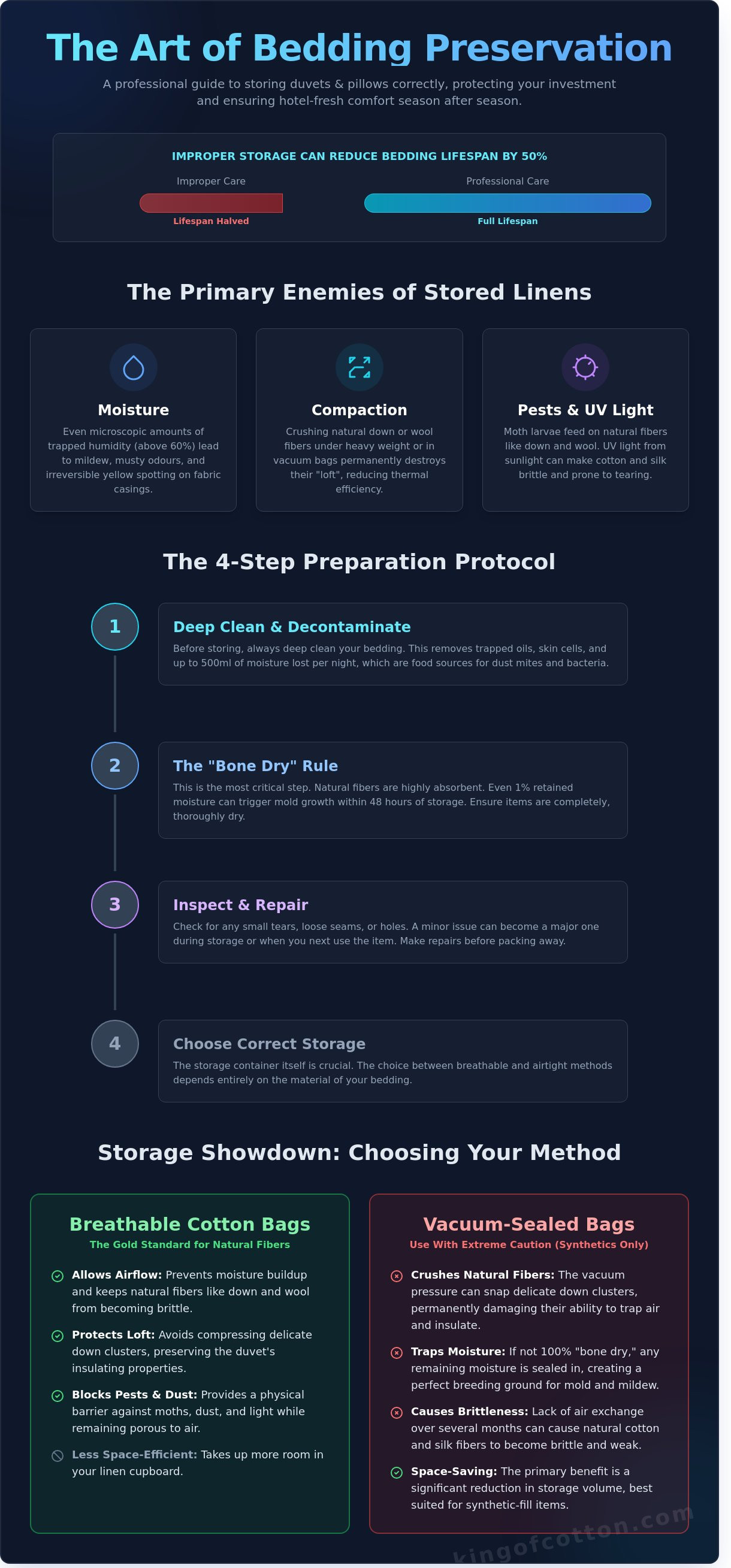
Investing in premium bedding is a commitment to your long-term well-being. A high-quality Hungarian goose down duvet or a set of silk-filled pillows often represents a significant financial outlay, with luxury king-size duvets frequently retailing between £400 and £900. When you aren't storing duvets and pillows correctly, you risk reducing the lifespan of these items by as much as 50%. Correct storage is defined as the precise equilibrium between shielding materials from environmental hazards and facilitating essential airflow. It's not merely about tucking items out of sight; it's about biological and structural preservation.
The primary enemies of fine linens and natural fills are moisture, UV light, and stagnant air. Even in a seemingly dry cupboard, microscopic moisture particles can settle into dense fillings. Without circulation, this trapped humidity becomes a breeding ground for bacteria. By prioritising the understanding bedding materials in your collection, you can tailor your storage environment to counteract these threats. Beyond the financial logic, there's a profound psychological reward. Retrieving a pristine, "hotel-fresh" duvet after a season in storage provides an immediate sense of luxury and calm, replicating the 5-star experience that 88% of luxury travellers cite as essential for restorative sleep.
The Risks of Improper Storage
Improper techniques lead to visible and structural decay. When humidity levels in a storage space exceed 60%, trapped moisture triggers the growth of mildew, often manifesting as irreversible yellow spotting on white cotton casings. The "crushing effect" is equally damaging. While synthetic hollowfibre might recover some volume, natural down clusters can snap under the weight of heavy boxes, permanently losing their "loft" or fluffiness. Furthermore, wool and down are high-protein materials that act as magnets for clothes moths. A single infestation can destroy a £500 duvet in under three weeks if the seal isn't sufficiently protective against pests while remaining porous to air.
- Moisture damage: Leads to musty odours and weakened fabric tensile strength.
- Compaction: Reduces the thermal efficiency of the duvet by crushing air pockets.
- Pest intrusion: Larvae feed on the keratin found in natural feathers and wool fibres.
Fibre Health and Airflow
Natural materials like Egyptian cotton and Giza 87 cotton are living fibres in a sense; they require a degree of thermoregulation even when they aren't on your bed. If these fabrics are sealed in non-porous plastic for six months, the lack of air exchange causes the fibres to become brittle and prone to tearing. This is particularly vital for maintaining the "hand-feel" of high-thread-count linens. Storing duvets and pillows correctly ensures that the natural oils in the down or the silk proteins don't dry out, which preserves the bedding's ability to wick away sweat during future use. Breathable storage is the gold standard for luxury linens because it utilises natural fabric barriers to facilitate air exchange while blocking dust and light.
By following these preservation principles, you ensure your bedding remains as soft and supportive as the day you purchased it. The difference between a duvet that lasts four years and one that lasts a decade lies entirely in how it spends its off-season.
The 4-Step Preparation Protocol: Before You Pack Away
Preparation is the defining factor in whether your bedding emerges next season with its loft intact or succumbs to musty odours. Storing duvets and pillows correctly begins long before you reach for a storage bag. It starts with a rigorous decontamination process. During a single night, the average adult loses approximately 500ml of moisture and sheds thousands of skin cells. These organic materials become trapped within the fibres. If you pack away bedding without a deep clean, these cells provide a primary food source for dust mites and bacteria over several months of dormancy.
The "Bone Dry" rule is your most vital defence, particularly for natural down and feather fillings. Natural protein fibres are highly hygroscopic, meaning they readily absorb atmospheric moisture. Even a 1% moisture retention rate can trigger the dangers of moisture and mold within forty-eight hours of airtight storage. This doesn't just create an unpleasant smell; it can permanently damage the delicate structure of the down, causing it to lose its insulating power.
Skipping a physical inspection is a common mistake that leads to storage-set damage. Examine every inch of the casing for thinning fabric or loose threads. A small 2cm tear in a seam might seem insignificant now, but the pressure of being folded or compressed for months will cause it to expand. Repairing these minor flaws before storage ensures the filling remains contained and the structural integrity of the duvet is preserved for years to come.
Before you finalise the packing, observe a mandatory cooling-off period. You should never pack bedding straight from the tumble dryer. Residual heat trapped in the dense centre of a pillow or duvet creates condensation when it meets a cooler storage environment or a plastic container. Allow your items to air on a drying rack for at least 2 hours. This ensures all thermal energy has dissipated, leaving the bedding at a stable room temperature before it's sealed away.
Washing and Drying to Professional Standards
Professional results require specific temperature controls. To effectively neutralise allergens and bacteria, wash white cotton casings at 60°C. For delicate silk or wool fillings, stick to a 30°C wool programme with a specialised pH-neutral detergent. When drying, the "Tennis Ball Trick" is essential. Place two or three clean tennis balls in the dryer drum; they physically beat the clumps of wet down, restoring the loft as the item dries. To verify dryness, use the "hand-press" test. Firmly squeeze the very centre of the duvet for ten seconds. If the fabric feels even slightly cooler than the outer edges, moisture remains in the core, and it requires another twenty minutes of drying time.
Deodorising Naturally
Natural fillings require a breathable environment, so avoid harsh chemical mothballs or heavy synthetic perfumes. These substances can cling to the fibres and cause the natural oils in down to deteriorate over time. Instead, use cedar blocks or dried lavender sachets to provide a gentle, sophisticated scent that also acts as a natural deterrent for pests. Preserving the luxury of your sleep environment is an investment in your long-term comfort. If your current bedding has lost its resilience despite these efforts, you might consider it time to view our professional-grade bedroom collections for a high-quality replacement that meets hotel-standard specifications. Storing duvets and pillows correctly ensures that when you do bring them back into rotation, they feel as fresh and inviting as the day you first purchased them.
Vacuum Bags vs. Breathable Cotton: Choosing Your Method
Selecting the right vessel for your bedding is the difference between a fresh, lofty duvet and a flat, musty disappointment. In the UK, where storage space in modern homes is often at a premium, the temptation to vacuum-seal everything is high. However, the physics of different materials dictates that a one-size-fits-all approach will eventually damage your investment. Storing duvets and pillows correctly involves matching the storage method to the specific fill and fabric of your items.
Synthetic bedding, such as hollowfibre or microfibre, is the primary candidate for high-compression vacuum bags. These polyester strands are engineered for resilience. They can withstand being crushed into a thin sheet and will generally return to their original shape once air is reintroduced. If you are dealing with guest bedding that only sees use once a year, vacuum bags provide an airtight seal that protects against dust mites and moisture in damp environments like cellars or attics. Even so, synthetic fibres have a limit. Keeping them compressed for more than 12 months can lead to "fibre fatigue," where the strands lose their spring and the bedding feels permanently thinner.
The Case for Breathable Storage
Natural materials demand a different level of care. Luxury Egyptian cotton linens and silk-filled duvets are "living" fabrics that require air circulation to maintain their integrity. If you seal high-quality cotton in airtight plastic, trapped gases and residual moisture can cause "yellowing." This discolouration is often permanent and ruins the crisp aesthetic of premium bedding. Using 100% cotton storage bags is the gold standard here. These bags allow the fabric to breathe while acting as a barrier against dust and moths. You might explore our luxury bed linen sets to find durable, high-thread-count cotton options that are designed to last for decades when cared for this way.
If you don't have dedicated storage bags, don't reach for the plastic. An old, clean cotton pillowcase is a perfect budget-friendly alternative. It provides the same breathable protection as a professional storage bag, ensuring your linens don't develop that tell-tale "stale" scent. This method is particularly effective for 400-thread-count sateen or percale sheets, which can become brittle if deprived of air for long periods.
When Vacuum Bags are Acceptable
Vacuum bags serve a specific purpose during short-term transitions, such as moving house or during a six-month seasonal rotation. They are particularly useful if your storage area is prone to humidity. According to a guide to storing bedding, protecting items from external moisture is vital in non-climate-controlled environments. However, you must observe the "50% Rule" for any natural fillings. Never vacuum-seal a down or feather duvet into a flat pancake. Natural down clusters and feathers have delicate quills that will snap under extreme pressure. Once these quills break, the duvet loses its "loft" and its ability to trap heat, effectively destroying a piece of bedding that might have cost upwards of £300.
- Synthetic/Hollowfibre: Safe for 100% compression for up to 6 months.
- Down and Feather: Compress by no more than 50% to avoid snapping quills.
- Egyptian Cotton: Never vacuum seal; use breathable cotton bags only.
- Wool: Avoid vacuum bags as they trap moisture, which can lead to mildew in natural animal fibres.
For those managing a household with limited cupboard space, prioritize your breathable storage for your most expensive natural items. Reserve the vacuum bags for the synthetic spares, and always ensure every item is bone-dry before it goes into any container. Even 1% residual moisture can turn into a significant mould problem within a sealed environment over a single winter season.
Organising Your Linen Cupboard Like a Five-Star Hotel
Achieving a five-star aesthetic in your home starts with the hidden foundations of your storage. Storing duvets and pillows correctly is the secret to maintaining that crisp, boutique-hotel feel over many years. Professional housekeepers don't just shove linens into the nearest gap; they follow strict protocols to ensure every guest experiences fresh, voluminous bedding. Your linen cupboard should be a sanctuary of order, reflecting the 25 years of expertise King of Cotton brings to the hospitality industry.
Location scouting is your first priority. While the traditional British airing cupboard is a popular choice, it isn't always the best spot. The residual heat from a water cylinder can often exceed 28°C, which creates a breeding ground for dust mites if any trace of moisture remains in the fibres. A cool, dry, and dark environment is far superior. To manage your inventory, adopt the First In, First Out (FIFO) method used in luxury resorts. Always place freshly laundered sets at the bottom of the stack. This ensures a 100% rotation rate, preventing your favourite sets from wearing out while others sit forgotten for months.
Efficiency is key to an effortless bed-change on a Sunday morning. Use the "Pillowcase Bundle" hack: fold your duvet cover and one pillowcase into a neat rectangle, then slide the entire set inside the second pillowcase. This creates a self-contained package that prevents you from hunting for matching pieces. For larger items, use small luggage tags tied with ribbon to identify tog ratings and sizes. Labelling a bundle as "Super King - 10.5 Tog" or "Guest Room - 4.5 Tog" saves you from unrolling an entire duvet just to check its dimensions.
Optimal Storage Locations
Utilising under-bed storage is an excellent way to save space, provided you use lidded bins. These prevent "dust bunnies" from settling into the weave of your 100% Egyptian cotton. If you prefer the top of a wardrobe, use breathable fabric bags rather than plastic. You should never store luxury linens in plastic bin bags or cardboard boxes. Plastic traps moisture and gasses, leading to a yellowing of the fabric, while cardboard contains acids that can break down natural fibres over 12 to 18 months.
Aesthetic and Functional Layout
Visual harmony makes the task of bed-making more enjoyable. Try colour-coding your linens by room or season; for example, keep all pure white sateen together and separate your winter flannels. Mastering the "Hotel Fold" is essential for maximising shelf space. By tri-folding your sheets and duvets, you maintain the loft of the material and reduce the need for heavy ironing. Browse our full range of hotel-quality products to find the perfect additions to your newly organised collection.
Ready to transform your bedroom into a high-end retreat? Shop our collection of luxury bedding to experience the difference that professional-grade materials make.
Long-Term Maintenance: Keeping the "Freshness" Alive
Storing duvets and pillows correctly isn't a task you simply finish and forget. If your high-quality bedding remains in a cupboard for more than three months, it requires a quarterly maintenance routine to preserve its integrity. For down and feather products, we recommend a "Shake and Air" session every 90 days. This simple action prevents the delicate clusters from matting together under their own weight. Take the items out, give them a vigorous shake to introduce oxygen, and let them breathe in a room with an open window for at least two hours.
You might occasionally notice "storage yellowing" on white cotton casings. This usually happens because of oxidation or minute traces of moisture trapped during the packing process. If you spot these faint marks, don't panic. You can treat small areas by dabbing them with a mild solution of white vinegar and water. However, if the discolouration covers more than 20% of the surface, it's a sign that the item needs a professional refresh. Always ensure the bedding is 100% dry before returning it to its breathable bag.
When you finally retrieve bedding after six months or more, give it a 24-hour "Wake Up" period. Fibres need time to regain their natural loft after being compressed. Before you decide to keep an older item, perform two essential health checks. For pillows, use the "Fold Test." Fold the pillow in half and hold it for 30 seconds. If it doesn't spring back to its original shape the moment you let go, it has lost its structural support. For duvets, use the "Clump Test." Feel along the channels for any permanent lumps. If more than 25% of the filling has migrated or clumped, the insulation will be uneven, and it's time to consider a replacement.
Retrieving from Storage
You don't always need to re-wash bedding when taking it out of storage. In fact, excessive washing can strip the natural oils from down. Instead, try a 15-minute tumble dry on a "Cool Air" or "Air Fluff" setting. This process uses air circulation to plump the filling without the risk of heat shrinkage. If it's a clear day, hanging linens on a washing line is the gold standard. Natural sunlight acts as a potent disinfectant, and just two hours of UV exposure can eliminate most lingering surface bacteria. Finish by manually massaging any flat spots to ensure the filling is evenly distributed.
The King of Cotton Commitment
Our 28 years of experience as a premier supplier to five-star hotels has taught us that the longevity of bedding depends on both quality and care. We've spent decades refining our Egyptian cotton weaves and down-fill ratios to ensure they withstand the test of time. Investing in premium materials means your linens will emerge from storage looking and feeling as luxurious as the day you bought them. If your current set fails the fold or clump tests, it's a perfect opportunity to refresh your home. You can upgrade your guest room with our world-class duvets and pillows to provide that hotel-standard comfort for your friends and family.
Protect Your Investment in Luxury Bedding
Preserving the loft of your down or the crispness of your Egyptian cotton isn't just about tidiness; it's about protecting a significant investment in your sleep health. By following the 4-step preparation protocol and choosing breathable cotton storage over suffocating plastic, you prevent the moisture traps that ruin high-end fibres. Mastering the art of storing duvets and pillows correctly ensures your bedroom remains a haven of freshness for years. It's the difference between a flat, stale guest bed and a rejuvenated, five-star experience every time you open the linen cupboard.
At King of Cotton, we've spent more than 25 years as specialist suppliers to the world’s finest hotels, bringing that same level of uncompromising quality to your home. Our products are crafted to withstand the test of time, a fact reflected in our Excellent rating on Trustpilot. When you're ready to upgrade your sanctuary, choose materials engineered for longevity and unparalleled comfort. Invest in Hotel-Quality Bedding Designed to Last and enjoy the serene confidence that comes with true craftsmanship. Your best night's sleep is waiting for you.
Frequently Asked Questions
Is it okay to store duvets in vacuum bags for a long time?
You shouldn't store natural down or feather duvets in vacuum bags for longer than 3 months. While they save space, prolonged compression damages the delicate clusters and reduces the loft or fluffiness of the filling. Synthetic fillings are more resilient; however, even they can lose up to 15% of their bounce if left vacuum-sealed for an entire year. It's better to use a breathable cotton bag to maintain the quality of your premium bedding.
How do I keep my stored bedding smelling fresh without using chemicals?
Place dried lavender sachets or cedar wood blocks inside your storage bags to maintain a natural, hotel-fresh scent. Lavender is a time-tested remedy used for over 400 years to repel insects and add a delicate fragrance. Avoid plastic containers, as these trap stale air and moisture. Opting for 100% cotton storage bags allows air to circulate, keeping your linens smelling clean for up to 6 months without any synthetic sprays.
Can I store my pillows and duvets in the garage or loft?
You should avoid storing your bedding in the garage or loft because temperature fluctuations and dampness will damage the fibres. UK lofts can range from 0°C in winter to 40°C in summer, creating a perfect environment for mildew and silverfish. Storing duvets and pillows correctly requires a cool, dry, and dark environment like a linen cupboard or under-bed storage. This prevents the 10% moisture retention that often leads to musty odours.
Why do my white sheets turn yellow while in the linen cupboard?
White sheets turn yellow due to the oxidation of trapped body oils, sweat, and skin cells that weren't fully removed during the wash. Even a 60°C cycle can leave behind 5% of microscopic residue if you don't use a high-quality detergent. When these items sit in a dark cupboard without airflow, the proteins break down and discolour the fabric. Using a breathable cotton storage bag helps prevent this chemical reaction by allowing the fabric to breathe.
How often should I air out my stored bedding?
You should air out your stored bedding every 3 months to prevent the build-up of stagnant air and moisture. Take the items out of their bags and hang them over a bannister or outside on a dry day for at least 30 minutes. Research shows that 20 minutes of direct sunlight can naturally eliminate a significant portion of surface bacteria. This simple habit ensures your guest duvets remain as fresh as the day they were put away.
What is the best way to store a heavy winter king-size duvet?
The best way to store a heavy winter king-size duvet is in a large, breathable 100% cotton storage chest or bag. Fold the duvet loosely into thirds to avoid permanent creases in the fabric and filling. Since a king-size winter duvet can weigh over 4kg, ensure it's stored on a flat surface rather than hung. This method is essential for storing duvets and pillows correctly as it protects the 13.5 tog rating from being compromised by moisture.
Should I wash my duvet before or after storing it for the season?
You must wash and thoroughly dry your duvet before storing it for the season. Storing bedding with even trace amounts of perspiration can lead to permanent yellowing and attract dust mites over a 6-month period. Ensure the duvet is 100% dry; even 2% residual moisture can cause mould to grow within weeks. Once clean, your bedding is ready to be tucked away in a cool, dry spot until the temperature drops.
How can I protect my natural down bedding from moths?
Protect your natural down bedding by using cedar wood rings or essential oil diffusers in your storage area. Moths are naturally repelled by the scent of cedar and lavender, which have been used by textile experts for decades to protect natural fibres. Ensure your bedding is stored in a zipped, breathable cotton bag rather than on an open shelf. Since a single female moth can lay 40 eggs at a time, these physical and scent barriers are vital for your investment.