
Quilt vs Duvet: The Definitive Comparison for Luxury Bedding
The most beautifully dressed beds in the world's finest hotel suites don't happen by accident, and the secret often comes down to one quietly strategic decision: quilt vs duvet. If you've ever stood in a bedding aisle feeling genuinely baffled by the terminology, or woken up at 3am in a sweat despite spending a small fortune on your bedding, you're far from alone.
The confusion is entirely understandable. In British and American English, these terms are used so interchangeably that even seasoned home decorators mix them up. But beneath the surface, a quilt and a duvet serve quite different purposes, and choosing the wrong one can mean the difference between a restless night and genuinely restorative sleep.
In this guide, we'll cut through the terminology once and for all. You'll gain a clear understanding of the thermal properties that govern each option, learn how the world's leading hotels layer their beds for that iconic, polished aesthetic, and walk away knowing exactly which combination suits your sleep style and bedroom. Consider this your definitive guide to sleeping and living at a higher standard.
Key Takeaways
- Understanding the quilt vs duvet distinction goes far beyond terminology — the right choice directly impacts your sleep quality, thermal comfort, and bedroom aesthetic.
- Tog ratings and filling materials, from Siberian Goose Down to high-quality synthetics, determine how well your bedding performs across different seasons and sleep styles.
- Professional hotel housekeepers rarely choose between a quilt and a duvet — they use both together, and you'll discover exactly how to replicate this layered look at home.
- Ease of laundering and long-term durability differ significantly between the two options, making the right choice especially important if you prioritise low-maintenance luxury.
- Whether you sleep hot or cold, there is a considered combination of fillings, weights, and layers that suits your precise needs — and King of Cotton's expertise in natural fillings and high-GSM fabrics makes finding it straightforward.
Quilt vs Duvet: Defining the Essentials of Luxury Bedding
At its most fundamental level, the quilt vs duvet distinction is a question of construction. These two bedding types are built differently, behave differently, and serve different purposes in a well-dressed bed. Understanding that distinction is the first step towards making a genuinely informed choice.
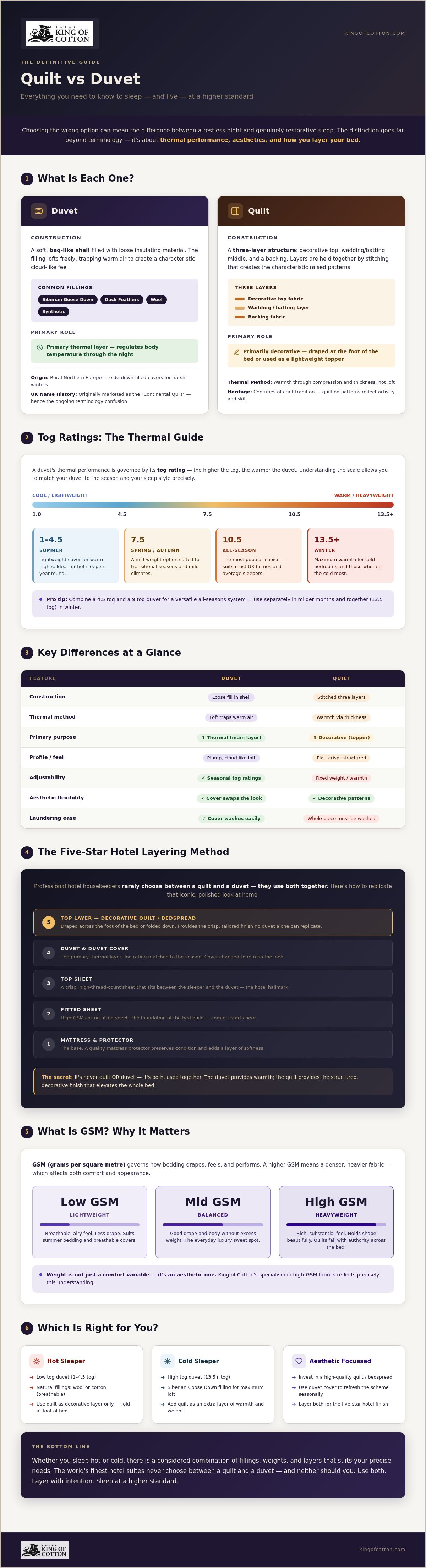
A duvet is essentially a soft, bag-like shell filled with loose insulating material, whether that's goose down, duck feathers, wool, or a high-quality synthetic alternative. Because the filling sits loose within the shell, it lofts freely, trapping warm air and creating that characteristic cloud-like feel. The duvet is designed to function as your primary thermal layer, the single most important component in regulating your body temperature through the night.
A quilt, by contrast, is a three-layer construction: a decorative top fabric, a layer of wadding or batting in the middle, and a backing fabric beneath. These layers are held together by stitching, which is where the craft element comes in. That stitching compresses the wadding at regular intervals, securing it in place and creating the characteristic raised patterns that make quilts so visually distinctive.
The Duvet: A Modern European Staple
The duvet's origins lie in rural Northern Europe, where eiderdown-filled bed covers were used for centuries to survive harsh winters. In the UK, it was initially marketed as the "Continental Quilt" during the mid-twentieth century, which explains precisely why so many British people still use the word "quilt" when they actually mean a duvet. The terminology stuck long after the product evolved.
Today, the duvet is the bedding of choice across five-star hotels worldwide, and for good reason. Its loose filling adjusts to body movement, its tog rating can be precisely calibrated to the season, and a well-chosen duvet cover allows the aesthetic to change entirely without replacing the duvet itself. That combination of thermal performance and stylistic flexibility is difficult to replicate with any other single bedding component.
The Quilt: Heritage, Craft, and Decoration
In the contemporary luxury bedroom, the quilt's role has shifted considerably. It now functions primarily as a decorative layer, draped across the foot of the bed or used as a lightweight topper during warmer months. Its structured stitching gives it a crisp, tailored appearance that a duvet, however beautiful, simply cannot replicate on its own. That's precisely why the world's finest hotel suites use both.
If you've ever admired a beautifully made hotel bed and wondered why it looks so considered, the answer almost always involves this pairing. King of Cotton's expertise spans both categories, from high-performance duvets filled with natural materials to finely crafted bedspreads that complete the layered look with quiet authority.
The Anatomy of Comfort: Materials, Tog Ratings, and Construction
The quilt vs duvet debate becomes genuinely illuminating once you understand the physics at work beneath the surface. A duvet's thermal performance is governed almost entirely by its filling: how much of it there is, how freely it can loft, and how well the casing retains it. A quilt, by contrast, derives its character from compression. Its wadding is deliberately flattened by stitching, producing a thinner, more structured profile that sits closer to the body rather than floating above it. Neither approach is superior in isolation; they simply serve different thermal and aesthetic functions.
GSM, or grams per square metre, is the metric that governs how a piece of bedding drapes across the bed. A higher GSM indicates a denser, heavier fabric or filling, which translates to a more substantial, weighted feel. For duvets, a higher fill weight typically means greater warmth. For quilts and bedspreads, GSM affects how crisply the piece holds its shape and how luxuriously it falls across the foot of the bed. King of Cotton's specialism in high-GSM fabrics reflects precisely this understanding: weight is not merely a comfort variable, it's an aesthetic one.
Understanding Tog Ratings for Duvets
A tog rating is the standardised measure of thermal resistance used in the UK, and it's the single most useful number when selecting a duvet. The scale runs broadly as follows:
- 4.5 tog: Lightweight summer duvets, designed for warmer months or those who sleep hot year-round
- 10.5 tog: The mid-season standard, suited to spring and autumn when temperatures fluctuate
- 13.5 tog and above: Winter-weight duvets, engineered for maximum thermal retention through the coldest months
What the tog rating doesn't tell you is how the warmth is achieved. A natural filling such as Siberian Goose Down reaches a given tog at a fraction of the weight required by synthetic alternatives, because down clusters trap air with extraordinary efficiency. The result is a duvet that breathes actively, releasing excess moisture rather than trapping it. A synthetic filling at the same tog will feel denser and may cause you to overheat during the night. The casing matters too: a tightly woven shell with a higher thread count prevents fine down from escaping whilst still allowing the filling to loft fully.
Wadding and Batting in Quilts
Quilts use a fixed layer of wadding rather than loose fill, and the material chosen for that wadding shapes the quilt's entire character. Cotton wadding produces a breathable, relatively flat profile that's well suited to warmer months. Wool batting adds natural temperature regulation with a little more body. Polyester blends offer durability and ease of care, though they lack the breathability of natural fibres. The stitching that holds these layers together isn't merely decorative; it prevents the wadding from shifting or clumping over time, ensuring the quilt retains its even, tailored appearance wash after wash.
If you're building a considered bedroom with both thermal performance and visual polish in mind, exploring King of Cotton's bedroom collection offers a practical starting point for understanding how natural fillings and high-quality construction translate into genuinely better sleep.
Key Differences in Performance, Maintenance, and Aesthetics
Choosing between a quilt and a duvet isn't simply a matter of personal preference. The practical realities of care, storage, and styling pull each option in quite different directions, and understanding those differences properly is what separates a considered bedroom from one that simply looks the part until the first wash cycle.
Laundering and Care Requirements
The duvet's greatest practical advantage lies in the duvet cover. Changing a cover takes minutes, instantly refreshing the look and hygiene of your bed without touching the duvet itself. For everyday maintenance, this is genuinely transformative. The duvet itself requires washing far less frequently, and when it does need attention, the care approach depends significantly on the filling. Natural down duvets benefit from a low-temperature machine wash followed by a long, tumble-dry cycle with clean tennis balls to break up any clumping and restore loft. Rushing this process, or under-drying the filling, can lead to mildew and permanent loss of that characteristic cloud-like volume.
Quilts present a different challenge. Their decorative stitching is both their defining feature and their most vulnerable element. Aggressive machine washing can distort or break the stitching over time, pulling the wadding out of alignment and compromising the structured appearance that makes a quilt so visually compelling. Gentle cycles at low temperatures, followed by flat or line drying, preserve both the stitching and the integrity of the wadding. For quilts made with natural fibres, this care investment is well worth making.
In hospitality settings, where bedding is laundered far more frequently than in a private home, the quilt vs duvet distinction becomes a practical operational consideration. Duvet covers absorb the brunt of daily use and can withstand repeated washing at higher frequencies without affecting the duvet's performance. This is precisely why five-star hotels favour the layered approach: the decorative quilt or bedspread at the foot of the bed is handled far less often than the cover itself.
Versatility and Bedroom Styling
A duvet lends itself naturally to clean, minimalist interiors. Dressed in a well-chosen cover, it creates that softly billowing, hotel-suite silhouette that reads as effortlessly modern. The aesthetic is unstructured in the best possible sense: generous, inviting, and quietly luxurious.
Quilts work differently. Their stitched surface introduces texture, pattern, and visual weight that a duvet cover simply can't replicate. Draped across the foot of the bed or used as a lightweight summer layer, a quality quilt anchors the room with a sense of considered craft. It suits traditional, country-house, and heritage-influenced interiors particularly well, though a pared-back geometric stitching pattern can translate beautifully into more contemporary spaces too.
Storage is worth considering as well. A winter-weight duvet is a substantial item to store during warmer months; a quilt's slim, compressed profile takes up considerably less space. If storage is limited, a year-round mid-tog duvet paired with a quilt for cooler evenings offers a practical and elegant solution.
For styling inspiration across both categories, King of Cotton's luxury bed linen collection offers a considered starting point, with options that complement both the structured elegance of a quilt and the softly layered look of a well-dressed duvet.
How to Choose: Seasonality, Sleep Style, and Room Aesthetic
The most practical starting point in the quilt vs duvet decision isn't thread count or filling weight. It's a simpler, more personal question: do you sleep hot or cold? Your answer shapes every subsequent choice, from tog rating to layering strategy to the precise role a quilt plays in your bedroom across the four seasons.
The UK climate makes this particularly relevant. A bedding setup that feels perfectly calibrated in October can leave you sweltering by June or shivering in January. The most considered bedrooms aren't built around a single configuration; they're built around adaptability.
Matching Bedding to Your Sleep Habits
Hot sleepers benefit most from a low-tog duvet, typically 4.5 to 7.5, paired with a lightweight cotton quilt that can be added or removed without disturbing a sleeping partner. Cotton wadding breathes freely and sits close to the body without trapping heat, making it the natural choice for warmer months or those who consistently run warm through the night.
For cold sleepers, the layering approach offers genuine advantages over simply reaching for the heaviest duvet available:
- A mid-weight duvet (10.5 tog) provides reliable year-round performance without the bulk of a winter-weight option
- A quilt folded across the foot of the bed can be pulled up on colder nights, adding warmth precisely where it's needed without overheating the upper body
- Wool-batted quilts offer natural temperature regulation, warming quickly but releasing excess heat before it becomes uncomfortable
Creating the 5-Star Hotel Look
Professional hotel housekeepers don't choose between a quilt and a duvet. They use both, and the result is that immediately recognisable sense of considered abundance that no single bedding layer can achieve alone. The method is straightforward: a well-filled duvet forms the primary thermal layer, dressed in a crisp, high-quality cover. A quilt or bedspread is then folded with precision across the lower third of the bed, adding visual weight, textural contrast, and an additional layer of warmth that guests can draw up or set aside as needed.
Colour and texture selection is where this approach becomes genuinely personal. A tonal palette, where the quilt sits one or two shades deeper than the duvet cover, creates depth without visual noise. Contrasting textures work particularly well: a smooth, high-thread-count cover paired with a subtly stitched quilt introduces tactile interest that reads as quietly luxurious rather than busy.
Sizing up your duvet is another detail the finest hotels get right. Choosing a duvet one size larger than your mattress, a king-size duvet on a double bed, for instance, creates that generous, cascading overhang that photographs beautifully and feels even better to sleep under.
For deeper technical guidance on selecting the right filling weight and construction for your specific needs, King of Cotton's guide to choosing the perfect duvet covers the full spectrum of options with the same level of detail. To explore the full bedroom range and begin building your layered look, browse King of Cotton's bedroom collection directly.
Elevating Your Sleep Experience with King of Cotton
There's a reason the world's most prestigious hotels return to King of Cotton when they need bedding that performs as beautifully as it looks. The quilt vs duvet decision, for all its nuance, becomes considerably more straightforward when the products themselves are built to an uncompromising standard. That standard is what King of Cotton has built its reputation on, supplying hospitality-grade bedding to discerning homes and world-class hotels globally.
The King of Cotton Quality Standard
Every duvet and quilt in the King of Cotton range is constructed with the same exacting attention to material quality that five-star hotels demand. Egyptian cotton casings, woven to high thread counts, provide the tightly constructed shell that prevents fine natural fillings from escaping whilst still allowing the filling to breathe and loft freely. It's a combination that cheap casings simply can't replicate, no matter how generously they're filled.
The craftsmanship applied to King of Cotton's stitched quilts and bedspreads deserves particular mention. The stitching that defines a quilt's visual character is also the engineering that holds its wadding in precise alignment through repeated laundering. Poorly constructed stitching fails under the conditions that hospitality bedding routinely faces. King of Cotton's quilts are built to withstand exactly those conditions, retaining their structured, tailored appearance wash after wash.
For those looking to transform their bedroom from the ground up, King of Cotton's bedroom collection brings together duvets, pillows, bed linen, and decorative layers in a single, considered range. It removes the guesswork from building a cohesive, hotel-quality sleep environment.
Investing in Better Sleep
Hospitality-grade bedding isn't simply a luxury. It's a long-term investment that pays dividends in durability, comfort, and sustained performance. Consumer-grade alternatives may look similar on the shelf, but they're rarely engineered to maintain their loft, shape, and thermal properties beyond the first year of regular use.
King of Cotton's products combine traditional material expertise, ethically sourced natural fillings, high-GSM fabrics, with modern performance expectations. The result is bedding that doesn't merely feel exceptional on the first night. It feels exceptional on the five hundredth.
- Durability: Designed to withstand professional laundering frequencies without loss of loft or structural integrity
- Natural fillings: Ethically sourced down and wool options that regulate temperature actively rather than passively trapping heat
- Expert guidance: Personalised advice available for both residential clients and corporate buyers sourcing at volume
Sleep is too important to compromise on the fundamentals. Browse King of Cotton's full range of luxury duvets and pillows and discover what genuinely superior bedding feels like from the very first night.
Make Your Bedroom Work Harder for You
The quilt vs duvet question has a more satisfying answer than most people expect: you don't have to choose. The finest bedrooms in the world are built on both, and now you have the knowledge to replicate that approach with genuine confidence.
Three things are worth carrying forward. First, your tog rating and filling material determine how well you actually sleep, not just how your bed looks. Second, a quilt's structured surface delivers the visual polish that no duvet cover alone can achieve. Third, layering both gives you a setup that adapts gracefully across every season.
King of Cotton supplies the world's finest homes and hotels with Egyptian cotton bed linen, natural-fill duvets, and beautifully crafted bedspreads, all available with global delivery. Whether you're dressing a single bedroom or sourcing at volume, the expertise is there when you need it.
Your best night's sleep is closer than you think. Explore the King of Cotton bedroom collection and start building a bed you'll genuinely look forward to climbing into.
Frequently Asked Questions: Quilt vs Duvet
Is a quilt warmer than a duvet?
Generally speaking, a duvet is warmer than a quilt. Because a duvet's filling sits loose within its shell, it lofts freely and traps warm air far more efficiently than a quilt's compressed wadding layer. A high-tog duvet, particularly one filled with natural down, delivers exceptional thermal performance at a relatively low weight. A quilt, by contrast, provides gentle warmth suited to layering rather than primary insulation.
Can I use a quilt as a duvet?
You can use a quilt as your sole bedcover, but it's not a like-for-like replacement for a duvet. A quilt's stitched wadding doesn't loft in the same way, so it won't provide the same depth of warmth, particularly through colder months. For mild weather or warmer sleepers, a quilt alone can work perfectly well. For year-round comfort, using a quilt as a decorative layer over a duvet gives you the best of both.
What is the UK difference between a quilt and a bedspread?
In UK usage, a quilt has a padded interior layer held in place by decorative stitching, giving it a raised, textured surface and a degree of warmth. A bedspread is typically a flat, unpadded cover used purely for decoration, designed to drape neatly over the entire bed. Both serve a similar styling purpose, but a quilt offers slightly more substance and warmth, making it the more versatile of the two for layering.
How often should I replace my duvet vs my quilt?
A well-constructed duvet filled with quality natural materials should retain its performance for around five to ten years with proper care, though signs of flattened loft or uneven filling distribution are reliable indicators that replacement is due. A quality quilt, with its fixed wadding and stitched construction, can last considerably longer provided the stitching remains intact and the fabric holds its condition. Gentle laundering is the single most important factor in extending the life of both.
Do I need a duvet cover for a quilt?
No, a quilt doesn't require a duvet cover. Unlike a duvet, which needs a removable cover for both protection and hygiene, a quilt's fabric surface is its finished face. It's designed to be used as-is. Some people do layer a lightweight quilt inside an oversized duvet cover for a different aesthetic effect, but this is purely a styling choice rather than a practical necessity. Regular gentle washing of the quilt itself is sufficient for upkeep.
Which is better for night sweats: a quilt or a duvet?
For those who experience night sweats, a lightweight quilt filled with cotton or wool wadding is often the more comfortable choice. Cotton breathes freely and doesn't trap moisture, whilst wool actively regulates temperature by absorbing and releasing humidity. If you prefer a duvet, opt for a low-tog natural down option with a tightly woven cotton casing rather than a synthetic alternative, as natural fillings manage moisture considerably more effectively than polyester blends.
What does Tog mean when choosing between a quilt and a duvet?
Tog is the UK's standardised measure of thermal resistance, and it applies specifically to duvets rather than quilts. A higher tog number means greater warmth retention: 4.5 tog suits summer use, 10.5 tog covers the mid-seasons comfortably, and 13.5 tog and above is designed for winter. Quilts aren't sold with tog ratings because their compressed wadding doesn't loft freely enough to be measured on the same scale. When navigating the quilt vs duvet decision on warmth alone, tog gives you the clearest, most reliable guide for the duvet side of the equation.
Why do hotels use duvets instead of quilts?
Five-star hotels don't actually choose one over the other. The duvet serves as the primary thermal layer, delivering consistent, adjustable warmth beneath a crisp, easily laundered cover. The quilt or bedspread is then folded across the foot of the bed as a decorative finish, adding visual weight and textural contrast. This layered approach is what creates the polished, abundant look associated with luxury hospitality, and it's entirely achievable at home with the right combination of both.