

How to Calculate Linen Par Levels for Your Hotel: A Professional Guide
It’s 4:00 PM on a frantic Friday in July, and your housekeeping lead has just realised the hotel is 45 sets of high-thread-count sheets short for a sold-out night. This specific inventory gap often results in a £450 emergency laundry collection fee or, even worse, a guest waiting in the lobby for a room that isn't ready. You understand that providing a seamless, luxurious experience requires a constant cycle of fresh, crisp linens, but keeping too much stock on hand unnecessarily traps your operational budget in the laundry store.
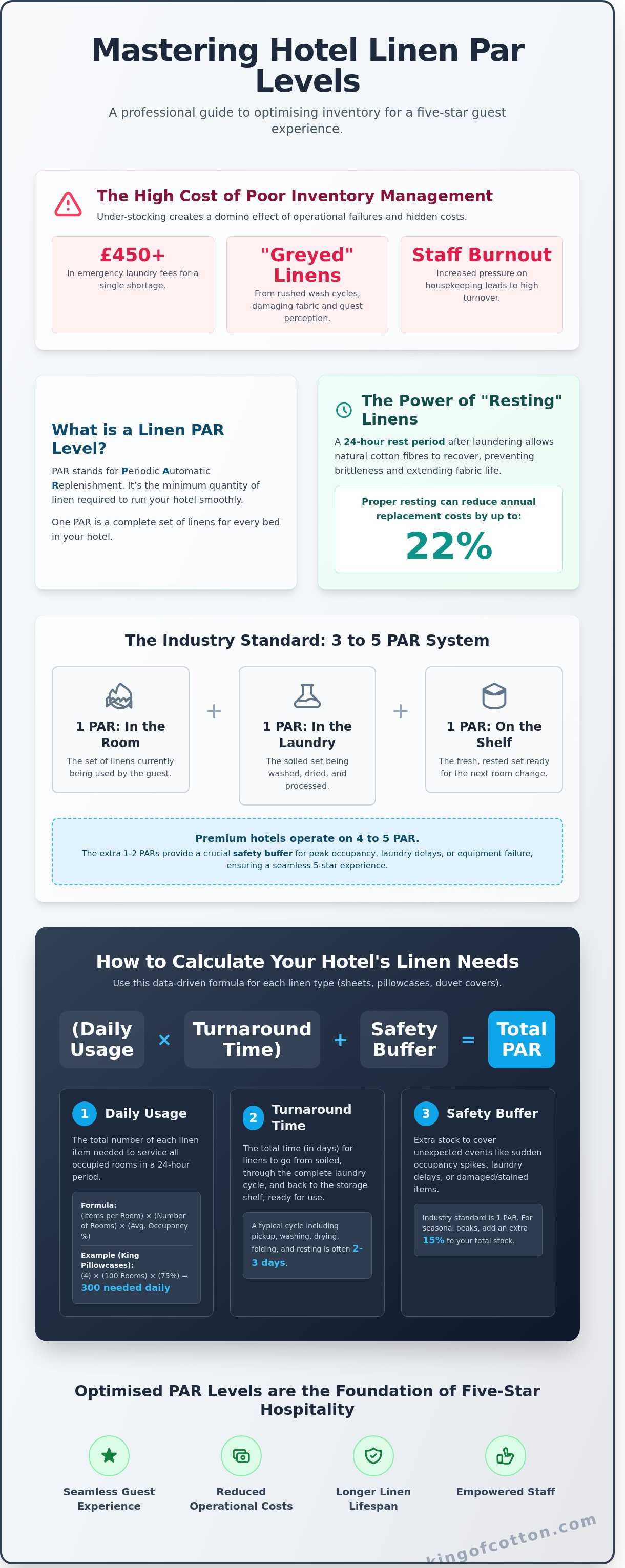
We agree that the constant pressure of potential shortages shouldn't detract from the serene, elegant atmosphere you've built for your guests. This professional guide will show you exactly how to calculate linen par levels for hotel properties using the 3.5 to 4.5 par industry standard we’ve championed for more than 25 years. You'll master the repeatable formulas required to protect your investment in premium cotton, reduce premature fabric thinning by up to 22%, and ensure your housekeeping staff always have the tools they need to create a haven of comfort. We’ll explore the specific inventory cycles that allow you to maintain five-star standards without overextending your annual budget.
Key Takeaways
- Understand why PAR levels are the foundation of five-star hospitality and how maintaining correct stock levels ensures a seamless, luxurious guest experience.
- Master the essential data-driven formula to learn how to calculate linen par levels for hotel operations based on daily usage, laundry turnaround, and necessary buffers.
- Discover how to refine your inventory requirements by room type and service model to avoid the hidden costs of overstocking or emergency shortages.
- Learn to manage the full lifecycle of your linens by accounting for discard rates and quality considerations to optimise your annual replenishment budget.
- Explore how partnering with an expert supplier for premium bulk orders can streamline your supply chain and uphold the highest standards of hotel-style luxury.
Understanding Linen Par Levels: The Foundation of Hotel Housekeeping
In the hospitality industry, PAR stands for Periodic Automatic Replenishment. It's the essential metric that dictates The Foundation of Hotel Housekeeping. Knowing how to calculate linen par levels for hotel operations ensures your guest rooms always look pristine without your team ever facing a shortage. It's the heartbeat of a five-star experience because it guarantees that every guest encounters fresh, crisp linens the moment they walk through the door.
To better understand this concept, watch this helpful video:
When stocks dip too low, the pressure mounts on your team, often leading to staff burnout and high turnover. Under-stocking also results in "greyed" linens because rushed, short wash cycles fail to remove all detergents or minerals. It forces managers into expensive emergency laundry contracts, which can cost upwards of £3.50 per kilogram compared to standard rates. You must distinguish between "on-hand" inventory, which is what's currently in the cupboard, and "total circulating" inventory, which includes every sheet, towel, and pillowcase the hotel owns across all departments.
The 3-5 Par Rule: A Professional Benchmark
A standard 3-PAR system allocates one set in the guest room, one in the laundry, and one in the storage cupboard. While independent boutiques might survive on a 3-PAR setup, premium UK chains typically demand 4 or 5 PAR. This provides a vital safety net for peak occupancy periods or unexpected laundry equipment failure. Mastering how to calculate linen par levels for hotel management involves balancing these numbers against your occupancy rates to ensure you're never caught short during a bank holiday weekend.
Why "Resting" Your Linens Matters
Cotton is a natural, organic material. After the intense heat and agitation of industrial laundering, cotton fibres need time to recover and flatten. A 24-hour resting period on the shelf significantly extends the life of luxury bed linen. Without this rest, the fabric becomes brittle and loses the signature softness that guests expect in a high-end establishment. Investing in a higher par level can reduce your annual replacement costs by 15% to 20% by preventing premature fibre breakdown and maintaining that premium feel for longer.
The Standard Formula: How to Calculate Your Hotel’s Linen Par Levels
To maintain the high standards expected of a luxury establishment, you need a data-driven approach to inventory. The core formula for how to calculate linen par levels for hotel operations is: (Daily Usage × Turnaround Time) + Safety Buffer. You shouldn't apply a "one size fits all" number to your entire property. A King Room requires a different inventory count than a Twin Room or a bespoke Junior Suite. Using "full house" numbers for every calculation often leads to over-investing in stock that sits idle. Instead, base your primary figures on your actual average occupancy to keep your budget efficient. Be aware that seasonal peaks, such as the December holiday period or summer bank holidays, often require a temporary 15% increase in safety stock to handle back-to-back turnovers.
Step 1: Determine Your Daily Usage
Start by counting every piece required for a single room change. This varies significantly by room type and your specific bed configurations:
- King Rooms: 1 flat sheet, 1 duvet cover, 4 pillowcases.
- Twin Rooms: 2 flat sheets, 2 duvet covers, 2 pillowcases.
- Suites: Additional items for sofa beds or decorative bolster cases.
If your average occupancy rate is 75%, multiply your total room count by 0.75 to find your realistic daily requirement. Daily Usage is the total items stripped and replaced in 24 hours.
Step 2: Factor in Laundry Turnaround Time
Turnaround time is the number of days it takes for soiled linen to be cleaned, dried, and returned to your shelves. If you operate an on-site laundry (OPL), your turnaround might be 24 hours, meaning a multiplier of one. However, outsourced services in the UK often require 48 to 72 hours. You must adjust this multiplier for weekend delays or public holidays when delivery schedules often fluctuate. A three-day turnaround effectively triples your base requirement before you even consider spares. Accurate timing is essential when learning how to calculate linen par levels for hotel management.
Step 3: Apply the Safety Stock Buffer
Safety stock protects your operations against unexpected occupancy spikes or laundry equipment failure. We recommend a percentage-based buffer, typically between 10% and 20%, depending on your historical data. This extra stock prevents "last room" syndrome, where housekeeping teams are left waiting for a delivery while guests are checking in. It's a small investment that ensures seamless service during the busiest Saturdays of the year. Investing in premium bed linen for your buffer stock ensures that every guest receives the same high-quality experience, regardless of how busy the hotel is.
Critical Factors That Influence Your Inventory Requirements
Establishing a baseline is only the start. To truly master how to calculate linen par levels for hotel environments, you must account for the variables that disrupt a standard 3.0 or 4.0 par system. Your service model dictates the mathematical load; a five-star property in Mayfair offering twice-daily service will naturally require a higher par than a limited-service lodge. If your policy allows guests to opt out of daily changes, you might see a 20% reduction in daily laundry volume. This doesn't mean you should buy less stock, but it does change how quickly you rotate through your resting par.
Staff training plays a silent but pivotal role in preserving these levels. When housekeeping teams aren't trained to distinguish between a stained item that needs reclaiming and a rag for cleaning, your replacement costs will spike. Statistics show that roughly 15% of annual inventory loss in UK hotels stems from internal misuse or improper chemical applications during the wash cycle. Ensuring your team understands the value of high-quality cotton helps maintain the integrity of your stock for its intended lifespan.
Bathroom vs. Bedroom Par Considerations
Towels and floor mats face a much harsher life than bed sheets. While a duvet cover might last 150 to 200 washes, bathroom linen often requires replacement after 100 cycles due to frequent heavy laundering and guest misuse. Face cloths and hand towels are the most frequently "borrowed" or ruined items, often showing a 25% higher loss rate than bedroom items. For these high-turnover pieces, we recommend a par level of 5.0 or 6.0 to prevent shortages during peak weekends.
Special Amenities: Spas, Pools, and Gyms
Leisure facilities require their own dedicated calculations separate from guest rooms. When figuring out how to calculate linen par levels for hotel spas, you must factor in a 30% higher replacement rate. Massage oils and specialist treatments can permanently degrade fibres, even with professional laundering. Additionally, "pool-to-room" migration is a common issue where guests take leisure towels back to their rooms; this often leaves the pool deck short by mid-afternoon if you haven't accounted for a 1.5 par safety buffer specifically for the leisure area.
Managing the Life Cycle: Buffers, Losses, and Quality Considerations
Budget constraints often lead hoteliers to claim they can't afford a full 4 PAR stock. However, running a lean inventory is a false economy that increases long-term costs. When you understand how to calculate linen par levels for hotel success, you realise that 2 PAR systems lead to "resting" periods of zero hours. This lack of recovery time causes cotton fibres to break down 30% faster than those in a properly rotated 4 PAR system. To keep your standards high, perform a physical inventory audit every 90 days. This practice identifies discrepancies caused by damage or loss before they become guest-facing shortages.
Calculating the Replacement Rate
Your monthly replenishment order relies on a clear "Discard Rate". Use this formula for your annual planning: (Total Inventory × Annual Discard %) / 12. In the UK hospitality sector, common causes of inventory shrinkage include permanent staining from cosmetics, guest theft, and "ragging" where worn items are demoted to cleaning cloths. High-quality Egyptian cotton significantly lowers this rate. Its long-staple fibres provide a natural tensile strength that resists the mechanical stress of industrial laundries, often keeping a property's discard rate well below the 15% industry average.
The ROI of High-Quality Linen
Investing in premium luxury bed linen provides a measurable return that offsets the initial purchase price. While a basic percale might seem cost-effective on a spreadsheet, a 300-thread count sateen will typically survive 20% more wash cycles than a basic percale. This durability is a vital factor when learning how to calculate linen par levels for hotel budgets over a three-year cycle. If a £20 sheet lasts 250 washes while a £12 sheet fails at 100, the premium option costs 8p per use compared to 12p for the budget version. For a 100-room property, these small margins represent thousands of pounds in annual savings.
Quality also dictates the "feel" of the buffer. Cheaper fabrics pill and thin after 30 washes, meaning your back-up stock won't match the quality of your newer items. Premium Giza cotton maintains its lustre and smoothness for much longer, ensuring that even when you dip into your buffer during peak occupancy, the guest experience remains consistent. Don't view par levels as a static number; view them as a moving target that requires high-quality materials to remain stable.
Explore our full range of professional-grade hotel linen products to secure your inventory longevity.
Optimising Your Supply Chain with King of Cotton
King of Cotton has spent 28 years perfecting the art of hospitality supply. We don't just sell sheets; we provide the logistical infrastructure for a seamless guest experience. Knowing how to calculate linen par levels for hotel operations is only the first step. The real challenge lies in securing a supply chain that guarantees those levels never drop during peak occupancy. Our extensive range of products, from 1,000-thread-count Egyptian cotton to 800gsm zero-twist towels, is engineered specifically for the rigours of industrial laundering. We currently support over 1,500 luxury properties across the UK, ensuring their cupboards stay stocked with the finest materials.
Bespoke Solutions for Every Property
Whether you're running a 10-bedroom boutique retreat in the Cotswolds or a 400-room city hotel in London, we scale our services to match your footprint. Brand consistency is vital for guest loyalty. We provide custom embroidery for approximately 92% of our contract partners, adding a signature touch to every duvet cover and bathrobe. Reordering is straightforward. We've streamlined our wholesale portal so you can top up your par levels in seconds. This prevents the stock shortages that lead to 24-hour turnaround stress in the laundry room, which often results in a 15% increase in fabric wear and tear.
Experience the Quality First
You can't judge a thread count from a digital screen. We encourage you to visit our stores or request a bespoke sample pack to experience the Giza cotton difference first-hand. Our delivery reliability is the backbone of our service; 98% of our contract orders are dispatched within 48 hours. This speed allows you to maintain a leaner, more cost-effective par level without the risk of running out during high-demand periods like the December festive season.
A reliable supplier doesn't just deliver boxes; they help you manage your investment. By partnering with experts, you reduce the risk of mismatched stock and inferior replacements that frustrate guests. Contact our contract team today for a professional linen audit and let us help you refine your inventory for maximum efficiency and long-term savings.
Master Your Inventory for Five-Star Guest Experiences
Maintaining a seamless housekeeping operation relies on more than just guesswork. By implementing a standard 3.0 par level as your absolute minimum, you ensure there's always one set in the room, one in the laundry, and one ready in the linen cupboard. Most successful UK hoteliers now aim for 4.0 or 5.0 pars to account for 24-hour turnaround cycles and unexpected weekend surges. It's also vital to factor in a 15% buffer for annual losses and natural wear to keep every bed looking pristine. Mastering how to calculate linen par levels for hotel requirements is the first step toward reducing staff stress and protecting your bottom line.
King of Cotton has served as a specialist supplier to the UK's finest homes and hotels for over 25 years. We back our products with an Exceptional Quality Guarantee and maintain a reputation for excellence, currently Rated Excellent on Trustpilot. Whether you're managing a boutique guest house or a large-scale luxury resort, we provide the durable, premium fabrics your guests expect.
Explore our full range of hotel-quality linens and request a trade quote
Start optimising your supply chain today and give your guests the world-class comfort they deserve.
Frequently Asked Questions
What is the standard par level for a luxury hotel?
A luxury hotel typically maintains a par level of 4 to 5. This ensures one set is on the bed, one is in the laundry, one is ready in the linen cupboard, and a fourth or fifth set acts as a buffer for same-day guest turnarounds or accidental damage.
High-end establishments often use a 5-par system to protect the lifespan of their 600-thread-count Egyptian cotton sheets. This allows for a 24-hour rest period between washes, which helps the natural fibres recover their shape and softness.
How often should a hotel conduct a physical linen inventory?
You should conduct a full physical linen inventory at least four times per year, ideally at the end of every quarter. Regular counts allow you to identify a 15% annual loss rate before it impacts your daily operations or guest satisfaction.
By tracking these figures in March, June, September, and December, you can adjust your procurement budget to account for linen migration or wear and tear. This prevents a sudden shortage during peak summer months when occupancy reaches 90% or higher.
Does a higher thread count mean I need a lower par level?
Higher thread count linens actually require a higher par level because dense fabrics like 800-thread-count sateen take 25% longer to dry than standard 200-thread percale. If you're learning how to calculate linen par levels for hotel suites, you must account for this increased processing time.
A 4-par minimum is essential to prevent staff from using damp sheets or over-drying fabrics. Rushing the laundry process for premium cotton can lead to brittle fibres and a 10% shorter product lifespan, which increases your long-term replacement costs.
How do I calculate par levels for a small Airbnb or vacation rental?
For a small Airbnb or vacation rental, you should aim for a minimum of 3 par per bed. This configuration provides one set for the guest, one set at the professional cleaners, and one set stored on-site for immediate turnovers or emergency replacements.
If your property averages more than 20 bookings per month, increasing this to 4 par is a safer investment. It protects you against late-night spills or laundry delays that could cost you a £50 cleaning fee or a negative review from an arriving guest.
What is the difference between circulating par and backup par?
Circulating par refers to the 3 or 4 sets of linen currently moving between guest rooms and the laundry room. Backup par is the additional 10% to 20% of brand-new stock kept in central storage, often still in its original packaging from the supplier.
Maintaining a dedicated backup stock ensures you can instantly replace a stained towel or torn sheet without waiting for a new delivery. This system keeps your rooms at a 5-star standard even if your monthly discard rate spikes unexpectedly during a busy bank holiday.
How does an on-site laundry affect my par level calculation?
An efficient on-site laundry can reduce your required par level to 3 or 3.5 because it eliminates the 48-hour transport time associated with external contractors. When you know how to calculate linen par levels for hotel operations with internal laundries, you factor in a faster 24-hour turnaround.
However, you still need a buffer for equipment maintenance or unexpected downtime. If your commercial dryer breaks, a 3-par system gives you a 24-hour window to complete repairs before guest service is affected, whereas a 2-par system would fail immediately.
What is a typical discard rate for hotel towels?
The typical discard rate for hotel towels ranges from 5% to 10% of your total stock every month. This figure includes towels that are permanently stained by cosmetics, frayed at the edges, or borrowed by guests as souvenirs.
In a 100-room hotel using 600gsm luxury towels, this might mean replacing 60 to 120 towels each month to maintain quality. Tracking this monthly discard rate helps you maintain your par levels and ensures your bathroom linen always feels thick, white, and absorbent.
Can I run a hotel on 2 par levels?
Running a hotel on 2 par levels is extremely risky and generally discouraged by industry experts. This setup leaves zero room for error, meaning a single laundry delay or a busy weekend with multiple spills will result in unmade beds and lost revenue.
You'll likely see a 20% increase in staff stress and a higher risk of grey linen from rushed washing cycles that don't allow for proper stain removal. For a sustainable operation, a 3-par minimum is the absolute baseline for maintaining the hygiene and quality your guests expect.