

Hotel Linen Inventory Management: A Practical Guide to Software and Stock Control
What if the linen you need is already on site, but its location is unclear? A shortfall in a guest room might mean stock is in the laundry, a store cupboard or still in circulation. Hotel linen inventory management makes those movements visible, so teams can see what is available, where it is and what needs attention.
Manual counts and spreadsheets can work for a smaller operation, but keeping records current becomes harder when housekeeping, stores and purchasing all handle linen. Unclear par levels and replacement needs can make ordering feel like guesswork. The most useful approach isn’t necessarily the one with the longest list of software features. It’s the one that fits the property’s routines and gives staff information they can keep accurate.
This practical guide compares stock-control methods, from manual records to dedicated software and RFID tracking. You’ll learn what to record, how to follow linen between rooms, storage and laundry, and how to set par levels that reflect your operation. We’ll also look at how consistent records can support considered purchasing, including planning linen categories and replacement needs.
Key Takeaways
- Track linen by category, location, condition and movement to build a more useful picture than a single stock total.
- Assign clear responsibility for recording counts and movements, then reconcile records regularly to spot discrepancies.
- Compare spreadsheets, dedicated software and PMS-linked systems against your hotel’s routines, access needs and capacity to keep records up to date.
- Choose hotel linen inventory management tools for clarity and staff adoption, not an oversized list of features.
- Use consistent records to guide replenishment and purchasing plans for bed linen, towels and bathrobes.
Hotel linen inventory management starts with understanding where stock goes
Hotel linen inventory management is the practice of recording linen quantities, locations, condition and movement across hotel operations. It gives housekeeping and purchasing teams a clearer view of what is in rooms, clean storage, collection points or circulation. It is distinct from laundry-service management: inventory follows linen and its status, rather than managing the washing process.
A single stock total can conceal a practical shortfall. A hotel may own enough sheets overall, yet have too few clean sets available for rooms being turned over that morning. Useful inventory management principles apply: records need to show where items are and how they move, not simply how many were purchased.
This video offers a housekeeping-focused view of linen stock routines:
Which linen movements should an inventory record capture?
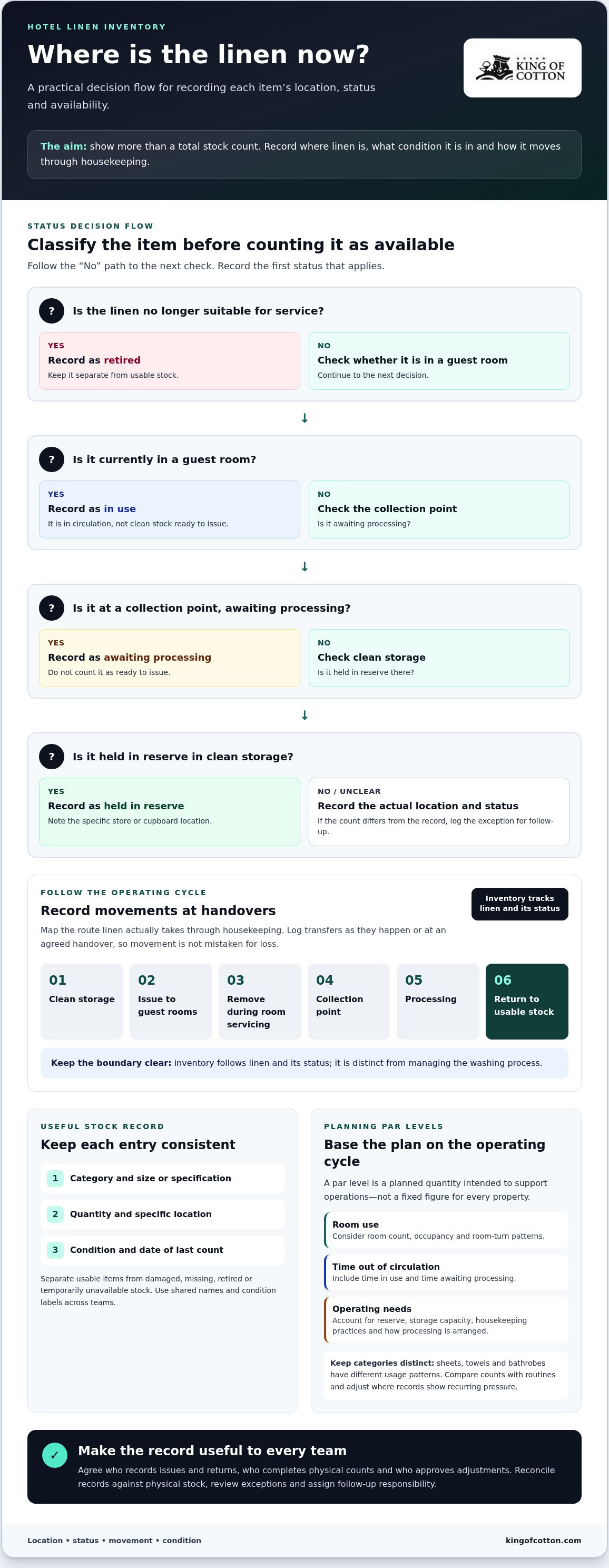
Map each item through the hotel’s operating cycle: clean storage, issue to guest rooms, removal during room servicing, collection, processing and return to usable stock. Record transfers as they happen or at an agreed handover, so a movement isn’t mistaken for a loss. The record should reflect the route linen actually takes through housekeeping.
Give each status a clear meaning. For example, distinguish linen in use in rooms, awaiting processing at a collection point, held in reserve in clean storage and retired because it is no longer suitable for service. That way, items awaiting return aren’t counted as ready to issue. Room occupancy and housekeeping schedules also affect availability: check-outs can bring used linen back in a concentrated period, while occupied rooms may keep sets in circulation for longer.
Why do hotels set linen par levels?
Build the plan around actual movement. A property with frequent room turns may need a different balance of clean, in-use and unavailable stock from one with a slower operating rhythm. Compare counts with occupancy and housekeeping routines, then adjust where records show recurring pressure. Keep categories distinct too: the quantities and usage patterns for towels, bathrobes and sheets are not interchangeable. Planned bed-linen levels should reflect the sizes and specifications used across the rooms; hotels can review suitable bed linen options as part of that planning.
Build a hotel linen inventory around accurate records and clear responsibilities
Reliable records begin with a shared method, not a complicated system. For hotel linen inventory management, agree which categories to track, count the opening stock, then record each issue, return and adjustment. A practical sequence keeps the process clear:
- Define categories and naming conventions, including size or specification where items differ.
- Count opening stock by item and location, separating usable linen from items that need review.
- Record movements at agreed handover points, such as issue to housekeeping or return to stores.
- Review exceptions, including damage, missing items, unusual demand and temporary holds.
- Reconcile records against physical counts and approve any corrections.
Location and status matter as much as quantity: a sheet in a guest room, one awaiting processing and one ready in storage have different availability. This distinction gives teams a more practical view of supply and supports the wider coordination involved in hotel operations management.
What information belongs in a hotel linen stock record?
Use a consistent record for each item: category, size or specification, quantity, storage location, condition and date of the last count. Separate usable stock from damaged, missing, retired or temporarily unavailable items. For example, “bath towel” should mean the same item to housekeeping, stores and purchasing. Add a specific location, such as a particular linen store or floor cupboard, rather than relying on informal labels that may vary between teams.
Choose condition terms staff can apply consistently. A short set of agreed labels is easier to maintain than open-ended descriptions. If an item is damaged, record it separately from stock ready for issue; if it is temporarily unavailable, note why and where it is held. The record should make the next action clear, whether that is review, correction or removal from usable stock.
How should housekeeping and stores coordinate stock updates?
Set handover points around existing routines. Housekeeping can record linen issued to rooms and returns to collection points; stores can log what is received, moved or made available for reissue. Agree who owns each update, who completes physical counts and who approves adjustments. A named accountable role helps prevent discrepancies from being noticed repeatedly without being resolved.
Keep an exception log brief and factual. Capture the item, quantity, location, date and reason where known, then assign someone to follow up. If a count differs from the record, note the difference before changing the total. This creates a traceable explanation and helps teams distinguish a one-off error from a recurring problem in the movement process.
Consistent item names and specifications also support precise purchasing records. A hotel standardising the bed linen it counts can compare like with like when reviewing bed linen options for its rooms.
Compare spreadsheets, hotel linen software and PMS-linked inventory
The right record-keeping method should fit the way a hotel handles linen. A spreadsheet may be a sensible starting point for a limited operation, while dedicated inventory software can provide a more structured home for records as locations, categories or users increase. Linking inventory with a property management system (PMS) or housekeeping system may help when shared information serves a clear operational purpose. Each approach still depends on accurate updates and agreed ownership.
The right tool depends on operational complexity and reliable data ownership, not on the length of its feature list. Compare options against the tasks teams need to complete: recording a movement, finding an item’s status, reviewing a count or preparing purchasing information. For hotel linen inventory management, a tool staff can update as part of normal routines is more useful than a sophisticated system whose records regularly fall behind.
When can a spreadsheet be sufficient for linen stock?
A centralised spreadsheet can work for a hotel with a manageable number of categories and storage points, provided someone is responsible for maintaining it. Use one shared record with consistent item names, location labels and fields for movements. Agree how staff access it across shifts and how changes are captured when linen is issued, returned or set aside for review.
The main risks are procedural. Copies saved in different places can create competing versions; updates made later from memory can be missed; and comparing the sheet with physical stock takes manual effort. Consider whether the teams handling linen can reliably update one trusted record during ordinary shifts. If not, the apparent simplicity may conceal a growing reconciliation burden.
What should hotels compare in dedicated inventory software?
Assess tools against the hotel’s actual workflow rather than assuming every platform offers the same functions. Check whether the system can organise the required categories and locations, record movements, present useful reports and give relevant staff appropriate access. Test a typical task, such as logging a transfer from a store to a housekeeping area, and note whether the steps are clear or create unnecessary friction.
Dedicated software can give stock records a more structured format, but its value depends on whether teams use it consistently. Consider how it handles corrections, count reviews and responsibility for maintaining records. Reporting is useful only if it helps answer practical questions, such as which categories need attention or where a discrepancy is occurring.
A PMS or housekeeping-system connection is worth considering when it supports a defined task. A hotel may want teams to use related operational information in a coordinated way. Identify the decision or handover the connection should improve, then assess whether it fits existing routines. Avoid adding complexity if an integration does not make stock records clearer or easier to maintain.
Test a proposed approach before committing to it. Map the hotel’s categories, storage points, team handovers and reporting needs, then trial the process with the staff who will use it. If updates are timely and information is easy to interpret, the method is serving its purpose. If not, simplify the workflow or clarify ownership before adding more features.
Choose hotel linen inventory software using a property-specific checklist
Start with the operation, not a supplier’s feature list. Note how many linen categories you manage, where stock is stored, which teams handle it and how often items move between rooms, housekeeping and stores. These details define the records the system must support. A single-property hotel with a small number of storage points may need dependable counts and simple updates; a group may also need consistent category definitions across sites.
Prioritise clarity and staff adoption. Reports should help people make specific decisions, such as replenishing a category, redistributing stock between locations, reviewing replacement needs or following up a discrepancy. For hotel linen inventory management, detailed dashboards add little value if teams can’t maintain the underlying records during normal work.
Use this short decision matrix to compare options against the work they must support:
- Operational fit: Can staff record routine movements without disrupting established tasks?
- Administration: Is ownership for updates, counts and corrections clear and manageable?
- Data visibility: Can the right teams understand stock by category, location and status?
- Reporting: Does the information help guide replenishment, redistribution or exception follow-up?
Which requirements matter most for a single property or hotel group?
For one property, look first for dependable counts, clear responsibility and manageable daily updates. The process should fit the team’s handovers and store locations. For a group, shared category names and comparable reporting can help teams interpret records consistently across sites. Include multi-property functions only if the operation needs them.
How can a hotel test usability before adopting a system?
Run a realistic trial before extending the process. Choose a representative linen category and follow it through a normal movement cycle, from storage to issue and back to recorded stock. Ask housekeeping and stores staff to make updates in their usual working conditions, not just during a demonstration. Then compare the system’s figures with a physical count and note missing fields, confusing steps and training needs.
Use the trial to check whether the record stays clear from one handover to the next. If staff need workarounds or a routine update is easily missed, refine the process before adding more categories. A measured evaluation helps show whether the system supports the hotel’s operation rather than adding administrative weight.
Consistent specifications can also simplify purchasing once records make category needs easier to plan. Bed linen for hotel rooms is one part of a considered stock plan.
Connect accurate linen records to confident hotel linen purchasing
Inventory records become valuable when they inform a purchasing decision. Repeated shortages in one category may point to a need for replenishment, while persistent surplus elsewhere could prompt a review of planned quantities or stock distribution. Recurring condition issues may also warrant a closer look at the item specification and the demands of the hotel’s operation. These are signals for review, not automatic instructions to buy.
For hotel linen inventory management to support considered orders, purchasing records need to match the categories and specifications used in stock counts. Record textile type, size and relevant specification consistently, so teams compare like with like rather than treating different items as interchangeable. A bed sheet, towel or bathrobe should have a clear description that carries through from the stock report to the purchasing plan.
Turn stock reports into clearer linen replenishment decisions
Review replenishment needs alongside the reason behind them. If a category repeatedly falls short, consider whether demand, stock location or the planned quantity explains the pattern. If stock remains unused, check whether it is held in the wrong place or no longer matches current room requirements. Condition records can help identify items for replacement review, but decisions should reflect the property’s own use and standards. No single record can promise savings or establish a fixed lifespan.
Standardised descriptions make the review more precise. Distinguish bed linen by size and specification, and record towel and bathrobe categories separately. This supports clearer comparisons between what the hotel holds, needs and intends to order. For bedding decisions, use a consistent hotel bed linen selection framework that reflects room requirements and the experience the property aims to deliver.
Plan hotel linen orders around guest experience and operating needs
Purchasing should balance the guest-facing standard with the realities of daily use. Bedding contributes to a room’s comfort and presentation; towels and bathrobes shape the experience in bathrooms and other guest areas. Set specifications for each category in line with the hotel’s service style, then use stock records to plan replenishment and replacement reviews around those choices.
King of Cotton supplies bed linen, towels and bathrobes to hotels and other hospitality businesses, and has been trusted for 25+ years. Consistent records can make supplier planning more focused by clarifying the categories and quantities a property needs to maintain. For relevant UK mainland orders, Free Mainland Delivery on Orders Over £100* applies; the UK mainland minimum delivery charge is £3.95.
Explore hotel linen options for hospitality purchasing as part of your stock plan.
Make your next linen decision with confidence
Let your records shape the next practical improvement. Choose one recurring stock question, such as whether a category needs replenishment or whether its current specification still suits the property, and use inventory information to guide a focused review. This turns hotel linen inventory management into an ongoing decision-making habit, rather than a record-keeping task that ends once counts are entered.
As patterns become clearer, purchasing conversations can become more precise. A consistent view of what the hotel uses and needs helps teams plan orders around guest expectations and day-to-day operations. King of Cotton is rated Excellent on Trustpilot, offering an established point of reference as you consider linen for your property.
When you’re ready to align your stock plan with the linen guests experience, explore King of Cotton’s hotel linen options.
Frequently Asked Questions
What is hotel linen inventory management?
Hotel linen inventory management is the process of keeping reliable records of the linen a hotel owns and how it is being used. Records can cover item type, quantity, location, condition and availability, helping staff decide what can be issued or needs attention. It isn’t a laundry service: it concerns stock information and decisions, not washing, drying or pressing linen.
Is hotel linen inventory software worth it for a small hotel?
It can be, but suitability depends on the hotel’s categories, storage locations, staff workflow and the reliability of its current records. If a small team can maintain accurate counts in a shared record, dedicated software may add little value. If updates are often missed or stock is hard to locate, assess whether a tool would make everyday tasks clearer before adopting it.
Can a hotel manage linen inventory in a spreadsheet?
Yes, a shared spreadsheet may suit a simpler operation with a manageable range of items and one clear owner for updates. Use consistent labels and a single trusted version, so changes aren’t lost across separate files. Agree who updates it after stock moves and how often entries are checked. If staff can’t maintain it during normal shifts, accuracy may slip.
How often should a hotel count its linen inventory?
Set count frequency according to how quickly stock moves and how much visibility the operation needs. A hotel handling frequent room turns may need closer checks on fast-moving categories than on reserve items. Combine scheduled physical counts with targeted reviews whenever a discrepancy appears, a store is reorganised or a category repeatedly runs short. Record each count date so teams can judge how current the figures are.
What should hotel linen inventory software track?
Useful records can include item category, quantity, location, condition and status, such as ready for use, held for review or retired. Movement history can help staff understand how a count changed between checks. Define what the hotel needs to record before comparing tools. For example, a property may need to distinguish room-ready towels from stock awaiting inspection.
What happens if linen stock records do not match the physical count?
Pause before changing the total. Check recent issues and returns, nearby storage points and whether damaged, retired or temporarily held items were counted differently. Record the discrepancy and any explanation found, then assign someone to approve and enter the correction. If the cause remains unclear, keep it in an exception log for follow-up. This leaves a traceable record rather than hiding an unresolved difference.
Can hotel linen inventory systems connect with a PMS?
Some systems may connect with a property management system, but integrations and functions vary by platform. Start by identifying a specific workflow need, such as making relevant operational information easier for a team to use. Then assess whether the connection supports that task without adding steps or unclear responsibilities. A link between systems isn’t automatically useful if staff still need to duplicate or correct records manually.