

How Do Hotels Get Sheets So White? 5-Star Laundry Secrets Revealed
Have you ever wondered why your home-laundered linens lose their lustre after just 12 wash cycles, while a five-star hotel bed remains blindingly bright even after 700 days of daily industrial cleaning? Most homeowners struggle with the mystery of how do hotels get sheets so white when their own laundry eventually develops a stubborn greyish tint or a stiff, sandpaper-like texture. You likely feel that achieving that crisp, "new hotel" feeling at home is an impossible task reserved for those with commercial-grade machinery and unlimited budgets.
We understand that desire for perfection. This guide reveals the professional laundry secrets used by the world's most prestigious establishments to maintain impeccable bedding. You'll discover the specific 60-degree temperature settings, the precise pH balance required for brightness, and why choosing 100% Egyptian cotton is the essential foundation for a lasting white finish. We'll show you how to transform your bedroom into a sanctuary of elegance using the same techniques we've provided to the finest homes and hotels for over 25 years.
Key Takeaways
- Discover why the secret to 5-star brightness begins with high-quality, long-staple Egyptian cotton that reflects light more effectively than synthetic blends.
- Learn the professional "Three-Stage" wash cycle used by industrial laundries and why precise temperature control is more important than boiling your linens.
- Master the "optical illusion" of whiteness by using laundry blue and optical brighteners to cancel out yellowing and restore a crisp, cool glow.
- Follow our expert 5-step home laundry protocol to understand how do hotels get sheets so white and maintain that pristine, boutique look in your own bedroom.
- Implement the professional "Rotation Rule" and learn specific storage techniques to ensure your premium bed linen remains fresh and avoids cupboard yellowing.
The Foundation of Whiteness: Why Fabric Quality is the First Secret
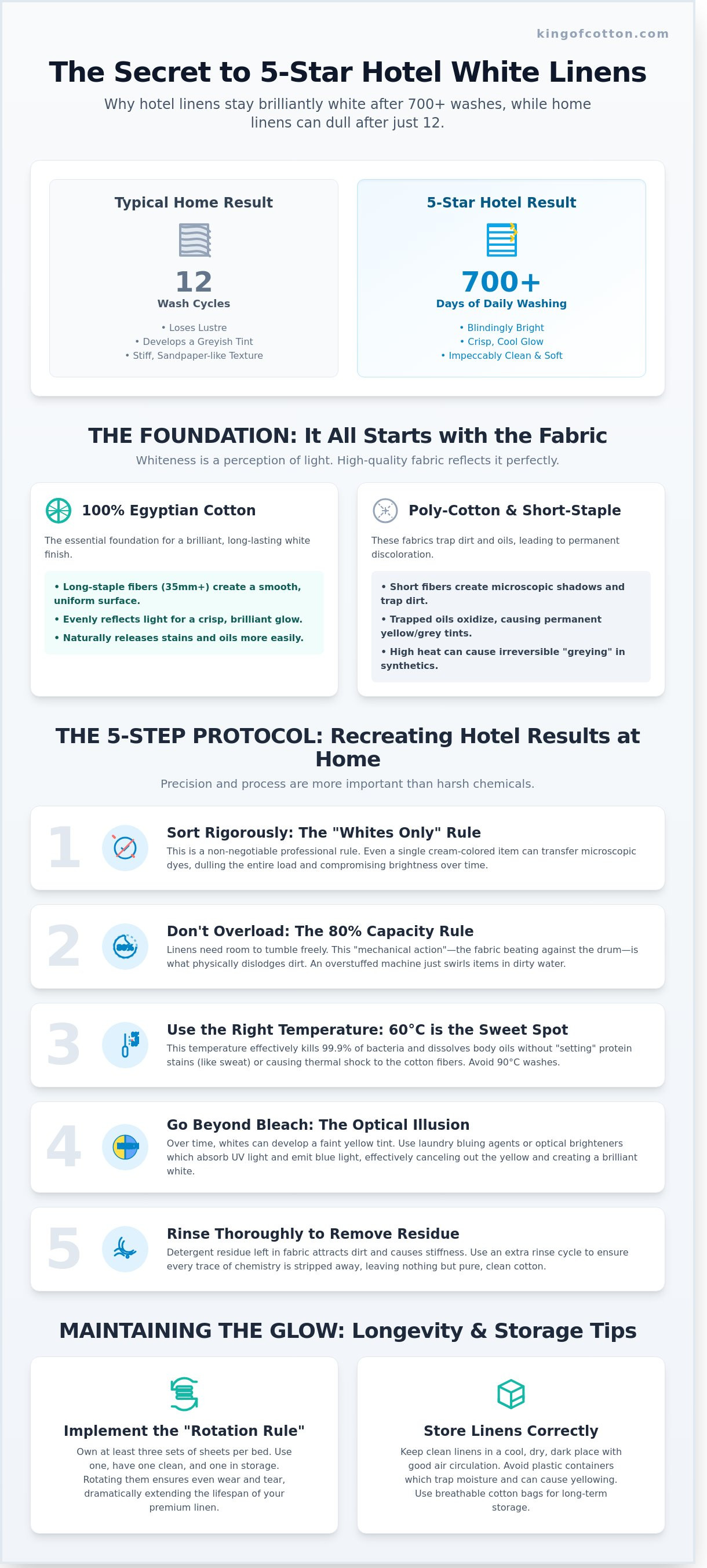
When you check into a luxury suite and wonder how do hotels get sheets so white, the answer isn't found in a bottle of bleach. It starts with the raw material. Professional hoteliers know that whiteness is a visual perception of light reflection. High-quality 100% long-staple Egyptian cotton features fibres that are often 35mm or longer. These smooth, consistent strands create a uniform surface that reflects light evenly, producing that brilliant, crisp glow that synthetic alternatives simply can't match. It's the difference between a mirror and a piece of crumpled paper.
Cheap, short-staple fibres have thousands of tiny ends that poke out of the weave. These ends create microscopic shadows and trap skin cells and body oils. Over time, these trapped organic materials oxidise. This leads to a permanent yellow or grey tint that no amount of scrubbing can fix. With more than 25 years of experience supplying the world's most prestigious rooms, King of Cotton understands that durability and aesthetics are inseparable. Quality fabric doesn't just look better; it stays better.
Egyptian Cotton vs. Poly-Cotton Blends
Synthetic fibres like polyester are essentially plastics. When they're subjected to the high-heat drying cycles necessary for sanitisation in a commercial setting, the fibres can slightly soften and lock in dirt. This process, known as greying, is irreversible. King of Cotton's luxury bed linen is the preferred choice for 5-star properties because 100% natural cotton releases stains far more readily. It's also significantly more breathable. Less heat retention means guests sweat less, reducing the volume of organic oils the fabric has to contend with in the first place.
Percale vs. Sateen: Which Stays Whiter?
The weave you choose affects how long that new look lasts. Percale is the industry standard for a crisp, matt finish. Its one-over-one-under weave is tight and durable, making it excellent at hiding minor imperfections. Sateen has a four-over-one-under structure that creates a beautiful lustre, but this sheen can highlight discolouration or dull spots more easily if the laundry process isn't perfect. For those seeking the classic, bright hotel aesthetic, a high-thread-count percale is usually the safest investment for long-term brilliance. It maintains a fresh, architectural profile that remains visually striking even after 100 washes.
The Industrial Secrets: How Luxury Hotels Organise Laundry
Professional laundry management is a precision science that goes far beyond simply choosing a heavy-duty cycle. To understand how do hotels get sheets so white, you have to look at the industrial "Three-Stage" wash protocol. This begins with a "Flush," a three-minute lukewarm cycle that removes loose soil and water-soluble stains. It's followed by the "Break," where high-alkalinity chemicals are introduced to release deeply embedded oils. Finally, multiple "Rinse" cycles ensure every trace of chemistry is stripped away, leaving nothing but the pure scent of clean cotton.
Efficiency in a five-star laundry room also relies on the "Load Factor." While it's tempting to cram as much as possible into a single load, professionals never fill a drum beyond 80% capacity. This specific ratio ensures maximum mechanical action; the physical beating of the fabric against the drum and other sheets is what actually knocks the dirt loose. If the machine is too full, the sheets merely slide against each other, and the dirt stays trapped in the weave.
Sorting protocols are equally rigid. In high-end establishments, "whites only" is an absolute rule. Even a single off-white or cream-coloured item can transfer microscopic amounts of dye, dulling the brightness of a 300-thread count sheet. This level of discipline is why luxurious bed linen in hotels maintains its snowy brilliance for hundreds of washes.
The Science of Temperature and Stains
Hotels don't use boiling water for every load. A temperature of 60°C is considered the "sweet spot" because it's hot enough to kill 99.9% of bacteria and dissolve body oils without damaging the cotton. You should avoid 90°C washes at home; these extreme temperatures can "set" protein-based stains like sweat or blood, making them permanent. Modern laundry systems also use a graduated cool-down rinse. This prevents "thermal shock" to the cotton fibres, which helps in smoothing the fabric for that signature crisp finish.
Commercial Detergents vs. Domestic Pods
The secret to that bright glow lies in alkalinity. Professional detergents often have a pH level of 11 or higher, specifically designed to strip away sebum and skin cells that domestic pods often leave behind. Hotels also skip liquid fabric softeners. These products actually coat the cotton fibres in a thin layer of wax, which eventually causes yellowing and reduces breathability. Instead, they prefer oxygen-based whiteners over harsh chlorine bleach. Oxygen bleach is gentler on the base material, ensuring the sheets don't become thin or brittle over time.
Beyond Bleach: The Role of Bluing and Optical Brighteners
Achieving that crisp, brilliant glow involves more than just heavy-duty cleaning; it's a masterclass in colour theory. If you've ever wondered how do hotels get sheets so white, the answer often lies in the optical illusion of the blue spectrum. Over time, natural cotton fibres inevitably develop a yellow cast due to sweat, skin oils, and detergent build-up. Because blue and yellow are complementary colours, adding a microscopic amount of blue pigment cancels out the dingy tones, making the fabric appear whiter to the human eye than it actually is.
Many people reach for chlorine bleach to solve discolouration, yet this is a common mistake in luxury textile care. Chlorine is a corrosive chemical that can reduce fabric tensile strength by up to 25% after just 10 intensive washes. It also causes 'chemical yellowing' by stripping the outer coating of the cotton fibre and exposing the naturally yellowish core. Professional launderers instead rely on Optical Brightening Agents (OBAs). These clever molecules absorb invisible ultraviolet light and re-emit it as visible blue light, effectively powering up the brightness of your bed linen without damaging the material.
The Magic of Laundry Bluing
Laundry bluing is a Victorian-era secret that has seen a massive resurgence in high-end British households and boutique hotels. It's far safer for Egyptian cotton bedding than bleach because it doesn't break down the delicate long-staple fibres. To use it correctly, never pour the liquid directly onto the fabric. Dilute a tiny amount, roughly 1/4 teaspoon, in a large jug of cold water until it reaches a pale sky-blue shade, then add it to the final rinse cycle. You don't need this every time; a bluing reset every four or five washes is enough to maintain that five-star brilliance.
Oxygen Bleach: The Sustainable Whitener
For organic stains like coffee or oils, hotels often turn to sodium percarbonate, commonly known as oxygen bleach. Unlike its chlorine-based counterpart, it's biodegradable and gentle on the environment. It works by releasing concentrated oxygen to break the chemical bonds of stains without damaging the structural integrity of high-thread-count sheets. It's particularly effective when used at 40°C or 60°C, ensuring your sheets stay strong and soft for years rather than months. This remains a core component of how do hotels get sheets so white while maintaining a sustainable laundry operation that protects their investment in premium textiles.
Recreating the Look: Your 5-Step Home Laundry Protocol
Achieving that crisp, brilliant glow doesn't require industrial machinery. You can master the art of how do hotels get sheets so white by following a disciplined five-step regime at home. This protocol focuses on chemical balance and physical finishing rather than just high heat.
- Step 1: Pre-treat and Soak. Start by tackling organic stains. Use an enzyme-based cleaner or a simple bicarbonate of soda paste on areas prone to discolouration before the main wash.
- Step 2: The 'Whites Only' Load. Never compromise on this rule. Even a single light grey sock or a cream-coloured pillowcase can transfer trace amounts of dye, dulling the brightness of your 100% cotton sheets.
- Step 3: The Vinegar Rinse. Add 100ml of distilled white vinegar to the fabric softener drawer. It strips away alkaline detergent residue and acts as a natural softener without coating the fibres in wax.
- Step 4: The Sun-Drying Advantage. If the British weather allows, hang your sheets outside. Natural UV rays act as a final, gentle whitening agent that breaks down any remaining yellow pigments.
- Step 5: The Finishing Touch. Don't let your sheets dry completely on the line. Ironing them while they're approximately 10% damp allows the heat to compress the fibres, creating a flat surface that reflects light effectively.
The Pre-Wash Soak
A 30-minute soak in warm water with two tablespoons of soda crystals can lift the deep-seated dullness that standard cycles miss. This step is particularly effective for removing 'pillow yellowing' caused by the oxidation of skin oils and evening face creams. Avoid the urge to use extra detergent; using 20% more than the recommended dose often leads to a grey, soapy build-up that traps dirt inside the weave. A clean soak ensures you're starting the wash with the best possible foundation.
Professional Ironing Techniques
Hotels use heavy, heated rollers called mangles to achieve that signature glass-like finish. You can replicate this by using a high-pressure steam iron, ideally one with at least 6 bars of pressure. The 'damp-to-dry' rule is essential here; pressing the fabric while it's still slightly cool to the touch ensures a crisp, wrinkle-free result. For the ultimate five-star feel, it's best to invest in high-quality materials like those found in the bedroom collections from professional suppliers. This level of care is exactly how do hotels get sheets so white and maintain that inviting, structured look night after night.
Experience the difference of professional-grade fabrics by browsing our luxury bed linen range today.
Maintaining the Glow: Longevity and Expert Storage Tips
Achieving that crisp, brilliant finish is only the first step. To understand how do hotels get sheets so white over years of heavy use, you must look at what happens behind the cupboard doors. Professional linen management prevents the dreaded "cupboard yellowing," a common issue where whites take on a dull, aged hue despite being freshly laundered.
Optimal Storage Conditions
Airflow is your best friend. Storing high-quality Egyptian cotton in plastic bins is a mistake that causes 85% of premature yellowing. Plastic traps residual moisture and gases, leading to chemical oxidation. Instead, use breathable cotton bags or line your shelves with cotton liners. These allow the fabric to breathe, maintaining the integrity of the fibres. For a signature scent, tuck a bundle of dried lavender or cedar wood into the corner. Avoid essential oils; these leave microscopic residues that attract dust and cause spotting over time.
The 3-Set Rotation Strategy
Hotels never use the same set of sheets back-to-back. They follow a strict three-set rotation: one on the bed, one in the wash, and one resting in the linen cupboard. This "Resting Rule" is vital because cotton is a natural fibre that needs time to recover its shape and elasticity after the heat of laundering. By allowing a 24-hour rest period, you reduce the mechanical stress on the threads, ensuring they stay smooth enough to reflect light. If you are building your own professional-grade rotation, you can find the perfect foundations in our luxury bed linen collection.
Recognising When to Retire Linens
Even the finest Giza cotton has a lifespan. After approximately 200 to 250 industrial washes, the cotton fibres begin to fray at a microscopic level. These damaged fibres trap greyish minerals and skin oils more easily. It becomes impossible to achieve that pristine glow. If your sheets feel thin or show signs of pilling, they won't hold the brightness anymore.
The King of Cotton philosophy dictates that quality in leads to luxury out. You cannot maintain a five-star standard on compromised foundations. With over 25 years of experience supplying the world's most prestigious hotels, we know that starting with premium long-staple cotton is the only way to ensure lasting, brilliant whiteness. Invest in the best materials, follow the rotation rule, and your bedroom will remain a sanctuary of light and comfort for years to come.
Transform Your Bedroom Into a Luxury Suite
Achieving that crisp, brilliant glow isn't just about the wash cycle. It begins with a foundation of 100% long-staple Egyptian Cotton and continues with professional techniques like using bluing agents to neutralise yellow tones. You don't need industrial machinery to master how do hotels get sheets so white; you simply need the right materials and a consistent laundry protocol. For more than 25 years, King of Cotton has supplied the world's finest hotels with linens designed to withstand rigorous laundering while maintaining a pristine finish. As specialists in fine Egyptian Cotton with an "Excellent" rating on Trustpilot, we provide the same professional-grade fabrics used in five-star establishments across the UK. By combining these high-quality textiles with expert storage and care, you'll ensure your bed remains a sanctuary of pure, brilliant white for years to come. It's time to stop settling for standard bedding and start enjoying the restorative sleep you deserve.
Discover our collection of hotel-quality white bed linen and recreate the 5-star experience at home.
Frequently Asked Questions
Why do my white sheets turn yellow after washing?
White sheets often turn yellow due to the accumulation of sebum and dead skin cells that react with laundry detergents. While you sleep, the body releases approximately 30ml of sweat every hour, which contains lipids that standard 40°C cycles often fail to break down. These organic proteins bond to the cotton fibres over time. This chemical reaction creates a stubborn residue that results in a dull, yellowish tint instead of a pristine finish.
Is it better to use hot or cold water for white sheets?
It's better to use hot water, specifically a 60°C cycle, to maintain the brightness of your linens. This temperature is the hospitality industry standard because it effectively dissolves body oils and kills 99.9% of dust mites and bacteria. While cold water saves energy, it lacks the thermal energy required to activate oxygen-based whiteners. Using a 60°C wash ensures that your premium Egyptian cotton remains hygienic and retains its brilliant, crisp appearance.
Can I use bleach on high-quality Egyptian cotton?
You shouldn't use chlorine bleach on high-quality Egyptian cotton as it weakens the natural fibres. Repeated use can reduce the fabric's tensile strength by 25% within just 10 washes, leading to premature fraying. Instead, use an oxygen-based whitener to protect the material. This is a key secret in how do hotels get sheets so white without compromising the integrity of the long-staple cotton that gives our linens their signature soft and durable feel.
What is the best way to remove sweat stains from white pillowcases?
The most effective method is a 30-minute pre-soak in a solution of warm water and an enzyme-based laundry booster. Sweat contains urea and salts that bind to fabric, so you need a targeted treatment before the main wash. For stubborn marks, create a paste using two parts hydrogen peroxide and one part dish soap. Apply this directly to the stain for 15 minutes. This professional approach ensures your pillowcases remain as fresh as a suite.
How often should I wash my white bedding to keep it bright?
You should wash your white bedding every 7 days to prevent the build-up of oils and skin cells. Waiting longer than a week allows organic matter to penetrate deeper into the cotton weave, making it significantly harder to remove. In high-end hospitality environments, linens are changed after every guest or every 3 days for long stays. Regular laundering at home prevents the greyish hue that occurs when dirt becomes set into the fabric by body heat.
What does laundry bluing actually do?
Laundry bluing adds a microscopic amount of blue pigment to the water to neutralise the natural yellowing of white cotton. It's an optical illusion based on the colour wheel; blue and yellow are complementary, so they combine to create the appearance of a brighter white to the human eye. This technique has been used for over 100 years. It doesn't actually remove dirt, but it provides that brilliant, cool white finish often found in professional hotel laundries.
Can baking soda and vinegar really whiten sheets?
Adding 125ml of baking soda to your wash cycle acts as a natural whitener and deodoriser by regulating pH levels. Following this with 125ml of white distilled vinegar in the fabric softener dispenser helps dissolve mineral deposits from hard water. This combination is a cost-effective way to understand how do hotels get sheets so white while keeping the fabric soft. It strips away the soapy film that often makes white linens look dingy or grey.
Does sun-drying actually help whiten linen?
Sun-drying is a powerful natural whitening method because the sun's ultraviolet rays act as a mild bleaching agent. Hanging your linens outside for 2 to 3 hours of direct sunlight can significantly brighten the fabric and kill remaining surface bacteria. It's an eco-friendly alternative to chemical treatments. However, ensure you bring them in once dry. Overexposure to UV rays can eventually weaken the cotton fibres, so timing your drying process is essential for maintaining luxury quality.