

Fitted Sheet Depth: Choose the Right Fit for Your Mattress
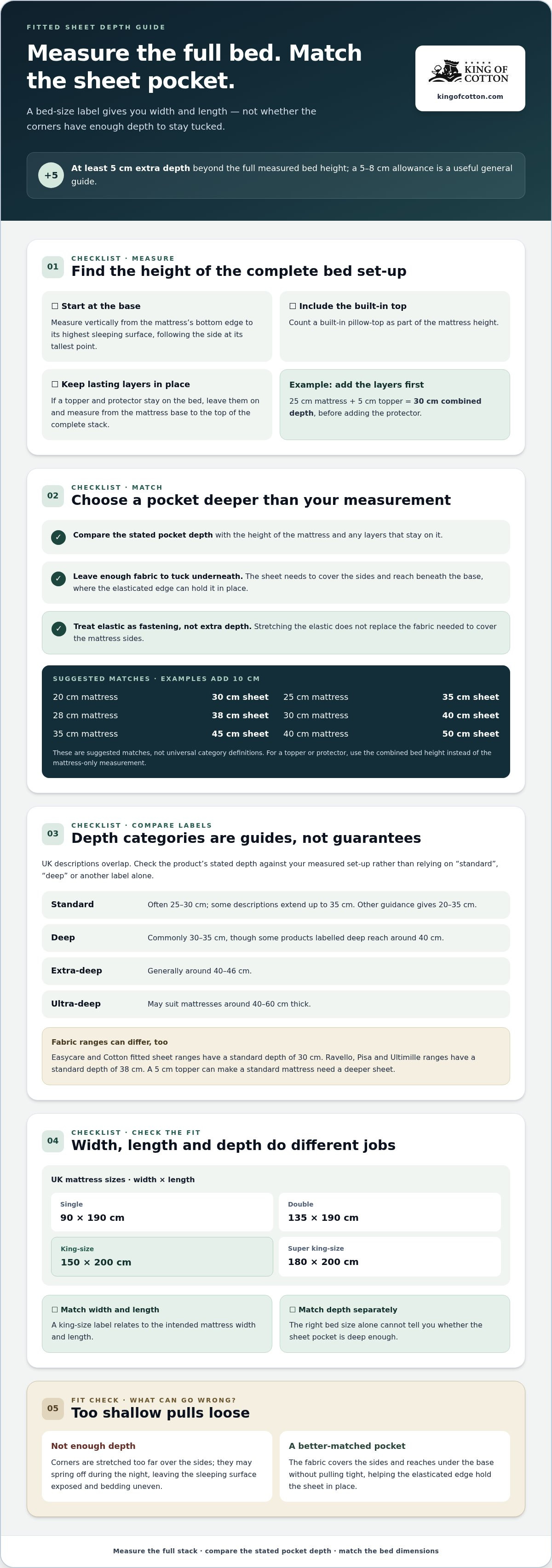
The right fitted sheet is chosen by mattress depth, not by bed size alone. It should be deeper than the mattress, with at least 5 cm of extra depth; include any topper that stays on the bed when measuring. This fitted sheet depth guide explains how to match the sheet to the full mattress height, including on a king-size bed.
A sheet can seem wide enough for the bed yet slip off if its corners lack enough depth to tuck underneath. A king-size label tells you the sheet’s intended width and length, not whether it will fit a deep mattress or topper.
Learn how standard, deep, extra-deep and ultra-deep fitted sheets differ, how to measure your mattress, and why shallow sheets pull loose. This guide also explains what to consider for a UK king-size bed, so you can choose a fit that stays smooth and secure through the night.
Key Takeaways
- Measure the mattress from its base to the highest point, including any topper that stays on the bed.
- Choose a sheet deeper than the full mattress height, with enough fabric to tuck beneath the corners.
- Standard, deep and extra-deep labels can vary, so compare the stated sheet depth with your measurement.
- A shallow sheet can pull loose when its corners are stretched over a mattress that is too deep.
- For a UK king-size bed, match the sheet’s width and length as well as its depth; the standard mattress size is 150 cm by 200 cm.
What are the different depths of fitted sheets?
Fitted sheet depth is how far the sheet’s sides extend down the mattress. Measure the complete sleeping setup, then choose a pocket deep enough to tuck underneath without pulling tight.
Measuring Mattress Depth
Mattress depth is the vertical distance from its bottom edge to the highest sleeping surface. Measure from the base to the top, following the side at its tallest point, and include any built-in pillow-top. This gives you the height the fitted sheet needs to cover, rather than just the mattress’s main body.
If a topper and protector stay on the bed, leave them in place while measuring. Measure from the base of the mattress to the top of the complete stack. For example, a 25 cm mattress with a 5 cm topper has a combined depth of 30 cm before adding the protector. That total is the useful figure for choosing bedding.
Matching Sheet Depth to Mattress Depth
A fitted sheet’s depth should exceed the full height of the mattress and any layers above it. Aim for at least 5 cm extra depth; a 5 to 8 cm allowance is a useful general guide. That fabric must cover the mattress sides and reach underneath the base, where the elasticated edge can hold it in place.
Depth figures describe the sheet’s pocket, not extra allowance created by stretching the elastic. Elastic secures the corners, but it cannot replace the fabric needed to cover the mattress sides. Use a fitted sheet depth guide to compare the stated pocket depth with the measured mattress and bedding layers, not just the mattress label.
Suggested Depths for Different Mattresses
Use the total measured height to choose a sheet, allowing enough depth to tuck beneath the mattress. These examples add 10 cm to the mattress measurement:
- A 20 cm mattress pairs with a suggested 30 cm sheet.
- A 25 cm mattress pairs with 35 cm, while a 28 cm mattress pairs with 38 cm.
- A 30 cm mattress pairs with 40 cm; a 35 cm mattress pairs with 45 cm.
- A 40 cm mattress pairs with 50 cm.
These are suggested matches, not universal category definitions. If your mattress has a topper or protector, use the combined depth in place of the mattress-only figure. For instance, a 25 cm mattress with extra layers may need a deeper sheet than the 35 cm example.
UK Sheet and Mattress Sizes
UK fitted sheet sizes match mattress width and length, while depth is a separate measurement. A UK single mattress measures 90 cm by 190 cm; a double measures 135 cm by 190 cm. A king-size mattress is 150 cm by 200 cm, and a super king-size is 180 cm by 200 cm.
What fitted sheet depths are available in the UK? Common descriptions include standard, deep, extra-deep and ultra-deep, with product depths varying. Standard sheets are often 25 to 30 cm deep; deep options may be 30 to 40 cm, extra-deep sheets around 40 to 46 cm, and ultra-deep options around 40 to 60 cm.
What depth do you need with a topper and protector? Measure from the mattress base to the top of both layers, then choose a sheet at least 5 cm deeper than that total. The sheet’s stated depth is the pocket measurement; elastic isn’t extra fabric allowance.
Standard, deep and extra-deep sheet depth categories
Depth labels show how far a fitted sheet’s sides can reach around a mattress. In the UK, standard, deep, extra-deep and ultra-deep are useful guides, but the measurements can overlap. Compare the stated depth with your mattress measurement instead of relying on the category name alone.
A standard fitted sheet is commonly around 25 to 30 cm deep. Some UK sizing descriptions place standard sheets up to 25 cm, while broader product guidance gives a range of 20 to 35 cm. That variation means a “standard” label doesn’t guarantee the same fit across every fabric range.
Deep sheets also have overlapping descriptions. They’re often described as 30 to 35 cm deep, though some products labelled deep measure around 40 cm. Extra-deep sheets are generally around 40 to 46 cm, while ultra-deep options may suit mattresses around 40 to 60 cm thick. These are category guides, not fixed rules.
- Standard: often 25 to 30 cm, with some descriptions extending up to 35 cm.
- Deep: commonly 30 to 35 cm, though products may reach around 40 cm.
- Extra-deep: typically 40 to 46 cm.
- Ultra-deep: described for mattresses around 40 to 60 cm thick.
Fabric range can affect the depth offered, so compare the product specification rather than assuming every material has identical sizing. For example, Easycare and Cotton fitted sheet ranges have a standard depth of 30 cm. Ravello, Pisa and Ultimille ranges have a standard depth of 38 cm, despite that measurement exceeding many standard-category descriptions.
A 38 cm sheet may be useful when a mattress, topper and protector create a taller stack. A mattress topper as little as 5 cm thick can make a standard mattress require an extra-deep sheet. The relevant figure is the assembled bed’s height, not the fabric name or the sheet’s category label.
Bed width and length are separate from depth. A UK double mattress measures 135 cm by 190 cm, but that size alone doesn’t indicate whether standard or deep fabric is needed. Larger beds and non-standard mattresses still need a sheet matched to their own measurements; a deep pocket doesn’t make a sheet wider or longer.
Comfort depends on the sheet reaching beneath the mattress without straining at the corners. A shallow fit can pull upwards, while excessive loose fabric may bunch. A pillowcase size also tells you nothing about fitted-sheet depth. For a considered bedroom look, explore the bedroom collection alongside your mattress measurements.
Problems caused by sheets that are too shallow
A fitted sheet without enough depth has to stretch too far over the mattress sides. Its corners may spring off during the night, leaving the sleeping surface exposed and the bedding uneven. This is a fit problem that Egyptian cotton, sateen or percale cannot fix on its own.
Look at how the sheet behaves at each corner. If it pulls tight across the mattress top, strains at the seams or rides upwards, the pocket may not accommodate the full mattress height. A protector or mattress topper can add height that the original sheet choice didn’t account for. Even a 5 cm topper changes the stack and can make an otherwise suitable sheet too shallow.
Repeated tension can also make a fitted sheet harder to put on and remove. Pulling one corner down may lift another, while fabric stretched tightly around the bottom edge can shift as you move in bed. The result is a rumpled surface that needs readjusting instead of bed linen that stays smooth and neatly in place.
Washing can affect the fit, too. Cotton and linen sheets may shrink slightly after washing, leaving less room around a mattress that was already close to the sheet’s depth limit. A sheet that barely fits when new may become more prone to slipping over time. Follow the care instructions for the fabric, and do not rely on extra stretch to make up for insufficient depth.
How can you stop a fitted sheet from slipping off? Measure the mattress with any topper and protector in place, then choose a pocket deeper than the full stack, with at least 5 cm extra depth. Fit each corner without forcing the fabric, and check that the elastic sits beneath the mattress rather than partway up its side.
If a corner keeps coming loose, identify where the fit fails. One slipping corner may point to uneven mattress height or a moving topper; if all four corners pull away, the sheet may be too shallow. Also confirm that the sheet matches the mattress width and length, since the right depth cannot compensate for the wrong overall size.
Changing the fabric alone will not solve a depth mismatch. Percale, sateen and Egyptian cotton describe fabric or weave choices, not how deeply a sheet fits. Choose the pocket for the complete bed first, then select a fabric for the feel you prefer. A well-fitted sheet covers the sides without excessive strain, keeping the surface smooth and the corners secure.
Ultra-deep fitted sheets
Ultra-deep fitted sheets are designed for unusually tall mattresses and layered beds. Their deeper pockets can accommodate a substantial mattress depth, including a permanent topper and protector. This category is useful when a standard or deep fitted sheet cannot reach beneath the mattress without straining at the corners.
In the UK, ultra-deep sheets are described for mattresses around 40 to 60 cm thick. That range refers to the mattress height they’re intended to fit, not one universal pocket measurement. Product descriptions also use “extra-deep” and “ultra-deep” differently, so compare the stated sheet depth with the full bed measurement.
A sheet with a 46 cm pocket, for example, isn’t automatically a proper match for a 46 cm mattress. The fabric needs to cover the sides and extend beneath the mattress, rather than stopping level with its base. Check that the sheet’s depth leaves enough material to secure the elastic without pulling the top surface tight.
Consider an ultra-deep option when the complete bed is thicker than a deep fitted sheet can cover. A tall pillow-top mattress combined with a topper and protector can raise the sleeping surface considerably. Measure those layers together, from the mattress base to the highest point, then compare the result with the sheet’s stated pocket depth.
- Measure the finished bed: include any topper or protector that stays in place.
- Compare the figures: the sheet pocket must extend beyond the measured mattress depth.
- Check each corner: the fabric should reach underneath without excessive stretching.
On an adjustable mattress, the fit has another consideration. The fabric must accommodate movement as the bed flexes, so the guidance recommends adding 15 cm to the depth measurement. This allowance helps the sheet move with the mattress rather than pulling free as its position changes.
Choosing a much deeper sheet than necessary can affect the finish, too. Excess fabric may gather beneath the mattress or form loose folds across the surface. For a smooth bed, match the pocket to the actual height rather than simply choosing the largest depth label available.
Ultra-deep sizing can be useful for thicker, layered mattresses, but the category name alone does not determine the fit. The mattress depth, the sheet’s stated pocket size and secure corners all matter. Comparing them helps you choose a fitted sheet that sits properly without straining the fabric or leaving excess material.
King-size fitted sheet depth
A UK king-size mattress measures 150 cm by 200 cm, but those dimensions don’t tell you its depth. Width, length and height are separate measurements. A king-size fitted sheet must match the mattress size across the surface, then provide enough depth to reach beneath its sides.
This distinction matters because two king mattresses can share the same width and length yet have different profiles. One may have a lower surface, while another has a deep mattress, pillow-top or permanent topper. The size label identifies the footprint, not the pocket depth needed to cover the complete bed.
For example, a 30 cm-deep king mattress has a suggested fitted sheet depth of 40 cm. If the mattress measures 35 cm deep, the suggested sheet depth is 45 cm. Measure any topper and protector that remain on the bed, too, because those layers increase the height the sheet must accommodate.
Check the sheet dimensions in this order:
- Width and length: match the sheet to the king mattress, 150 cm by 200 cm.
- Depth: compare the pocket measurement with the full height, including permanent layers.
- Corner fit: make sure the fabric can pass beneath the mattress without excessive strain.
A super king mattress is wider, measuring 180 cm by 200 cm, but shares the UK king’s 200 cm length. Don’t choose a super king sheet just to gain extra depth. Its larger surface dimensions can leave excess fabric across a king mattress, while the pocket may still be unsuitable for the mattress height.
Cotton describes the sheet’s material, not the mattress size or pocket depth. A smooth finish depends on choosing a sheet that fits across the top and reaches around the sides. The same principle applies whether the cotton fabric feels crisp or soft: choose a fit for the measured mattress, rather than relying on the king-size label alone.
For an adjustable king bed, allow for movement as the mattress flexes. The depth guidance recommends adding 15 cm to the measurement for an adjustable mattress. This allowance addresses movement, while the 150 cm by 200 cm footprint still determines the required king-size width and length.
For a reliable king-size fit, match the 150 cm by 200 cm mattress footprint first, then select pocket depth from the full measured height. Explore cotton bed linen with those three measurements in mind, so the sheet’s dimensions support a smooth, secure finish.
King of Cotton: Bed Linen
King of Cotton offers bed linen to suit different mattress measurements. Once you know the mattress width, length and full depth, use those figures to narrow your choice and create a smooth, considered finish for the bed.
The bedroom range also includes duvets and pillows, helping you bring together the essential layers of a comfortable sleep space. For a king-size bed, match the sheet’s surface dimensions to the mattress, then choose a suitable depth for its height and any permanent topper.
For bed linen and other bedroom essentials, visit kingofcotton.com.
Make your bedroom feel complete
Once your fitted sheet suits the mattress, consider how the rest of the room works together. Coordinated textures and colours can give the bed a composed, inviting feel, while practical details help make the space comfortable day after day. Use this fitted sheet depth guide when choosing bedding to suit your sleeping setup and preferred finish.
King of Cotton also offers towels, bathrobes and gowns, giving you options for extending a considered feel beyond the bedroom. Choose pieces that suit your home and the atmosphere you want to create, from a smoothly dressed bed to everyday bathroom essentials.
If you’d like to explore the range or discuss your bedding needs, contact King of Cotton. A thoughtful choice can make your room feel more restful and beautifully put together.
Frequently Asked Questions
How deep are pillow-top mattresses?
Pillow-top mattresses commonly measure 30 to 40 cm deep, although some luxury models exceed 50 cm. Their depth depends on the mattress construction and any separate topper or protector added above it. A built-in pillow-top counts as part of the mattress height. For a realistic sheet choice, measure the complete setup you sleep on, rather than relying on a product label or mattress type alone.
What is a standard mattress depth?
There isn’t one fixed depth for every standard mattress. UK mattresses range from 20 cm pocket-sprung models to memory foam designs measuring 35 cm or deeper. The word “standard” can also describe sheet-pocket categories, which vary between products. Treat your mattress’s measured height as the deciding figure, especially if its profile includes a built-in pillow-top or a protector that remains in place.
What thickness of mattress do most sheets fit?
Standard-depth fitted sheets are commonly intended for mattresses up to about 25 cm deep, though product sizing varies. Some standard ranges extend to 30 cm or beyond, so the label alone may not tell you whether a particular sheet will fit. A sheet’s stated pocket depth is more useful than a general “standard” description. Compare that specification with the mattress height and any layers kept on top.
How do I measure mattress depth for a fitted sheet?
Measure vertically from the mattress’s bottom edge to its highest sleeping surface, including any built-in pillow-top. Hold the tape measure straight against the side instead of following a rounded mattress corner. If a protector or topper stays on the bed, measure from the base to the top of that layer as well. Measuring at the tallest point captures the full height the sheet must cover.
How much extra depth should a fitted sheet have for a mattress topper?
Allow at least 5 cm more depth than the combined mattress and topper height. A general allowance of 5 to 8 cm helps provide fabric to cover the sides and tuck underneath. For example, a 25 cm mattress with a 5 cm topper creates a 30 cm stack, so choose a sheet deeper than 30 cm. Include a protector too if it stays beneath the sheet.
What is the difference between standard and deep fitted sheets?
Standard fitted sheets commonly measure 25 to 30 cm deep, while deep options are often described as 30 to 35 cm. These category ranges can overlap, and individual products may use different labels or dimensions. The practical difference is the depth of the sheet pocket: a deeper pocket reaches further down a taller mattress. Compare the actual measurement rather than choosing by the category name alone.
How do I choose a fitted sheet for a pillow-top mattress?
Measure from the mattress base to the highest point of its pillow-top, then include any separate topper or protector that stays on the bed. Match the sheet’s pocket depth to that full height, leaving fabric to tuck beneath the mattress. Pillow-top designs can measure 30 to 40 cm, and some exceed 50 cm, so a standard-depth sheet may not reach securely around every model.