

Fire Retardant Bedding Regulations UK: The Complete 2026 Guide
A single non-compliant pillowcase can result in a £50,000 fine or even a custodial sentence under the Regulatory Reform (Fire Safety) Order 2005. You've likely spent years curating a haven of elegance, so the thought of a fire inspector flagging your linens as a hazard is genuinely daunting. It's a common frustration; many hoteliers worry that meeting the fire retardant bedding regulations uk requires a compromise on the soft, indulgent feel of premium Egyptian cotton. You shouldn't have to choose between a "scratchy" contract fabric and the safety of your guests.
We've spent over 25 years as a trusted supplier to the world's finest hotels, and we know that safety and luxury can coexist beautifully. This 2026 guide will help you master the complexities of UK fire safety standards so your establishment remains compliant, secure, and undeniably sophisticated. We will break down the essential differences between BS 7175 and Crib 5 standards, giving you the confidence to pass every audit while sourcing linens that feel as exquisite as they look.
Key Takeaways
- Understand the crucial distinction between domestic and contract environments to ensure your property meets the specific legal mandates for 2026.
- Navigate the latest fire retardant bedding regulations uk by decoding BS 7175 standards and identifying the specific ignitability tests required for your establishment.
- Learn how to categorize your business by risk level, ensuring your procurement strategy aligns perfectly with building structure and occupancy requirements.
- Discover how to source high-performance linens from trusted suppliers that guarantee both rigorous safety certification and the signature softness your guests expect.
- Master the art of choosing fire-retardant collections that refuse to compromise on elegance, transforming safety requirements into a premium guest experience.
Understanding the UK Fire Retardant Bedding Regulations
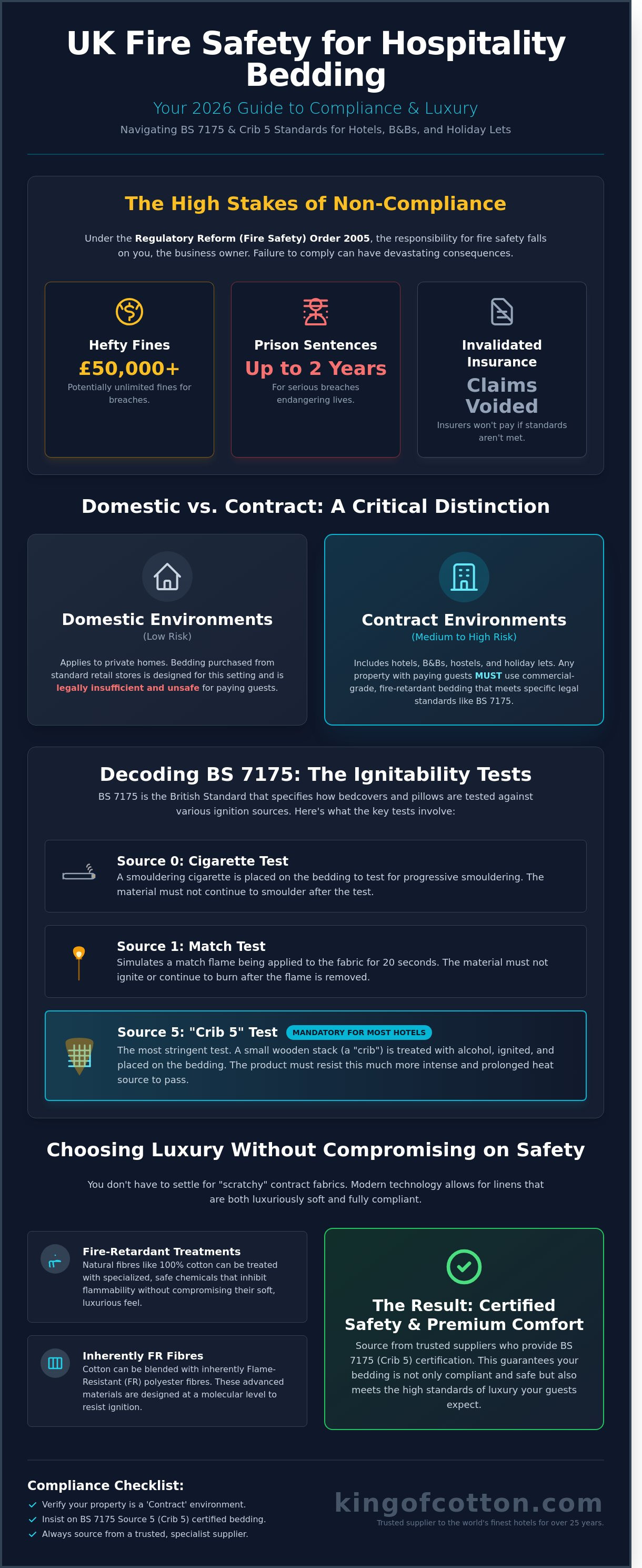
Safety isn't optional for professional hoteliers or property managers. Since the introduction of the Regulatory Reform (Fire Safety) Order 2005, the UK has operated under a strict framework designed to protect guests from the devastating impact of fire in shared spaces. This legislation shifted the responsibility of fire safety from the fire brigade to the "Responsible Person," typically the business owner. This individual holds a legal duty of care to ensure every item, including pillows and duvets, meets specific safety benchmarks. Understanding the fire retardant bedding regulations uk is a matter of legal survival for your business.
Failure to comply with these rules carries heavy penalties. In 2023, the Home Office reported that fire services attended over 11,000 fires in non-residential buildings across the UK. If an investigation finds that non-compliant bedding contributed to the spread of a fire, the consequences are severe. Business owners face unlimited fines and potential prison sentences of up to 2 years. Perhaps most critically for your bottom line, insurance providers will almost certainly invalidate any claims if the property doesn't meet the required fire safety standards.
The Legal Framework for Hospitality and Public Sectors
The UK government classifies environments based on their specific risk levels. While a private house is a "low-risk" domestic setting, hotels, hostels, and holiday lets are "medium-to-high-risk" contract environments. The primary legislation governing these spaces is the Furniture and Furnishings (Fire Safety) Regulations 1988. These laws dictate that all furniture and furnishings supplied in a business context must pass rigorous ignitability tests. When you source bed linen or fillings for a commercial property, you're entering a regulated "Contract" environment where domestic-grade products are legally insufficient.
Domestic vs. Commercial Standards: A Crucial Distinction
Standard retail bedding usually fails commercial fire audits because it's only tested for domestic use. The fire retardant bedding regulations uk require contract-grade items to meet BS 7175 standards. This British Standard tests the ignitability of bedcovers and pillows using various heat sources, such as smouldering cigarettes or butane flames. Most high-street duvets don't have the chemical treatment or inherent fibre properties to resist these sources. If you run a B&B or an Airbnb, you cross into contract territory the moment you accept paying guests. You can't rely on standard consumer products; you must invest in specialized "Source 5" or "Crib 5" rated items for your bedroom setups to ensure total compliance and guest protection.
Decoding BS 7175 and Contract Bedding Standards
The British Standards Institution (BSI) has served as the UK's national standards body since its founding in 1901. It creates the technical specifications that define safety for the textile industry. For anyone managing a commercial property, BS 7175 is the most critical document to understand. This standard details the "Methods of test for the ignitability of bedcovers and pillows by smouldering and flaming ignition sources." Following these fire retardant bedding regulations uk isn't just a recommendation; it's a legal necessity for professional landlords and hoteliers.
Safety begins with the "Match and Cigarette" tests. These benchmarks ensure that a stray ember or a small flame won't turn a duvet into a fire hazard within seconds. While 100% cotton is the gold standard for luxury, it's naturally flammable. Manufacturers solve this by treating fibres with fire-retardant chemicals or blending them with inherently flame-resistant (FR) polyesters. These treatments ensure that even the most elegant bed linen meets the rigorous safety demands of the modern hospitality sector.
Ignition Sources: From Cigarettes to Crib 5
Testing involves specific "Sources" that simulate real-world hazards. Source 0 uses a smouldering cigarette to check for progressive smouldering. Source 1 mimics a match flame, testing if the fabric ignites or continues to burn after the 20-second flame application. For higher-risk environments, Source 5, or "Crib 5," uses a small wooden stack (a crib) soaked in isopropyl alcohol to test for more intense heat resistance. Crib 5 is the mandatory standard for most UK hotels to ensure guest safety in multi-occupancy buildings.
BS 5815: Public Sector and Institutional Requirements
While hotels focus on BS 7175, the public sector adheres to BS 5815. This standard applies to hospitals, prisons, and nursing homes where bedding undergoes intense industrial laundering. Fabrics must withstand 71°C thermal disinfection cycles without losing their fire-retardant properties or structural integrity. Unlike standard hospitality items, BS 5815-compliant linens are built for extreme durability and repeated high-heat processing. These institutional fire retardant bedding regulations uk ensure that safety remains constant even after 100+ industrial wash cycles. This differs from standard hospitality requirements, where the aesthetic finish and "hand-feel" of the fabric are often given equal weight to its durability.
Compliance Requirements for Different Establishments
Understanding your specific risk category is the first step toward meeting fire retardant bedding regulations uk. The Regulatory Reform (Fire Safety) Order 2005 dictates that the "Responsible Person" for any business must assess risk based on occupancy and building design. A ground-floor holiday cottage presents a different profile than a 15-storey city hotel. Buildings exceeding 11 metres in height now face rigorous oversight under the Building Safety Act 2022, which often influences the choice of interior textiles to minimize potential fire load.
Insurance providers frequently set the bar higher than the baseline legal requirement. While the law might permit lower standards in specific domestic-style lets, a significant majority of commercial insurers demand BS 7175 Source 5 (Crib 5) compliance to maintain valid coverage. Falling short of these private mandates can result in voided claims, even if you've technically met the minimum statutory requirements. This is particularly true for multi-storey hotels where evacuation times are longer. A fire on the 10th floor is a vastly different emergency than one in a ground-floor studio.
Hotels, B&Bs, and Holiday Lets
Most hospitality sites fall into the "Medium Hazard" category. This classification requires mattresses and bed bases to meet Crib 5 standards. Guests expect a premium feel, so the challenge lies in sourcing luxury bed linen that feels indulgent while adhering to safety protocols. High-end establishments often opt for naturally fire-retardant materials or treated cotton percales that maintain a 300-thread count feel. It's about blending the five-star experience with the necessary fire retardant bedding regulations uk to ensure guest safety without sacrificing comfort.
Care Homes and High-Risk Environments
Residential care facilities are classified as "High Hazard" because residents may have limited mobility or cognitive impairments. In these settings, bedding must often meet BS 7175 Source 5 as a minimum, and sometimes Source 7 for extreme risk areas. You'll need specialized combinations, such as waterproof, vapour-permeable covers that are also flame retardant. Pillows and duvets must be polyester-filled and encased in high-performance FR fabrics. These materials ensure they don't contribute to flame spread, providing vital extra minutes for staff to assist with evacuations.
How to Ensure Your Bedding is Compliant
Achieving full compliance requires more than a cursory glance at a product description. By January 2026, the updated fire retardant bedding regulations uk demand a verifiable audit trail for every item in a commercial setting. You should start by partnering with established hotel linen suppliers who provide full transparency regarding their manufacturing processes. Professional procurement involves more than just buying; it's about verifying that every batch meets the specific BS 7175 standards required for your building type.
Don't rely on "self-treating" fabrics with fire-retardant sprays. These topical applications often fail the "Source 5" (Crib 5) test after fewer than five washes. They also lack the uniform coverage required for professional certification, leaving dangerous "hot spots" in the fabric. Maintaining a dedicated fire safety log is now a vital requirement for 95% of UK hospitality insurers. This log must record the date of purchase, the specific batch number, and the scheduled replacement date for all linens. It functions as your primary defense during a local fire authority inspection.
Reading Labels and Certification Documents
Every compliant item must feature a permanent care label citing specific British Standards, such as BS 7175 or BS 5815 Part 3. If a label simply says "fire resistant" without a standard number, it's likely non-compliant. Always request a "Certificate of Conformity" from your supplier. A valid certificate will include a UKAS-accredited laboratory's stamp, the test date, and a clear pass result for the relevant ignition sources. Vague claims or photocopied certificates from unnamed sources are common red flags that can lead to failed audits.
Maintaining Fire Retardancy Through Washing
Inherently flame-retardant (IFR) fabrics have safety built into the fiber level. These differ from treated fabrics where the chemical coating can leach out over time. You must avoid fabric softeners; they leave a fatty acid residue that acts as a fuel source, potentially voiding your safety certification. Stick to professional detergents and ensure rinse cycles are thorough to remove all chemical traces. Commercial laundries should provide a wash process validation to confirm they aren't compromising the fabric's integrity during high-temperature cycles.
Ensure your property meets the highest safety standards by browsing our certified contract bed linen collection today.
Choosing Luxury Without Compromising on Safety
Many hospitality managers believe that adhering to fire retardant bedding regulations uk means sacrificing the tactile softness guests love. This is a common misconception that often leads to unnecessary compromises in guest satisfaction. Modern textile engineering allows us to treat 100% cotton fabrics so they meet BS 7175 Source 5 standards without losing their signature crisp, airy feel. We focus on high-thread-count weaves, specifically our 300 and 400 thread count options, to ensure the fabric remains breathable and smooth against the skin.
Safety shouldn't feel industrial or coarse. When you choose premium materials, the flame-retardant properties are integrated so seamlessly that guests won't distinguish them from standard luxury linens found in residential settings. It's how we help establishments maintain a five-star rating while staying fully compliant with 2026 safety benchmarks. Achieving that iconic hotel feel requires a balance of weight, weave, and finish that we've perfected over 25 years of manufacturing.
- 300-thread-count sateen provides a silky touch with inherent safety.
- Percale weaves offer a matte, cool-to-the-touch experience for warmer rooms.
- Specialised treatments ensure the fabric remains soft after 50 or more industrial wash cycles.
King of Cotton’s Contract Grade Collections
Our contract collections are designed for the rigours of professional use. These BS 7175 compliant ranges are built to withstand high-temperature industrial washes without losing their protective qualities or their aesthetic appeal. We've spent decades as suppliers to the world's most prestigious hotels, ensuring our luxurious bathroom and bedroom collections meet the highest safety standards. Every item in our contract range is a result of rigorous testing and a deep understanding of the hospitality environment.
Expert Consultation for Your Establishment
Upgrading your bedroom linen is a significant investment that requires technical precision. We don't just sell products; we provide a full consultation to ensure your choices align with your specific fire risk assessments. Whether you're a boutique 12-room guest house or a 400-key city hotel, our team offers bespoke solutions. You can request a tailored quote that accounts for your specific laundry cycles and durability needs. Contact King of Cotton today to benefit from our 25 years of industry leadership and secure your establishment's safety for the future.
Future-Proof Your Hospitality Business for 2026
Navigating the fire retardant bedding regulations uk is a critical step for every hotelier and property manager heading into 2026. You'll need to confirm that every item of bed linen meets the BS 7175 Source 5 or Source 7 standards to remain legally compliant and fully insured. These requirements aren't just about ticking boxes; they're about safeguarding your guests while maintaining the high standards of a premium establishment. You don't have to sacrifice the tactile luxury of fine Egyptian cotton to meet these rigorous safety benchmarks.
King of Cotton brings over 25 years of experience as a trusted supplier to 5-star hotels worldwide. We provide full BS 7175 certification on all our contract ranges, ensuring your business stays ahead of the latest UK legislation. Our UK-based support team is ready to help you select linens that offer both ultimate softness and complete fire safety. It's time to invest in quality that protects your reputation and your guests alike. Explore our range of contract-grade luxury bedding and transform your rooms into a safe, elegant haven that guests will love.
Frequently Asked Questions
Is fire retardant bedding a legal requirement for UK Airbnbs?
Yes, fire retardant bedding is a legal requirement for UK Airbnbs under the Regulatory Reform (Fire Safety) Order 2005. Since October 1, 2023, updated government guidance for "small paying-guest accommodation" explicitly requires hosts to ensure all upholstered furniture and bedding meet strict safety standards. You must complete a written Fire Risk Assessment to prove your linens don't pose an undue risk to guests.
What is the difference between BS 7175 and BS 5815?
BS 7175 is the test method used to measure how easily bedding ignites when exposed to different heat sources like smouldering cigarettes or wooden cribs. In contrast, BS 5815 defines the actual manufacturing specifications for the fabrics, such as their durability and construction. For total compliance, your linens should be tested to BS 7175 standards while meeting the fabric quality requirements of BS 5815-3.
Does washing fire retardant bedding make it less safe?
Washing only reduces safety if the fabric is chemically treated rather than inherently flame retardant. Inherent fabrics like 100% polyester retain their properties for their entire lifespan, while treated cotton usually loses its efficacy after 50 industrial washes at 75°C. It's vital to track wash cycles for treated items to ensure they still meet fire retardant bedding regulations uk for guest safety.
Can I use domestic duvets in a guest house if the covers are fire retardant?
No, you shouldn't use domestic duvets in a professional guest house because the inner filling remains highly flammable. A fire retardant cover won't stop the internal synthetic filling from melting or igniting if a heat source penetrates the outer layer. To satisfy insurance providers and fire inspectors, both the duvet and the cover must be certified to at least Ignition Source 5 standards.
What does "Crib 5 compliant" actually mean for bed sheets?
Crib 5 refers to Ignition Source 5, which is a test involving a 17 gram wooden structure that's set on fire to see if the fabric self-extinguishes. For a sheet to be Crib 5 compliant, it must stop burning within 10 minutes and the resulting char must not reach the edges of the sample. This level of protection is 4 times more rigorous than the standard cigarette test used for domestic bedding.
Are there specific fire regulations for pillows and mattress protectors?
Yes, pillows and mattress protectors must comply with BS 7175 Source 2 for low-risk environments or Source 5 for higher-risk settings like hotels. Home Office data shows that 12% of dwelling fires start with bedding, so these items are scrutinized during safety audits. You'll need to ensure every component of the bed assembly, including the protector, carries a permanent label confirming it meets these British Standards.
How often should I replace fire retardant linens to remain compliant?
You should replace your fire retardant linens every 2 to 3 years or once they reach 50 professional wash cycles. Over time, the chemical treatments can degrade and the physical fibers can thin, which reduces the fabric's ability to resist flames. Check your labels every 6 months; if the "FR" mark is faded or the fabric shows signs of fraying, it's time to invest in new stock.
Where can I find the official BS 7175 certification for my bedding?
The official certification is typically found on a permanent white or blue label stitched into the side seam of the bedding. For your professional records, you should also request a formal Certificate of Conformity from your supplier at the time of purchase. Keeping these 100% digital or paper copies in your Fire Safety Log Book is essential for passing inspections by the local fire authority.