

What Size Fitted Sheet for a 35cm Mattress? Find the Right Fit
A fitted sheet can match your bed across the surface and still spring off at the corners if its pocket isn’t deep enough. If you’re wondering what size fitted sheet for 35cm mattress, separate mattress depth from bed size: 35cm describes how thick the mattress is, while its width and length determine whether you need a single, double, king or another size.
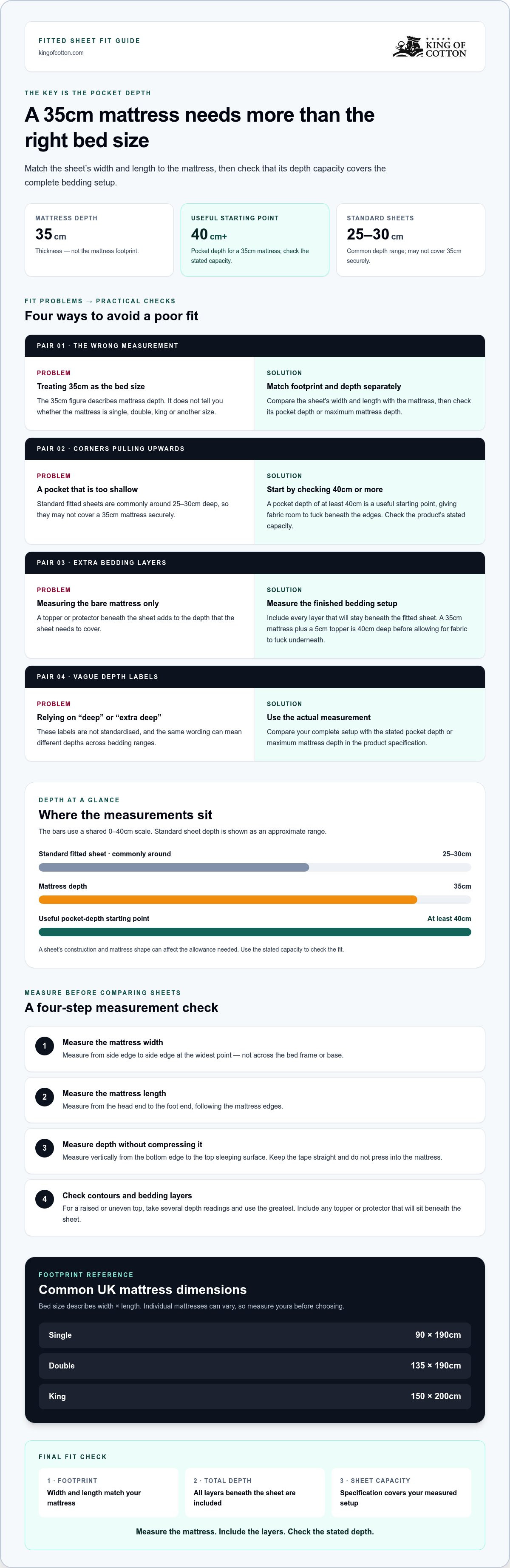
For a mattress that’s 35cm deep, a fitted sheet with a pocket depth of at least 40cm is a useful starting point. The right fit depends on your full bedding setup, though. Measure from the mattress’s bottom edge to its top, including any topper or protector that will sit beneath the sheet, then compare that total with the sheet’s stated capacity. Terms such as “deep” and “extra deep” aren’t standardised, so the actual measurement matters more than the label.
This guide explains how to identify your mattress size, measure its full depth and choose a pocket that provides secure corner coverage. With those details to hand, you can compare options in King of Cotton’s bed-linen range and choose a sheet that gives your bed a smoother, more settled finish.
Key Takeaways
- For what size fitted sheet for 35cm mattress, match the sheet’s length and width to the mattress, then check its depth capacity.
- Measure the mattress itself, not the bed frame or divan base, and note its width, length and depth.
- Include a mattress topper and any other layers beneath the sheet when calculating the total depth to cover.
- Compare the stated pocket depth or maximum mattress depth with your measurements; labels such as “deep” can vary.
- Use the mattress footprint and total depth as a checklist to help avoid corners pulling upwards or exposed mattress edges.
What size fitted sheet fits a 35cm mattress?
Choose a fitted sheet that matches the mattress’s width and length, then check that its stated depth capacity covers the mattress from its base to its highest point. The 35cm measurement refers to thickness, not whether the bed is a single, double or king. In short: fitted-sheet size depends on the mattress footprint, its depth and any added layers.
For a mattress that measures 35cm deep, a sheet with a pocket depth of at least 40cm is a practical starting point. The extra depth gives fabric room to tuck beneath the edges, although the required allowance can vary with the sheet’s construction and the mattress shape. If the product specification states a maximum mattress depth, use that figure to check whether it accommodates your measured setup.
Does a 35cm mattress need a deep fitted sheet?
Does the bed size change the fitted-sheet dimensions?
Yes. Bed size describes the mattress’s width and length, whilst 35cm describes its depth. A UK single mattress is commonly 90 × 190cm, a double 135 × 190cm, and a king 150 × 200cm, though individual mattresses can vary. See this UK bed-size dimensions guide for standard footprints, then use your own mattress measurements to make the final match.
Don’t select a sheet by a single or double label alone if your mattress differs from the usual dimensions. A sheet that’s too narrow or short may not sit correctly, even if its depth is suitable. Mattress construction and sizing can differ by type; this overview of mattress types and dimensions offers useful background, but measure your own mattress before choosing.
- Match the footprint: compare the sheet’s stated width and length with the mattress.
- Check the full depth: include a topper or other layer beneath the sheet.
- Compare measurements: use the sheet’s stated capacity, not just “deep” or “extra deep”.
Getting both parts right helps the sheet sit smoothly across the mattress and keeps its corners in place. Keep the width, length and depth together when comparing bed linen, so you can check each option against the same measurements.
How to measure a 35cm mattress for a fitted sheet
Take measurements from the mattress, not the bed frame, divan base or slatted platform. A frame can be wider or longer than the mattress, and measuring it may lead you to choose a sheet that won’t sit smoothly. Use a flexible tape measure and record each result in centimetres so you can compare like with like against sheet specifications.
Measure mattress width, length and depth accurately
Measure width and length from edge to edge across the mattress. For depth, measure vertically from the bottom edge to the top of the sleeping surface. Keep the tape straight and avoid pressing into the mattress. For a pillow-top or uneven surface, take a few depth readings and use the greatest measurement, so the sheet can cover the highest point.
- Record the width. Measure across the mattress at its widest point, from one side edge to the other.
- Record the length. Measure from the head end to the foot end, following the mattress edges.
- Record the depth. Measure vertically from the base edge to the top sleeping surface, without compressing the padding.
- Check unusual contours. If the edges are rounded or the top is raised, repeat the depth measurement at several points and note the largest result.
Measurement rule: measure width and length across the mattress edge to edge, then measure depth vertically from its bottom edge to the highest sleeping surface.
Include mattress toppers and other layers
If a topper will stay on the bed, the fitted sheet must cover the mattress and topper together. Measure the topper’s thickness separately, then check the total depth of the assembled bed. Measuring the finished setup directly is also useful, particularly if the topper shifts or compresses when in place. Include a protector in your assessment if it sits beneath the fitted sheet, as it adds to the depth the sheet needs to cover.
For example, if the mattress measures 35cm and a topper adds 5cm, the sheet needs to accommodate a combined depth of 40cm before allowing for fabric to tuck beneath the mattress. Don’t assume a sheet suitable for the bare mattress will still fit once extra layers are added. If you remove the topper before making the bed, measure the mattress without it instead.
These measurements give you a clear basis for answering what size fitted sheet for 35cm mattress: match the width and length to the mattress, then compare the sheet’s stated depth capacity with your complete bedding setup. Keep the figures together when comparing options in the bed linen collection, so you can choose with the fit and finish of your bed in mind.
Fitted-sheet depth labels compared for a 35cm mattress
“Standard”, “deep” and “extra deep” can help you narrow down fitted sheets, but they don’t describe a universal set of measurements. Retailers may use the same label for sheets with different depths, so check the figure in the product specification rather than relying on the wording alone.
Standard, deep and extra-deep: what do the labels mean?
Use these terms as general descriptions, not guarantees. A standard fitted sheet is often around 25-30cm deep, whilst a deep sheet is commonly around 40cm. “Extra deep” has no single agreed measurement. For a 35cm mattress, a standard option may fall short; look for the stated mattress capacity and make sure it covers your measured setup.
| Label | Typical depth information | What to check for a 35cm mattress |
|---|---|---|
| Standard | Often around 25-30cm deep | Check carefully: this may not accommodate a 35cm mattress. |
| Deep | Often around 40cm deep | Confirm the stated depth or compatible mattress capacity. |
| Extra deep | No consistent measurement across retailers | Use the stated specification, not the label alone. |
These figures are general descriptions, not a promise that every sheet carrying a particular label will have that depth. To answer what size fitted sheet for 35cm mattress, separate the mattress footprint from its depth: width and length determine the bed-size fit, whilst the depth specification determines whether the sheet can cover the mattress securely.
How to compare fitted-sheet specifications
Look for whether the listing gives the sheet’s pocket depth or the maximum mattress depth it can accommodate. They aren’t interchangeable: pocket depth describes the fabric at the corner, whilst maximum mattress depth states the mattress thickness the sheet is designed to fit. If the listing gives only pocket depth, compare it with the full measured height of your bed setup and make sure there is enough fabric to tuck beneath the mattress.
Include any topper that will remain beneath the sheet. A specification that covers the bare mattress may not provide enough tuck once a topper is added. If the product page gives a maximum mattress depth, compare that figure with the combined height of mattress and topper. If it gives pocket depth, check that measurement against your setup and consider how much fabric will need to sit beneath the edges.
For a considered bedding choice, compare depth alongside fabric and finish. King of Cotton’s bed linen range offers options to explore while you keep your measurements in mind. The key is simple: trust the stated capacity, and treat depth labels as descriptions rather than specifications.
How to check whether a fitted sheet will stay on
A sheet that fits well should cover the mattress edges without putting excessive strain on its corners. Before buying, compare the mattress footprint and the complete depth of your bed with the sheet’s stated size and capacity. A mismatch in any of these can affect how securely the fabric sits, even if the sheet is described as “deep”.
Use this quick checklist before choosing:
- Footprint: check that the sheet’s width and length correspond to your mattress measurements.
- Combined depth: account for any topper or protector that will sit beneath the fitted sheet.
- Stated capacity: compare your total depth with the sheet’s listed pocket depth or maximum mattress depth.
- Corner coverage: look for enough fabric to tuck under the mattress edges without stretching the elastic to its limit.
Signs the fitted sheet is too shallow
If a corner lifts shortly after you make the bed, or the elastic repeatedly slips off, the sheet may not have enough depth to grip beneath the mattress. Exposed sides are another clue: the fabric may be pulled upwards instead of reaching below the mattress edge. Before replacing it, recheck the mattress footprint and the combined depth with your usual layers in place. Incorrect width or length can also create tension at the corners.
Corner construction and elastic can vary between sheets, so the fit may not look identical across different designs. However, persistent lifting is a reason to revisit your measurements and compare them with the stated sheet capacity. Avoid forcing a corner into place if doing so leaves the fabric taut across the mattress.
What to check after fitting the sheet
Fit the sheet over the mattress in the usual order, then inspect each corner. The elastic or corner seam should sit beneath the mattress edge, rather than riding up its side. Check the sleeping surface too: pronounced pulling across the middle suggests too much tension, whilst large, loose folds may indicate excess fabric or a footprint mismatch.
Make the bed with the topper and protector you normally use. A sheet can appear secure on the bare mattress but shift once additional layers change the overall depth or surface. After getting into bed and moving naturally, check whether a corner has come loose. If it has, note which corner lifts and whether the fabric is stretched tightly there. That can help distinguish an overall sizing issue from a corner that has simply been displaced during use.
For a smooth, settled finish, prioritise accurate measurements and a secure fit over the label alone. Once you know what works for your bed, explore King of Cotton bed linen and compare options with your measurements to hand.
Choose fitted sheets for a 35cm mattress with confidence
Choose the right fitted sheet by matching three things: the mattress footprint, the total depth of the bed as you use it, and the sheet’s stated capacity. Keeping these measurements together makes product specifications easier to compare and avoids relying on a bed-size name or a broad label such as “deep”. It also helps you choose a sheet that sits smoothly and comfortably on the bed.
A quick 35cm mattress fitted-sheet checklist
Before comparing sheets, write down the mattress width, length and depth. Add the topper’s thickness if it stays on the bed, and include any protector beneath the fitted sheet when checking the overall setup. Then compare those figures with the sheet’s stated dimensions and pocket depth or maximum mattress capacity. Keep the note to hand while browsing, so each option is judged against the same measurements.
- Footprint: record mattress width and length edge to edge.
- Finished depth: account for the mattress and any layers that remain beneath the sheet.
- Sheet specification: match its dimensions to the footprint and check its stated depth capacity.
- Label: use “standard”, “deep” or “extra deep” as a description, not as a measurement.
This simple record is useful if you compare several sheets at different times. Keep units consistent, preferably centimetres, and note whether your depth figure is for the bare mattress or the complete setup. That distinction helps prevent accidentally comparing a sheet’s maximum mattress depth with a measurement that excludes the topper.
When custom sizing may be worth considering
An unusual width or length can make standard single, double or king labels less useful. Start by measuring the mattress and comparing its footprint with the UK bed-size guide. If the dimensions don’t align with a familiar size, use the actual measurements as your reference rather than choosing by label. A correct footprint and depth are central to a smooth, secure fit.
Once you’ve identified the appropriate bed size, check the depth specification separately. A sheet may match the width and length but still be too shallow for a 35cm mattress, particularly when a topper is included. Conversely, choosing more depth won’t correct a mismatch in the mattress footprint. Treat each measurement as its own part of the decision.
With the dimensions recorded, you can compare bed linen with greater confidence and choose a finish that suits your bedroom. Explore King of Cotton’s bed linen range with your mattress footprint and finished depth in mind.
Make your next bedding choice with confidence
A well-fitted sheet is a small detail that can bring a more polished, restful feel to the whole bedroom. With your measurements to hand, you can compare options with care and choose bed linen that suits the way your bed is dressed. That thoughtful approach makes it easier to answer what size fitted sheet for 35cm mattress without relying on a label alone.
King of Cotton supplies premium cotton bed linen to homes and hospitality businesses. Compare bedding options with the same attention to fit and finish, and choose a sheet that suits your mattress and the layers you use.
Explore King of Cotton bed linen and choose a fitted sheet with your mattress measurements in mind.
Frequently Asked Questions
What depth fitted sheet do I need for a 35cm mattress?
For a bare 35cm mattress, look for a fitted sheet with at least 40cm pocket depth as a starting point. Mattress depth is its thickness; pocket depth describes the sheet fabric at the corner. If a topper stays on the bed, include its thickness too, then compare the combined height with the sheet’s stated maximum mattress depth. That specification is the clearest guide to whether it can accommodate your setup.
Is a 35cm mattress considered extra deep?
There’s no universal classification that makes a 35cm mattress “extra deep”. Retailers use terms such as “deep” and “extra deep” differently, so the same mattress might be described differently across product ranges. Treat the label as a broad category, not a fit measurement. Check the actual pocket depth or maximum mattress depth in the specification, and compare it with the bed as you use it.
Will a standard fitted sheet fit a 35cm mattress?
It may not. Standard fitted sheets are often around 25-30cm deep, which can leave too little fabric to tuck beneath a 35cm mattress. The deciding detail is the sheet’s stated compatible mattress depth, not its “standard” label alone. For example, if the specification lists a maximum depth below your mattress’s measured height, the sheet is unlikely to cover it securely, even if its width and length match.
How do I measure a mattress for a fitted sheet?
Use a tape measure on the mattress itself, not the bed frame. Measure width and length from edge to edge, then measure depth vertically from the bottom edge to the top sleeping surface without compressing the padding. If the top is uneven or has a raised pillow-top, take depth readings in several places and record the greatest. Note all measurements in centimetres for easy comparison with sheet specifications.
Can I use a fitted sheet with a mattress topper?
Yes, provided the sheet can accommodate the mattress and topper together. Measure the topper’s thickness and add it to the mattress depth, or measure the assembled bed from its base edge to the top of the topper. Then compare that finished height with the sheet’s stated capacity. If you remove the topper before making the bed, take measurements for that arrangement instead, so the sheet suits your usual setup.
Why does my fitted sheet keep coming off the corners?
Insufficient depth can pull the corners upwards, while an incorrect width or length may create tension that loosens the fit. Check that the sheet is positioned evenly and each corner is tucked beneath the mattress edge. If it still slips, compare the sheet’s capacity with your mattress and any layers beneath it. A corner displaced after movement may simply need refitting; repeated lifting suggests checking the size.
Should fitted-sheet pocket depth include the mattress protector?
Include the protector if it sits beneath the fitted sheet and will normally remain on the bed. Its thickness adds to the depth the sheet must cover, particularly alongside a topper. Measure the finished setup or account for each layer, then read the specification carefully: it may state pocket depth or maximum mattress depth. If the listing explains which layers its capacity covers, use that guidance when comparing measurements.