

How Many Sets of Towels Should You Own? A Practical Guide
The right number of towels depends less on matching sets and more on your laundry routine. If you’re wondering how many sets of towels should you own, start with how many people use them, how often you wash them and how long they take to dry. A familiar guideline is three sets per person: one in use, one in the wash or drying, and one clean and ready.
That’s a useful starting point, not a rule for every household. You might run short before laundry day or have a cupboard full of spares that rarely leave the shelf. And “set” can mean different things: a coordinated group of bath and hand towels, or a bundle that also includes smaller towels.
This guide will help you choose a comfortable everyday quantity, keep enough in rotation while towels are being washed or drying, and set aside a practical reserve for guests or unexpected delays. Consider household size, laundry habits and drying time to plan a useful rotation without overfilling your cupboards.
Key Takeaways
- Work out how many sets of towels should you own by starting with regular users, wash frequency and drying time.
- Separate a retail towel set from the number of individual towels your household needs in its everyday rotation.
- Use a simple calculation to plan for the gap between laundry days, then add only a small, useful reserve.
- Adjust your towel count for household size, washing habits and drying space rather than following one rule for every home.
- Review what’s stored, in use and awaiting laundry to keep your cupboard practical and your towels ready for everyday use.
How many sets of towels should you own? Start with your household routine
Set your towel quantity according to three things: how many people use towels regularly, how often you wash them and how long they take to dry. If you’re asking how many sets of towels should you own, treat the familiar guideline of three sets per person as a starting point, not a household rule. It allows for one set in use, one being washed or dried and one clean and ready. Adjust it to fit your actual routine.
What counts as a set of towels at home?
A retail set usually means coordinated pieces sold together. A household rotation is different: it’s the individual towels available for everyday use. One person might use a bath towel and a hand towel, while another also uses a face cloth. Not every home needs every type, and towels don’t need to match to serve their purpose. For an overview of the history and types of towels, see Wikipedia’s general reference.
Count what you use instead of assuming a packaged set reflects your needs. Bath towels dry you after bathing; hand towels are often shared and may need changing more frequently; face cloths are smaller and can be washed after use. Counting each type separately makes gaps easier to spot. You may have plenty of bath towels but too few hand towels for a busy bathroom.
Why one household may need more towels than another
More regular users mean clean towels are used up more quickly. The time between washes matters too: if laundry happens less often, you’ll need enough clean towels to bridge the longer gap. Drying time adds another variable. A towel that’s still damp cannot comfortably return to the clean rotation, and indoor drying can take longer when space or airflow is limited.
Adaptable starting point: For one regular user, begin with two or three bath towels and two or three hand towels, plus face cloths if they’re part of your routine. This gives you room to rotate towels between use and washing, but it’s not a prescription. If two people share a bathroom, count each person’s bath towel needs separately, then work out how many hand towels the household uses between washes. Add a modest reserve if laundry or drying often runs behind.
To make your own estimate, note each person’s usual towel needs, the number of days between washes and whether towels dry before the next change. If towels are regularly unavailable, increase the number of that type rather than buying another complete matching set. If clean towels remain untouched in the cupboard, reduce the reserve. Comfortable cotton towels can make daily routines more enjoyable, but a practical rotation starts with the number and types your household genuinely uses.
Calculate how many towel sets you need between laundry days
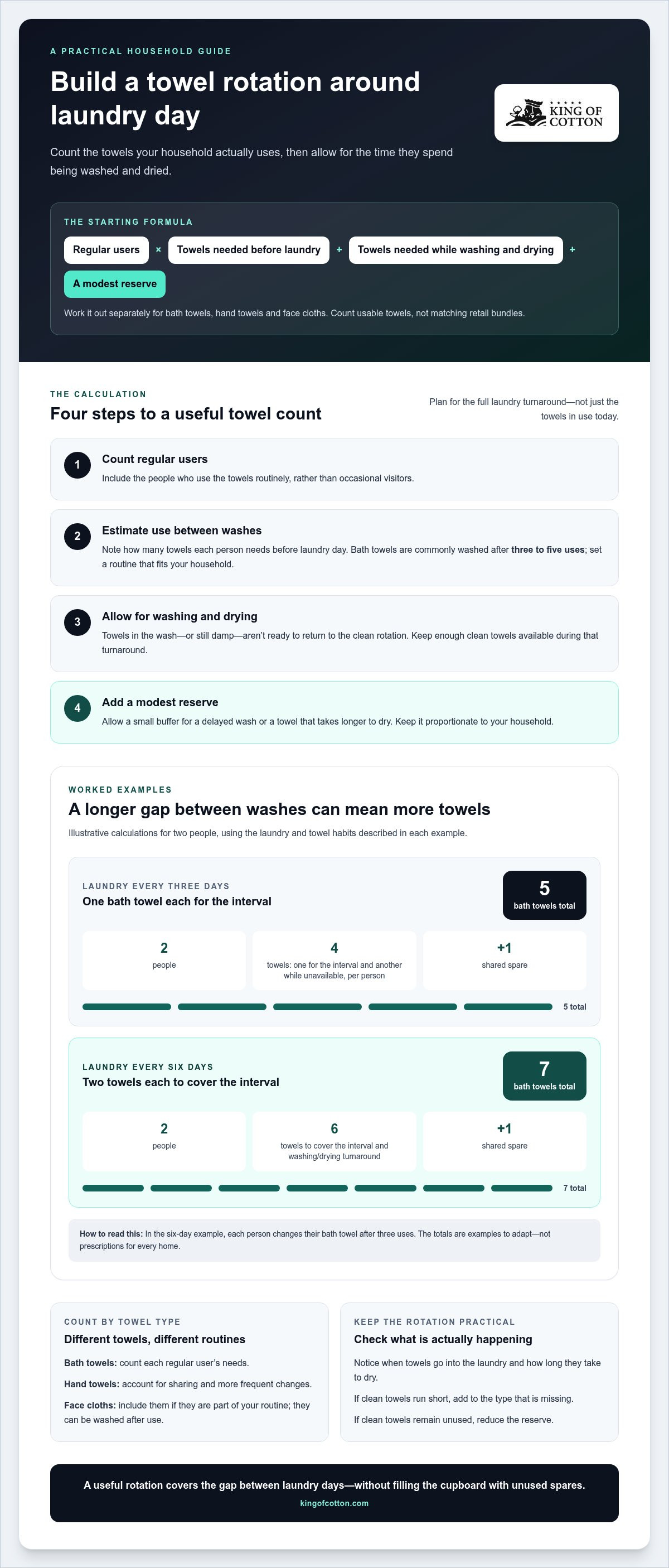
Calculate each towel type separately, because bath towels, hand towels and face cloths may follow different washing routines. A useful starting formula is: regular users × towels needed before laundry + towels needed while washing and drying + a modest reserve. This counts usable towels, not matching retail bundles.
A towel rotation includes towels that are clean and stored, currently in use, or awaiting a wash. The aim is to have enough clean towels to cover the other stages without filling the cupboard with rarely used spares.
A simple four-step towel-count calculation
- Count regular users. Include people who use the towels routinely, rather than occasional visitors.
- Estimate use before washing. Note how many towels each person needs during the interval between washes. Bath towels are commonly washed after three to five uses; see hygienic guidelines for towel use when setting your own routine.
- Allow for laundry and drying. Towels in the wash or still drying aren’t ready to use. Keep enough clean towels available to cover that turnaround time.
- Add a modest reserve. Include a small buffer for a delayed wash or a towel that takes longer to dry. Keep it proportionate to your household.
Example: adjust the calculation to your laundry schedule
Illustrative assumptions: Two people each use one bath towel for three days, towels are washed every three days, and washing plus drying takes one day. Each person needs one towel for the three-day interval and another clean towel while the first is unavailable. That’s four towels, plus one shared spare: five bath towels in total. This is an example to adapt, not a prescription for every home.
If the same household washes every six days, and each person changes their bath towel after three uses, each person needs two towels to cover the interval before washing. They also need another clean towel while those towels are being washed and dried. That makes six towels for the two people, plus one shared spare: seven in total. Washing less often can therefore increase the number required, even if each person’s towel habits stay the same.
Try the calculation for a normal week rather than relying on memory. Note when towels go into the laundry, how long they take to dry and whether anyone has to reach for an unsuitable spare. If clean towels run short, add to the type that’s missing; if several remain unused, reduce the reserve. Once you’ve settled on a useful quantity, choose comfortable cotton towels that suit your rotation.
Which household factors change the number of towels you need?
There isn’t one correct towel count for every home. Two households with the same number of people may have different needs if one washes towels regularly and has room to dry them, while the other does laundry less often or has to wait for indoor drying space. Laundry rhythm, not household size alone, shapes towel needs.
Use the table to identify what might change your estimate. These aren’t fixed quantities: focus on where towels are most likely to run short in your own routine.
| Household routine | Effect on towel supply | Practical adjustment |
|---|---|---|
| Frequent washers | Used towels return to the cupboard sooner, provided they’re dry. | A smaller reserve may be enough; check whether towels are ready before the next change. |
| Larger household | More regular users draw on clean towels at the same time. | Count each person’s everyday needs, then consider shared hand towels separately. |
| Limited drying space | Towels may stay out of use for longer while drying. | Allow for the extra turnaround time, especially during damp or busy periods. |
How washing frequency and drying space affect your towel supply
A household that washes towels frequently can often return clean stock to use sooner than one that leaves a longer gap between washes. But the wash day is only part of the picture: a towel still drying is not ready to return to the cupboard. An outdoor line or heated airer can provide more drying capacity, while a small indoor space may mean several towels take longer to dry fully. Base your count on what actually happens at home, rather than assuming every washed towel is immediately available.
Consider the busiest point in your week. If towels are still drying when the next clean one is needed, increase the supply of that particular type or adjust how you organise laundry and drying. If towels are consistently clean and ready well before they’re needed, you may not need as large a reserve.
Do couples, families and guest rooms need different quantities?
Additional regular users increase everyday demand, but occasional visitors don’t necessarily need a permanent full rotation of their own. Keep guest towels separate from household stock so hosting doesn’t leave the bathroom cupboard unexpectedly short. If you often have overnight guests, a small, ready-to-use reserve may be worthwhile. For occasional visits, a modest number of spare towels may be more practical than storing a large unused stack.
To decide whether guest towels justify extra cupboard space, consider how often guests stay, how many people typically visit and whether their stay overlaps with laundry day. Then choose a reserve that covers those occasions without treating rare visits as everyday demand. This makes it easier to answer how many sets of towels should you own for your household, rather than for an imagined busiest day of the year.
Plan a towel rotation that stays practical, fresh and uncluttered
A clear rotation makes it easier to see whether you have enough towels without keeping every spare within reach. Give your towels three simple places: clean and stored, currently in use, and awaiting laundry. Once used towels are washed and fully dry, return them to the clean section so the next towel is easy to find.
Spread towels out on a rail between uses where possible, rather than bunching them on a hook. Better airflow helps them dry more thoroughly and keeps the rotation moving. You don’t need a complicated system: a shelf for clean towels and a separate laundry basket are often enough to show what’s available at a glance.
Separate everyday towels from occasional spares
Give the towels you reach for most often the easiest cupboard space. Store guest towels elsewhere, or on a separate shelf, so they don’t make your everyday supply look larger than it is. This distinction helps when deciding how many sets of towels should you own: count guest towels as a hosting reserve, not as part of the regular rotation.
Review the cupboard after a household change, a move or a shift in laundry habits. A seasonal check can also reveal towels that have stayed untouched through several rotations. If a towel is rarely chosen, consider whether it still serves a purpose as a guest spare or whether it’s surplus. Avoid replacing towels simply because you’re reviewing them; keep those that remain comfortable and useful.
Use towel quality and storage space to refine your reserve
A smaller, well-planned rotation can work well when the towels you use regularly feel comfortable and suit your routine. Balance easy access with storage space: a tightly packed cupboard can make it harder to find a clean towel, while a generous stack of rarely used spares takes up space without improving daily comfort. The right count leaves room for towels to be stored neatly and returned easily after washing.
Choice matters too. Towel size, feel and absorbency can affect which pieces you reach for and how often you use them. For detailed advice on selecting a towel, use the related luxury bath towel guide. If you’re planning a rotation around your household’s needs, explore the bathroom towel collection for options in different weights.
Keep the care routine straightforward: wash towels at a frequency that suits their use, and make sure they’re dry before folding them away. If the cupboard is still crowded after separating guest and everyday towels, reduce the reserve gradually rather than clearing out useful pieces all at once. Choose towels for a considered everyday rotation that brings practical ease and comfort to your bathroom.
Choose the right towel quantity for your home and enjoy everyday comfort
A comfortable towel supply meets your household’s routine without crowding your cupboard. Count the people who use towels regularly, allow for washing and drying time, then add only the spares you genuinely rely on. The result may be a familiar number of matching sets or a practical collection of individual towels in the sizes your household uses.
There’s no need to get the count perfect for all time. A move, a change in household membership or a different laundry routine can alter how quickly towels are used and returned to the shelf. Treat your number as a useful guide that you can adjust, rather than a fixed target. Comfortable cotton towels can make the daily routine feel more considered, but the best rotation is still the one that suits how your home works.
A final checklist before settling on your towel count
- Count regular users. Include everyone who uses household towels routinely, and consider bath towels and shared hand towels separately.
- Allow for laundry and drying. Think about the usual interval between washes and how long towels remain unavailable while they dry.
- Set aside guest towels separately. Choose a reserve that reflects how often you host and how many guests typically stay.
- Review what’s stored. Notice which towels are used often and which stay untouched. Keep useful spares, but don’t let rarely used pieces dictate your everyday count.
This final check turns a rough estimate into a supply that works in practice. If you regularly run short before laundry is finished, identify which towel type is missing and adjust that part of the rotation. If clean towels remain unused, reduce the reserve gradually. The aim isn’t to own as little as possible; it’s to keep enough ready for daily comfort without storing more than your household needs.
When to reconsider your household towel supply
Revisit your count after a household change, a move or a change in how often you do laundry. New drying arrangements matter too: a heated airer or more room to dry towels may make them available sooner, while limited space can keep them out of use for longer. A quick review after one of these changes is usually more useful than constantly reorganising the cupboard.
Replace towels gradually according to how they feel and perform in everyday use, rather than buying a large reserve for future needs. If you’re still asking how many sets of towels should you own, return to the essentials: regular users, laundry timing, drying space and a modest reserve for real-life interruptions. For towels to complete your rotation, explore the bathroom towel collection.
Make your towel routine work beautifully
Your towel cupboard doesn’t need to follow a perfect formula. It needs to support the way you live, with enough clean, comfortable towels ready for everyday use and no unnecessary pile of spares. If your needs change, your towel count can change too. A small adjustment is often all it takes to restore a smooth routine.
Once you’ve settled on the quantity that suits your home, consider what will make each towel a pleasure to reach for. King of Cotton supplies bathroom textiles to individual customers and hospitality businesses, with towels categorised by weight to help you find an option suited to your preferences and daily use.
Choose with care, and your rotation can feel both practical and quietly indulgent. Explore towels for a more comfortable everyday routine, and enjoy creating a bathroom that feels welcoming, organised and entirely your own.
Frequently Asked Questions
How many towels should one person have?
A useful starting point is three usable sets per person, allowing one set to be in use, one being washed or dried and one clean. For a solo household, a practical minimum is two or three bath towels, two or three hand towels and two face towels, if you use face cloths. Your own count may be lower or higher depending on how often you wash and which towel types you actually use.
How many bath towels should a family of four own?
For a family of four, eight to twelve bath towels can provide a comfortable range for everyday use. The lower end may suit a household that washes regularly and has space for towels to dry; the higher end allows more room between washes. Count towels used by household members first, then consider separately whether visitors or slow drying mean you need a few additional spares.
Should each person have their own towel?
Ideally, each person should use their own bath towel rather than sharing one. Separate towels make it easier to keep track of whose is whose and avoid passing a personal item between people. A simple way to manage this is to give each household member a distinctive colour or a labelled hook. Shared hand towels are different, as they’re intended for common use and need frequent changing.
How many spare towels should you keep for guests?
Keep enough for the number of guests who usually stay at once, rather than stocking for an unlikely crowd. For example, if you typically host one or two overnight visitors, set aside that number of bath towels, with hand towels available for the bathroom. Store these separately from everyday towels so you can see what’s reserved for guests and avoid buying extra pieces that rarely leave the cupboard.
Do hand towels count as a set of towels?
They can be included in a coordinated retail set, but a hand towel isn’t a substitute for a bath towel in your personal rotation. Count each type separately according to its use. A shared hand towel may be used by several people throughout the day, so you might need more clean hand towels than the number of people in the home. Change them every one to two days as a practical hygiene measure.
How often should you replace your towels?
Towels generally need replacing every two to three years, but their condition matters more than the calendar. Consider replacing one sooner if it feels persistently rough, no longer absorbs well or keeps a musty smell after washing. You don’t have to replace the whole cupboard at once. Assess towels individually, keeping comfortable, effective ones in rotation and replacing only those that have stopped serving you well. Any worn pieces can easily be repurposed for household chores, while specialised cleaning and drying cloths from streakfreexl.com can help ensure your everyday bath linens remain reserved for personal use.