

How to Spot Fake Egyptian Cotton: An Expert Guide to Authentic Luxury in 2026
Recent forensic testing by the Cotton Egypt Association revealed that approximately 89% of textiles sold globally as "Egyptian Cotton" are actually deceptive blends or outright fakes. You've likely experienced the sting of this industry-wide issue; perhaps you've spent £120 on a sheet set that pilled within four washes or felt scratchy despite a high price tag. It's frustrating when luxury promises turn into low-quality disappointments that fail to provide the restorative sleep you deserve.
We're here to change that by showing you exactly how to spot fake egyptian cotton using the same rigorous standards we've applied for over 25 years as suppliers to the UK's most prestigious hotels. You'll learn to look past the marketing fluff of inflated thread counts and identify the specific DNA-verified certifications that guarantee authenticity. This guide breaks down the forensic details of staple length and the "Gold Seal" logos that distinguish a true investment from a clever imitation; ensuring your next purchase delivers the lasting elegance and comfort you expect.
Key Takeaways
- Understand why Extra-Long Staple (ELS) fibers are the essential foundation of genuine luxury and how they provide superior durability compared to short-staple imitations.
- Discover how to spot fake egyptian cotton by identifying the "Thread Count Trap" and understanding the realistic price points for authentic £-value linens in the UK market.
- Master expert forensic tests, such as the "Tactile Test" and "Sheen Check," to verify the natural luster and signature cooling properties of your bedding at home.
- Learn to navigate the 2026 luxury landscape by uncovering the industry secrets behind mislabeling and why a "100% Egyptian" label can often be deceptive.
- Realise the long-term ROI of investing in provenance, ensuring your bed linens offer decades of breathable, chemical-free comfort and five-star hotel excellence.
The Prestige and Pitfalls of the Egyptian Cotton Market
Egyptian cotton remains the undisputed gold standard for global luxury hospitality in 2026. High-end hotels from London to Dubai prioritise these linens because they offer a level of breathability and durability that synthetic alternatives can't match. However, the prestige of the "Made in Egypt" label has created a lucrative opening for counterfeiters. Industry data from the Cotton Egypt Association (CEA) has previously indicated that a staggering 90% of products labelled as "Egyptian Cotton" were actually blends or entirely different species. This reality makes it vital for consumers to understand how to spot fake egyptian cotton before investing in their home sanctuary.
At King of Cotton, we've spent 25 years sourcing the finest materials for world-class hotels and private residences. We've seen the market shift from a craft-based industry to one plagued by "DNA-washing," where inferior short-staple cotton is chemically treated to mimic the feel of the real thing. Genuine Egyptian cotton is rare, accounting for less than 1% of the world's annual cotton production. This scarcity is driven by both environmental constraints and the labour-intensive nature of its cultivation. When you're buying authentic sheets, you aren't just paying for a brand name; you're paying for a specific botanical heritage that's increasingly difficult to protect.
The 'Nile Delta' Difference
The Nile River Valley provides a unique microclimate with constant temperatures and nutrient-rich soil that's impossible to replicate in other regions. These specific conditions allow for the growth of extra-long-staple (ELS) cotton. Unlike machine-harvested varieties used in mass production, authentic Egyptian cotton is traditionally hand-picked. This process prevents the long-staple cotton fibers from being stressed or broken by heavy machinery. It's this length that allows the cotton to be spun into much finer, stronger yarns. If you see a label claiming "Egyptian-style" cotton, it's the first red flag to watch for. It usually means the seeds were grown in unsuitable climates, resulting in a coarse, brittle fabric that pilled after three washes.
Understanding the Global Supply Chain Crisis
Current trade regulations often allow manufacturers to legally, yet deceptively, sell "blended" cotton under the Egyptian name. This happens when a small percentage of genuine fiber is mixed with cheaper upland cotton. To combat this, the CEA introduced rigorous DNA testing and modern labelling laws to verify provenance. We don't rely on third-party brokers who might dilute the quality of the harvest. Instead, King of Cotton prioritises direct provenance for our luxury bed linen to ensure every thread meets the five-star standards our clients expect. When researching how to spot fake egyptian cotton, remember that price is a major indicator. If a "100% Egyptian" king-size set is priced under £50, the economics of the global supply chain suggest it's almost certainly a counterfeit or a low-grade blend.
The Anatomy of Authenticity: Science of Long-Staple Fibers
Extra-Long Staple cotton is a fiber exceeding 34mm in length, providing unparalleled strength and smoothness. This microscopic detail is the foundation of luxury bedding. While standard upland cotton fibers usually measure between 20mm and 25mm, the Gossypium barbadense species grown in the Nile Delta reaches lengths that allow for incredibly fine, yet resilient, yarn. When you're learning how to spot fake egyptian cotton, understanding this physical architecture is your first line of defense. Longer fibers mean fewer joinings are required during the spinning process; this creates a surface that feels like silk against the skin rather than the fuzzy, uneven texture found in cheaper alternatives.
ELS vs. Short-Staple Cotton
Short-staple fibers are the primary cause of pilling and fraying in low-quality linens. Because these fibers are shorter, a single square inch of fabric contains thousands of tiny "ends" that eventually poke through the weave. This results in a scratchy texture that worsens after just 5 or 10 washes. In contrast, ELS varieties like Giza 45 and Giza 87 possess a uniformity that minimizes these ends. Giza 45 is often called the "Queen of Cotton" because its fibers are both exceptionally long and remarkably thin, allowing for high thread counts that remain breathable. Giza 87 is prized for its extraordinary brilliance and "silky" handle, which actually improves over time. If a set of "Egyptian" sheets feels heavy, stiff, or develops small balls of fuzz within weeks, it's likely a short-staple blend masquerading as the real thing.
DNA Verification and the Gold Seal
The industry changed forever in 2016 when genomic testing became the standard for authenticity following several high-profile retail scandals. Before this, retailers relied on paper trails and shipping manifests that were easily falsified. Now, the Cotton Egypt Association uses forensic DNA mapping to identify the specific genomic markers of genuine Egyptian species. This laboratory process ensures that the cotton isn't just "long-staple" from another region, but is specifically the Gossypium barbadense grown in Egypt's unique soil. The CEA Gold Seal is the only accreditation that guarantees this level of scrutiny. Without this logo, you're essentially taking a gamble on the word of a manufacturer. Genuine products will always display this trademark clearly on their packaging to prove they've passed rigorous laboratory audits.
Spotting the difference isn't just about touch; it's about looking for the science behind the label. In a 2017 industry report, it was estimated that nearly 80% of products labeled "Egyptian Cotton" were actually blends or entirely fake. This is why looking for the "Accredited Gold Seal" is non-negotiable for the discerning buyer. Investing in high-quality Egyptian cotton bedding ensures you aren't just paying for a name, but for a fiber that will actually last for decades. Authentic ELS cotton becomes softer with every wash, whereas fakes begin to degrade and lose their luster within the first year of use. Always check for the pyramid logo and the DNA certification to ensure your investment provides the 5-star comfort you expect.
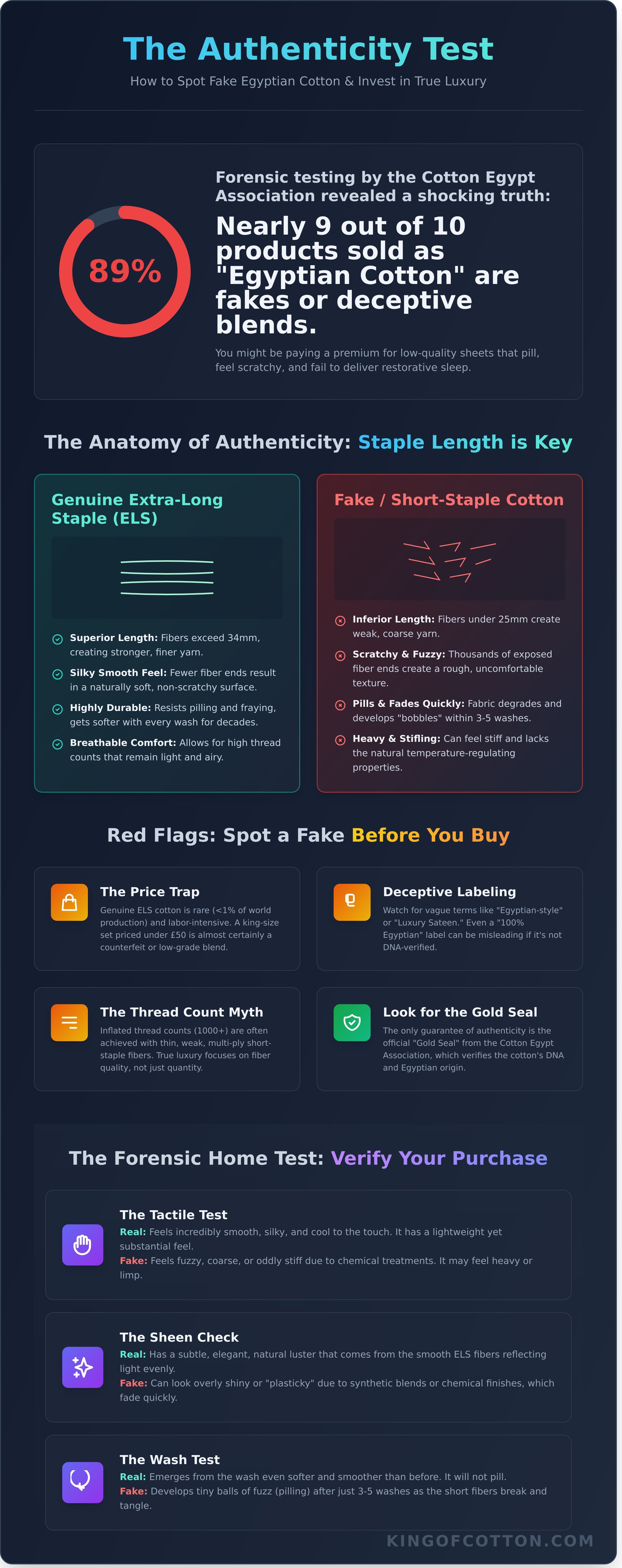
Red Flags and Retailer Tricks: How to Spot a Fake Before You Buy
The global textile market is currently saturated with mislabelled products. Industry data suggests that nearly 90% of products sold as "Egyptian cotton" are actually blends or entirely different species of cotton altogether. Learning how to spot fake egyptian cotton starts with ignoring the largest number on the packaging and looking instead for specific markers of authenticity. Genuine Egyptian cotton is a luxury commodity; it requires specific soil, climate, and hand-harvesting techniques found only in the Nile Delta. When these factors are absent, the resulting fabric lacks the strength, lustre, and longevity that define the "King of Cotton" standard.
The Thread Count Deception
Don't be fooled by the numbers. The "Thread Count Trap" is the most common tactic used to deceive shoppers. Many manufacturers use multi-ply yarns, where three or four inferior, short-staple fibres are twisted together to create a single "thread." They then count each individual fibre in that twist to claim a 1000TC rating. These sheets feel heavy and stiff because the dense weave prevents air from circulating. A genuine 300 to 400 thread count sheet made from single-ply, Extra-Long Staple (ELS) cotton will always outperform a 1000TC fake. Authentic ELS cotton is naturally fine and strong, allowing for a breathable weave that regulates temperature. If a sheet feels suspiciously thick or makes you sweat at night, it's likely a low-quality blend using artificial inflation tactics.
Pricing and Provenance
Price is a definitive indicator of quality. In 2026, the cost of raw, DNA-certified Egyptian cotton remains high due to limited yields and labour-intensive harvesting. If you find a "1000TC Egyptian Cotton" king-size set for £45 on a mass-market marketplace, it is statistically impossible for that product to be genuine. For a high-quality, authentic set in the UK market, you should expect to invest between £120 and £250 depending on the weave. This investment reflects the journey from the Nile Delta to our bedroom collection, ensuring every fibre meets professional hospitality standards.
Verification is now scientific. The Egyptian Cotton Association has implemented rigorous DNA testing to protect the integrity of the "Gold Seal." This process identifies the specific genomic fingerprint of cotton grown in Egypt. Always look for this trademarked logo rather than vague marketing terms. Avoid descriptions like "Egyptian-quality," "Nile-blend," or "Soft as Egyptian." These phrases are specifically designed to bypass legal requirements for fibre content labelling. They usually indicate a polyester blend or cotton grown in different regions that lacks the staple length required for true luxury linens.
Researching the retailer is your final line of defence. This is the most effective way to understand how to spot fake egyptian cotton before you reach the checkout. Trustworthy suppliers usually have a documented history in the hospitality industry. A company with 25 years of experience supplying five-star hotels has a reputation to uphold that a "pop-up" online brand does not. Check for "Made in" labels versus "Cotton grown in" labels. A sheet can be "Made in Italy" using cheap Indian cotton; the only label that guarantees the material's origin is one that explicitly certifies the raw fibre source through accredited bodies.
The Forensic Home Test: Identifying Genuine Cotton After Purchase
Once your new linens are out of the packaging, the real investigation begins. While labels can be misleading, the physical properties of the fibre don't lie. Learning how to spot fake egyptian cotton at home involves engaging your senses and understanding the physics of extra-long staple (ELS) fibres. Genuine Egyptian cotton, particularly the Giza 45 and Giza 94 varieties we've sourced for over 25 years, possesses a unique thermal conductivity. When you first touch a high-quality percale or sateen sheet, it should feel noticeably "cold" and crisp. This happens because the ELS fibres are spun so tightly and smoothly that they don't trap air, allowing heat to dissipate instantly. If the fabric feels room-temperature or slightly fuzzy against your palm, you're likely touching a synthetic blend or a low-grade short-staple cotton.
The visual profile of the fabric is equally telling. Real Egyptian cotton doesn't have the aggressive, plastic-like shine often found in polyester "satin" sheets. Instead, it displays a sophisticated, matte lustre. This natural glow comes from the length of the fibre, which typically exceeds 3.2cm. Longer fibres mean fewer "ends" sticking out of the yarn, creating a smoother surface that reflects light evenly. If the fabric looks dull or has a "hairy" texture under a bright lamp, it's a clear sign of inferior materials. Quality improves with age; a fake will look its best on the day you buy it, while the genuine article reaches its peak softness after several months of use.
The wash test remains the ultimate arbiter of quality. Most consumers expect new bedding to be at its softest immediately, but authentic Egyptian cotton often feels slightly stiff after the first 40-degree wash. This is a hallmark of purity. The fibres are settling into their weave. By the fifth or sixth wash, the "break-in" period concludes, and the fabric transforms into the buttery, supple material found in the world's finest hotels. In contrast, fakes will begin to "pill" or develop small bobbles within three washes as the short, weak fibres break and tangle together.
The 'Pull and Light' Method
Hold your fabric up to a 60-watt light source to inspect the architecture of the weave. Authentic Egyptian cotton shows a remarkably consistent grid with very few "slubs" or thick, uneven knots. You shouldn't see any synthetic "fuzz" floating on the surface of the threads. Perform a gentle tug test by pulling the fabric between your hands. Genuine ELS cotton has incredible tensile strength and won't distort easily. If the weave feels loose or has an unnatural stretch, it's a sign that polyester has been added to compensate for weak, short-staple cotton threads.
Moisture and Drying Performance
The superior capillary action of ELS fibres is why this material is the undisputed king for luxury towels. You can verify this with a simple drip test. Place a single droplet of water on the dry fabric. Genuine Egyptian cotton will wick the moisture away in under three seconds. If the water beads on the surface or takes longer to absorb, the fabric is either coated in chemical softeners or contains non-absorbent synthetic fibres. After washing, real cotton retains a characteristic "heft" when wet but dries to a crisp finish that precedes its signature softness.
Don't settle for clever marketing when you can have the real thing. Experience the difference with our authentic Egyptian cotton collections and invest in quality that lasts a lifetime.
Investing in Excellence: Why Provenance Matters for Luxury Bedding
Choosing genuine Egyptian cotton isn't just about the initial £150 or £200 spent on a high-thread-count duvet set. It's a calculated long-term financial decision. Cheap "Egyptian-style" blends often pill, thin, or lose their structural integrity within 12 months of regular use. Authentic long-staple fibers, by contrast, are engineered by nature to last for decades. These linens actually improve with age, often requiring 40 to 50 washes before they reach their peak level of softness. When you understand how to spot fake egyptian cotton, you're protecting yourself from wasting money on short-staple substitutes that degrade after a single season.
The health benefits of pure, natural fibers are equally significant. Pure cotton is a pH-neutral, breathable material that allows for efficient thermoregulation during the night. Synthetic mimics and low-quality blends trap heat and moisture against the skin. This can lead to disrupted sleep cycles or skin irritation for the 20% of the UK population who suffer from eczema or sensitive skin. By insisting on verified provenance, you're opting for a chemical-free sleep environment that supports your body's natural cooling processes.
To ensure your authentic linens remain a lifetime investment, proper maintenance is vital. Always wash your cotton at 40°C using a mild, liquid detergent. You should avoid fabric softeners entirely; these chemicals coat the natural fibers and actually reduce the breathability that makes Egyptian cotton so desirable. If you use a tumble dryer, select a low-heat setting and remove the linens while they're still slightly damp. This prevents the fibers from becoming brittle and makes ironing significantly easier.
The King of Cotton Guarantee
We've spent the last 28 years building our reputation as suppliers to the finest hotels across the globe. Our commitment to the 'Hotel Standard' means we never compromise on fiber length or geographical origin. We source only the highest grade of long-staple cotton to ensure every sheet provides that crisp, cool sensation guests expect from a five-star suite. If you're ready to transform your own bedroom into a sanctuary, you can check our delivery options for secure, global shipping of our authentic collections.
Establishing Your Own 'Linen Library'
Think of your bedding as a curated collection rather than a disposable commodity. Building a 'Linen Library' involves selecting versatile, authentic pieces that work together across different seasons. This approach is more sustainable and ethically sound. Supporting genuine Egyptian farmers ensures that the 1,000-year-old tradition of hand-picking cotton continues, which preserves the fiber's strength and supports local agricultural communities. It's a conscious choice to value quality over the fast-fashion cycle of the textile industry.
Before you make your next purchase, use this final checklist to ensure you're getting the real thing:
- The Price Point: If a "King Size" set is priced below £70, it's highly unlikely to be 100% authentic Egyptian cotton.
- The Seal of Approval: Look for the Cotton Egypt Association gold seal on the packaging.
- The Texture Test: Real long-staple cotton feels smooth and substantial, not "slick" or overly shiny like polyester blends.
- The Origin Detail: Authentic luxury brands will often specify the exact Giza grade (such as Giza 45 or Giza 87) used in the weave.
Mastering how to spot fake egyptian cotton allows you to shop with the confidence of a professional buyer. By investing in provenance, you aren't just buying a set of sheets; you're securing thousands of nights of superior sleep and a product that will remain in your linen cupboard for a generation.
Secure Your Investment in True Egyptian Elegance
Mastering how to spot fake egyptian cotton is the definitive way to protect your sleep sanctuary from the deceptive marketing prevalent in 2026. Authentic Giza cotton relies on extra-long staple fibers that typically measure over 32mm; this provides a level of durability and silkiness that short-staple blends simply can't replicate. You've learned that price is a primary indicator of quality. If a full set of bedding retails for under £50, it likely contains hidden synthetics or inferior weaves. True luxury requires transparency in the supply chain and a commitment to botanical purity.
King of Cotton brings more than 25 years of specialist expertise to your bedroom, serving as a trusted supplier to the world's finest 5-star hotels. Our commitment to authentic provenance has earned us an 'Excellent' rating on Trustpilot from discerning customers who value genuine quality. We don't just sell bedding; we provide the same indulgent experience found in global luxury suites. Experience the difference of authentic Egyptian cotton with King of Cotton's signature collections. You deserve the peace of mind that comes with owning the world's finest materials.
Frequently Asked Questions
Is 100% Egyptian cotton always real?
No, a label claiming 100% Egyptian cotton isn't a guarantee of purity. A 2016 audit by the Cotton Egypt Association found that roughly 90% of products tested were actually blends or inferior varieties. To know how to spot fake egyptian cotton, you've got to look for the Gold Seal of authenticity. This accreditation ensures the DNA of the fibres is verified and traceable back to the Nile River Valley.
What is the best thread count for real Egyptian cotton?
The ideal thread count for authentic Egyptian cotton ranges between 300 and 600. While some luxury brands offer 1,000 thread count sheets, anything exceeding 800 often indicates the use of multi-ply yarns. These yarns artificially inflate the count without adding quality. A 400-thread count sateen or percale provides the ultimate balance of breathability and that signature hotel-style softness you expect from premium linen.
How can I tell if my sheets are a polyester blend?
Check the fabric's sheen and how it reacts to heat. Polyester blends often have a shiny, plastic-like reflection and trap warmth, whereas 100% Egyptian cotton has a sophisticated matte or soft sateen lustre and remains cool. If your bedding doesn't wrinkle after a 40°C wash, it's likely a synthetic mix. Real cotton fibres are natural and will always show some level of characterful creasing.
Does real Egyptian cotton pill?
Authentic Egyptian cotton rarely pills because its extra-long staple fibres measure at least 32mm. These long fibres create a smooth, continuous yarn with very few loose ends to fray or tangle. If your sheets develop small balls of fuzz after just 3 or 4 washes, they're likely made from shorter, lower-quality cotton. Learning how to spot fake egyptian cotton involves checking for this lasting smoothness over time.
Why is Egyptian cotton so expensive compared to regular cotton?
The higher price reflects the meticulous hand-picking process and its extreme rarity. Egyptian cotton accounts for less than 1% of the world's total annual cotton production. Hand-picking ensures the fibres stay intact and unstressed, unlike machine-harvested cotton which can cost £2 to £5 less per kilogram to process. This labour-intensive method preserves the strength and fineness required for the world's most luxurious bed linen.
What logos should I look for on the packaging?
You should specifically look for the Cotton Egypt Association Gold Seal on the packaging. This logo features a white cotton boll inside a gold triangle and is the only legal guarantee of origin. Since its introduction, the seal has become the industry standard for purity. Without this mark, there's no verified proof that the product contains genuine Giza-grown fibres rather than cheaper, shorter staples from other regions.
How do I wash Egyptian cotton to keep it authentic?
Wash your linen at 40°C using a mild, liquid detergent to preserve the natural oils in the fibres. Don't use fabric softeners; they coat the 32mm staples and actually reduce the fabric's natural breathability and absorbency. Tumble dry on a low heat setting or line dry whenever possible. This careful maintenance ensures your investment remains as soft and rejuvenating as the day you first styled your bed.
Is Pima cotton the same as Egyptian cotton?
No, Pima and Egyptian cotton are different varieties grown in distinct geographical regions. Pima is primarily grown in the United States and Peru, while Egyptian cotton is native to the unique climate of the Nile Delta. Both are extra-long staple varieties that offer superior durability. However, the specific soil conditions in Egypt produce a finer, stronger fibre that is widely regarded as the ultimate material for luxury bedding.