

What is a Jacquard Weave? The Expert Guide to Luxury Textiles
Have you ever wondered why certain hotel linens possess a depth and texture that seem impossible to replicate at home? It isn't just a matter of thread count; it's a matter of structural artistry. Most people assume that intricate patterns on bed linen are simply printed onto the surface. However, true luxury is found in the architecture of the fabric itself. If you've ever asked what is a jacquard weave, you're already looking for a level of quality that transcends the ordinary. It's a technique where the design isn't an afterthought but is woven directly into the warp and weft of the material.
We understand that textile terminology can feel unnecessarily complex, making it difficult to distinguish between a genuine masterpiece and a cheap imitation. You want linens that offer both elegance and the durability to withstand frequent washing whilst maintaining their lustre. In this expert guide, we'll explore the rich history of the jacquard loom, dating back to 1804, and explain why this method remains the gold standard for the world's most prestigious hotels. You'll gain the confidence to identify authentic jacquard fabrics and learn how to care for these exquisite textiles to ensure they remain a staple of your home for years.
Key Takeaways
- Understand exactly what is a jacquard weave and how this structural technique integrates patterns directly into the fabric's architecture for unparalleled depth and texture.
- Learn to distinguish between genuine woven designs and surface-level prints to ensure you're investing in authentic, high-quality luxury textiles.
- Discover why jacquard is the preferred choice for prestigious global hotels due to its superior durability and ability to maintain a pristine appearance through frequent washing.
- Explore the historical significance of the 1804 jacquard loom and how it continues to represent the absolute gold standard in textile craftsmanship.
- Identify the most popular jacquard styles for bed and bath linens to help you select pieces that perfectly complement your interior aesthetic.
Defining the Jacquard Weave: More Than Just a Pattern
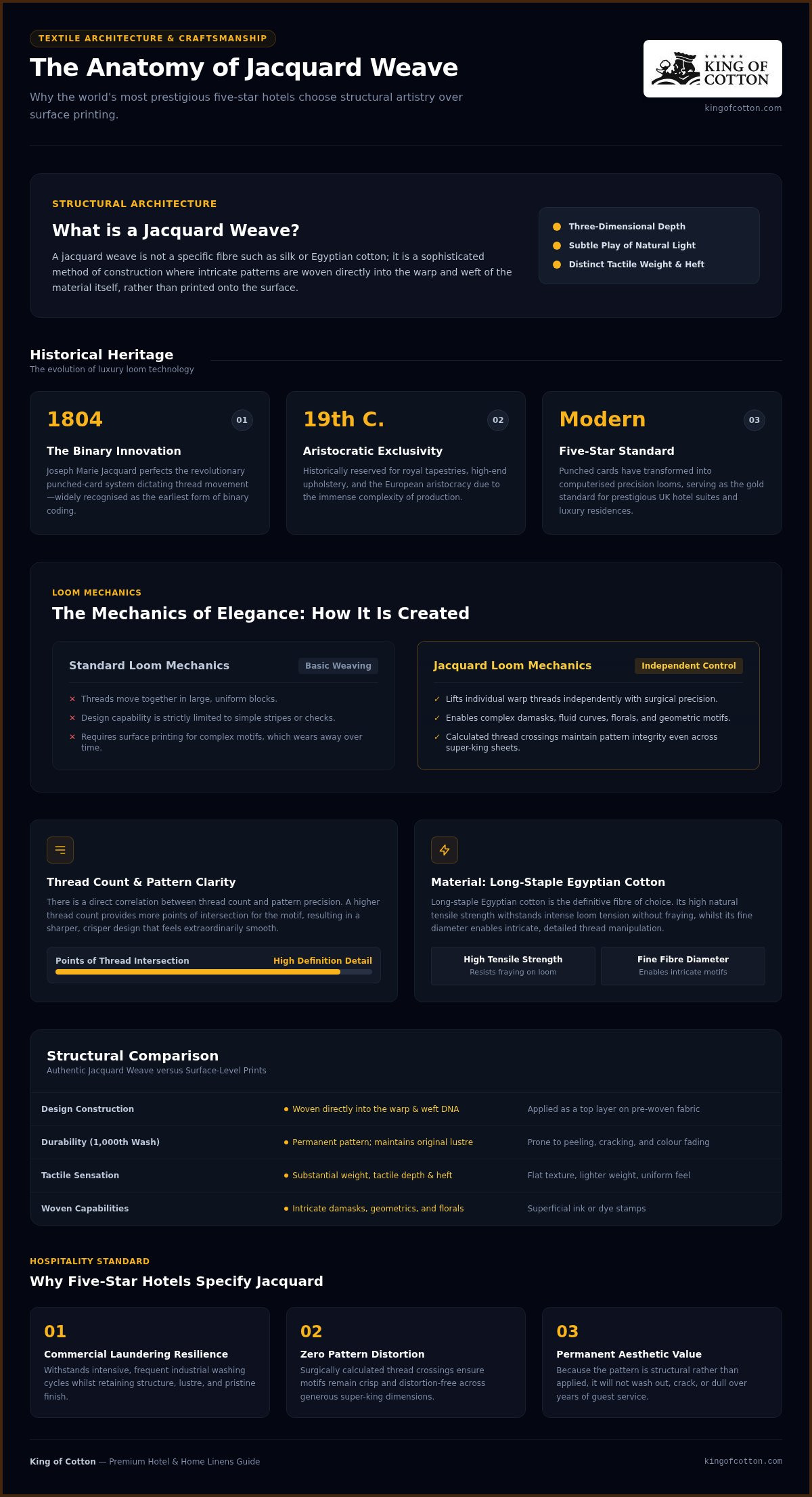
To truly appreciate the tactile richness of premium bed linen, one must first understand that what is a jacquard weave isn't a reference to a specific fibre like silk or Egyptian cotton. Instead, it defines a sophisticated method of construction that elevates a simple textile into a structural masterpiece. Whilst most decorative linens rely on surface-level applications, jacquard represents a form of structural elegance where the design is the fabric itself. This creates a three-dimensional depth and a subtle play of light that you simply won't find in printed alternatives. It's a choice that speaks of discernment and a preference for materials that offer more than just a visual pattern. For those who appreciate such high-quality craftsmanship in all their textiles, you might visit Purest to explore their luxury cashmere accessories.
The Structural Difference
In standard weaving, threads move in simple, uniform blocks. The Jacquard machine changed this by allowing for the independent control of every single warp thread. This level of precision enables weavers to create complex damasks, florals, and geometric motifs directly within the textile. If you're looking for a deeper understanding of what is a jacquard weave, consider the physical sensation of the fabric. Because the pattern is part of the weave, it adds a distinct weight and "heft" to the material. It feels substantial and luxurious against the skin. Unlike prints that might peel, crack, or fade after several laundry cycles, a jacquard pattern is permanent. It's built into the very DNA of the cloth. This ensures the aesthetic remains as sharp on its thousandth wash as it did on its first, making it an ideal investment for high-end hospitality environments.
A Brief Heritage: From 1804 to Modern Luxury
The story of this textile masterpiece began in 1804 when Joseph Marie Jacquard perfected his revolutionary punched-card system. This was arguably the world's first form of binary coding; each card dictated which threads should be raised or lowered to form the design. It was a technological marvel that transformed weaving from a slow, manual labour into a refined art form. Today, these punched cards have evolved into sophisticated computerised systems, yet the fundamental principle remains unchanged. Historically, these intricate weaves were reserved for royal tapestries and the aristocracy. Now, this technique has found its modern home in five-star hotel suites and prestigious residences across the UK. It's the definitive choice for those who value heritage and the serene confidence that comes with uncompromising quality, often found in our most exquisite bed linen collections.
The Mechanics of Elegance: How Jacquard is Created
The creation of jacquard is a meticulous dance between advanced technology and traditional craftsmanship. Whilst standard looms operate with limited, repetitive movements, a modern jacquard loom provides a level of freedom that mirrors a painter's canvas. If you have ever explored the technical side of what is a jacquard weave, you will find that the secret lies in the loom's ability to manipulate threads with surgical precision. This complexity begins with the master weaver. They must meticulously program the design, ensuring that every crossing of thread is calculated to maintain pattern consistency across expansive sheets. It is this high level of precision that prevents the distortion of elegant florals or sharp geometric lines, even on the largest super-king bedding.
Independent Thread Control
The technical brilliance of this method lies in the ability to lift individual warp threads independently. In simpler weaves, threads are lifted in large, uniform groups. This restricts the design to basic stripes or checks. The jacquard mechanism bypasses these limitations entirely. It allows for the creation of fluid curves and intricate textures that are literally woven into the fabric's foundation. There is a direct relationship between thread count and pattern clarity here. A higher thread count provides more points of intersection for the design. This results in a sharper, more defined motif that feels incredibly smooth and substantial to the touch.
Material Matters: Why Cotton is the Favourite
Choosing the right fibre is essential for achieving a premium, long-lasting finish. Long-staple Egyptian cotton is the preferred choice for these intricate designs. Its natural strength allows it to withstand the tension of the loom without fraying, whilst its fine diameter enables the creation of incredibly detailed patterns. To enhance the visual impact, we often utilise mercerised cotton. This treatment swells the fibres and creates a silk-like lustre. It allows the light to catch the "raised" portions of the weave, creating a sophisticated contrast. This subtle interplay of matte and sheen creates the characteristic depth found in high-end hospitality linens. You can experience this remarkable tactile depth first-hand by exploring our range of luxury bed linen, where traditional weaving meets modern comfort.
Jacquard vs. Prints and Embroidery: A Practical Comparison
Choosing the right textile finish involves weighing immediate visual appeal against long-term performance. Whilst prints and embroidery have their place in residential decor, they rarely match the enduring sophistication of a woven pattern. If you're investigating what is a jacquard weave in comparison to a standard print, the answer lies in the fabric's foundation. Prints are topical; they're applied to the surface of a finished cloth using pigments or dyes. Jacquard, however, is the cloth itself. This fundamental difference dictates everything from how the fabric breathes to how it performs after years of use in a busy household or a five-star suite.
Durability and Washability
In the demanding environment of high-end hospitality, linens undergo rigorous, high-temperature wash cycles to maintain impeccable hygiene. Printed designs often struggle under these conditions. They can flake, crack, or suffer from crocking, which is a process where the colour rubs off onto other surfaces. Because a jacquard pattern is created by the interlacing of dyed yarns, the design is permanent. It cannot peel or wash away. Similarly, whilst heavy embroidery offers a beautiful texture, the additional threads can sometimes snag or become distorted during industrial laundering. Jacquard maintains its structural integrity. It offers a textured surface that remains pristine whilst being far easier to iron and maintain than complex embroidered pieces.
The Aesthetic and Tactile Edge
The aesthetic appeal of jacquard is defined by its masterful interaction with light. By varying the weave structure, such as alternating between matte and sateen finishes, the fabric creates a shifting, iridescent effect. This creates a level of visual interest and heft that a flat print simply cannot replicate. It feels more substantial and luxurious to the touch, providing a sensory experience that signals quality. Another unique advantage is the reversible nature of many jacquard fabrics. The design often appears as a beautiful negative on the reverse side. This offers a versatility that is a hallmark of superior craftsmanship.
Beyond the visual, breathability is a key factor for restorative sleep. Heavy embroidered patterns can sometimes create hot spots on bed linen, trapping heat and reducing airflow. A jacquard weave preserves the natural breathability of the cotton fibres. This ensures you stay cool and comfortable throughout the night. It's this balance of elegance and performance that makes it the definitive choice for those who refuse to compromise on their sleep environment.
Common Types of Jacquard Weaves in Bed and Bath Linen
Whilst many appreciate the aesthetic of patterned fabrics, understanding what is a jacquard weave involves recognising the specific styles that define luxury interiors. In both the bedroom and bathroom, jacquard allows for a sophisticated "tone-on-tone" effect. This is achieved by using threads of the same colour but varying the weave structure to create a play between light and shadow. It's a hallmark of five-star hospitality because it provides visual interest without the distraction of bold colours. This understated elegance creates a serene atmosphere that's essential for a restorative environment.
Damask: The King of Formal Elegance
Damask is perhaps the most iconic jacquard style, distinguished by its reversible nature. The pattern is created by alternating sateen and matte weaves, which reveal intricate designs as the light catches the surface. In a professional laundry environment, damask is highly prized for its performance. Unlike surface-printed fabrics that can become limp or lose their "bloom" after industrial processing, damask retains its crisp, structured appearance. It withstands the high-pressure calendering and ironing used in luxury hotels, ensuring the linens look as impeccable on their hundredth guest as they did on their first.
Brocade and Matelassé
Whilst damask is smooth and flat, matelassé offers a heavier, quilted aesthetic that adds significant tactile depth. It mimics the appearance of a hand-stitched quilt but is created entirely on the loom. This makes it an ideal choice for bedspreads or coverlets in a neutral room where texture is the primary design element. Brocade is more decorative and often features multiple thread colours to create a raised, tapestry-like effect. These weaves are perfect for adding a layer of indulgence to the bed, providing a weight and "heft" that signals uncompromising quality.
The versatility of these techniques extends into the bathroom as well. Jacquard is frequently used to create patterns in high-GSM towels, where motifs are woven into the pile rather than just printed on the border. This ensures the design remains plush and absorbent throughout the life of the towel. To elevate your own space with these professional-standard textiles, we invite you to explore our curated collections of jacquard bed linen and accessories.
Why Choose Jacquard for Your Home or Hotel?
Choosing jacquard is an investment in both longevity and a refined lifestyle. When you understand what is a jacquard weave, you realise it's the gold standard for those who appreciate the subtle details of professional hospitality. Unlike trendy prints that lose their appeal after a single season, a woven pattern possesses a timeless quality. It doesn't scream for attention; it commands it through texture and a superior "hand." This tactile richness is why the world's most prestigious hotels rely on these textiles. They know that a structural design provides a level of comfort and aesthetic consistency that cheaper alternatives simply cannot match.
The Investment in Quality
Whilst the initial cost of premium jacquard may be higher than basic linens, the long-term value is undeniable. The structural integrity of the weave means the fabric is less prone to thinning or losing its shape over time. This durability leads to a significantly lower cost-per-use, as you won't need to replace your bedding every few years. It's a sustainable choice for the discerning homeowner who values quality over fleeting trends. For more insights on selecting the right materials for your sanctuary, we recommend reading The Ultimate Guide to Buying Luxury Bed Linen.
Caring for Your Jacquard Linens
To ensure your linens last for decades, following professional care guidelines is essential. We recommend washing your jacquard pieces at 40 to 60 degrees Celsius using a gentle, liquid detergent. Avoid bleach or harsh chemicals that can strip the natural oils from the cotton fibres and dull the lustre of the weave. For drying, air-drying is always the gentlest option, though a low-heat tumble dry can help soften the fabric.
Ironing is where the beauty of the jacquard truly comes to life. Iron whilst the fabric is still slightly damp to easily press out creases and flatten the woven motifs. This action enhances the contrast between the matte and sateen areas, restoring the three-dimensional effect that makes the textile so special. As experts in the field, King of Cotton remains dedicated to providing the same high-wash-cycle durability to your home that we supply to the finest global hotels. Choosing our jacquard means choosing a legacy of craftsmanship and a commitment to the highest standards of rest.
Elevate Your Sleep with Structural Artistry
Choosing the right textiles is the foundation of a refined lifestyle. We've explored how the intricate interplay of threads creates a fabric that is as durable as it is beautiful. Unlike surface-level decorations, a woven design offers a permanent elegance that won't fade or peel. Understanding what is a jacquard weave empowers you to look beyond thread count and appreciate the architectural integrity of your linens. It's the difference between a simple household item and a lasting investment in your comfort.
At King of Cotton, we bring decades of expertise to every piece we create. Our OEKO-TEX certified cotton linens are trusted by 5-star hotels worldwide, ensuring you receive the same calibre of luxury in your own home. These textiles are designed to withstand frequent washing whilst maintaining their signature lustre and tactile depth. It's time to move beyond the ordinary and embrace the serene confidence of professional-standard craftsmanship. Explore our exquisite range of luxury jacquard bed linen and experience the difference of a master weave. Your journey to a more indulgent and restorative sleep starts here.
Frequently Asked Questions
Is jacquard weave 100% cotton?
Jacquard is a method of weaving rather than a specific fibre, so it can be made from various materials including silk, wool, or synthetic blends. However, for premium bed linen, 100% long-staple cotton is the preferred choice. At King of Cotton, our jacquard collections typically utilise high-quality Egyptian cotton to ensure the best balance of breathability and durability. This combination creates a textile that feels exceptionally soft whilst maintaining the structural integrity of the woven pattern.
Does jacquard fabric shrink more than plain weaves?
High-quality jacquard fabrics don't shrink more than plain weaves if they are cared for correctly. Shrinkage is primarily determined by the fibre content rather than the weaving technique itself. Because we specialise in hospitality-grade linens, our cotton jacquards are designed to withstand frequent washing at professional standards. Always follow the specific care label instructions, particularly regarding temperature, to maintain the original dimensions and fit of your luxury bedding over years of use.
How can I tell the difference between jacquard and a print?
You can identify what is a jacquard weave by examining both sides of the fabric and feeling its texture. Unlike a print, where the design is applied only to the surface, a jacquard pattern is visible on the reverse; it often appears as a colour-inverted version of the front. Additionally, jacquard possesses a distinct tactile quality. You can feel the slight ridges and raised areas of the design because they are structurally part of the textile's foundation.
Is jacquard bedding suitable for hot sleepers?
Jacquard bedding is an excellent choice for hot sleepers provided it is made from natural fibres like 100% cotton. The weaving process doesn't compromise the inherent breathability of the cotton fibres. In fact, the varied texture of the weave can sometimes improve airflow across the skin compared to a very dense, flat-printed fabric. It offers a comfortable, temperature-regulated sleep environment whilst providing the sophisticated aesthetic and substantial feel associated with five-star hotel accommodation.
Why is jacquard fabric more expensive than other weaves?
The higher cost of jacquard reflects the complexity and time required for its production. Creating these intricate designs requires specialised looms and a high level of expertise to manage the independent thread controls. It's a slower, more deliberate process than producing plain or printed fabrics. This investment results in a superior product with greater durability and aesthetic depth, offering a lower cost-per-use over time compared to cheaper, less resilient alternatives.
Can you wash jacquard linen in a standard washing machine?
Yes, you can wash your jacquard linen in a standard domestic washing machine. We recommend using a gentle cycle at 40 to 60 degrees Celsius with a high-quality liquid detergent. It's best to avoid overcrowding the machine to prevent unnecessary friction, which can lead to pilling. Because our linens are designed for the rigorous demands of the hospitality industry, they are exceptionally resilient and will maintain their intricate texture and lustre throughout many home laundry cycles.
What is the difference between jacquard and damask?
Damask is a specific category of jacquard weave, distinguished by its reversible nature and the use of alternating matte and sateen surfaces. Whilst what is a jacquard weave encompasses many styles including brocade and matelassé, damask is specifically known for its flat, smooth finish and traditional floral or geometric patterns. It's the most common jacquard style found in luxury hotel bedding because it offers a sophisticated appearance that interacts beautifully with ambient light.
Does jacquard fabric wrinkle easily?
Jacquard fabric tends to wrinkle less than plain weaves like percale because the intricate interlacing of threads adds a natural weight and heft to the cloth. This structural density helps the fabric drape more elegantly and resist sharp creasing. Whilst all 100% cotton linens will require some ironing to achieve a crisp, professional finish, the textured nature of a jacquard pattern is much more forgiving at hiding minor wrinkles than a perfectly flat surface.