

Calculating Hotel Linen Cost-per-Use: A UK Guide
The cheapest hotel linen can become the most expensive choice once every wash, lost item and replacement is counted. Calculating cost-per-use for hotel linen gives you a clearer view of what each guest-ready cycle really costs, beyond the purchase price.
It’s easy to let the initial outlay guide a buying decision. But two similar-looking options may perform differently in use, and inconsistent records of wear, loss and laundry can make a fair comparison difficult. Include handling and processing costs, and the picture becomes more complex still.
This guide sets out a consistent way to calculate cost-per-use for each linen option, compare like-for-like products using operational evidence, and create a practical tracking process. You’ll see which costs to include, how to estimate useful life from wash-cycle and replacement records, and how material, construction and care affect the comparison. The aim is a repeatable method that helps you judge linen by reliable guest-ready use, not purchase price alone.
Key Takeaways
- Use cost-per-use to assess value across completed guest-ready uses, not just the purchase price.
- Compare equivalent items by specification, care process, laundering context and replacement history.
- Record linen movements, uses and retirement consistently, then reconcile the figures with housekeeping, laundry and purchasing data.
- Set comparison criteria before exploring hospitality linen from King of Cotton, including towels and bed linen.
- Free Mainland Delivery on Orders Over £100*. UK mainland deliveries cost £3.95 at minimum.
Why hotel linen cost-per-use reveals more than the purchase price
A lower purchase price is easy to compare. The operational value of hotel linen emerges over repeated guest-ready uses, laundering, handling and eventual replacement. A sheet that costs less to buy may need replacing sooner, while a higher-priced option may remain in service for longer. Neither outcome should be assumed: the hotel’s own records make the comparison meaningful.
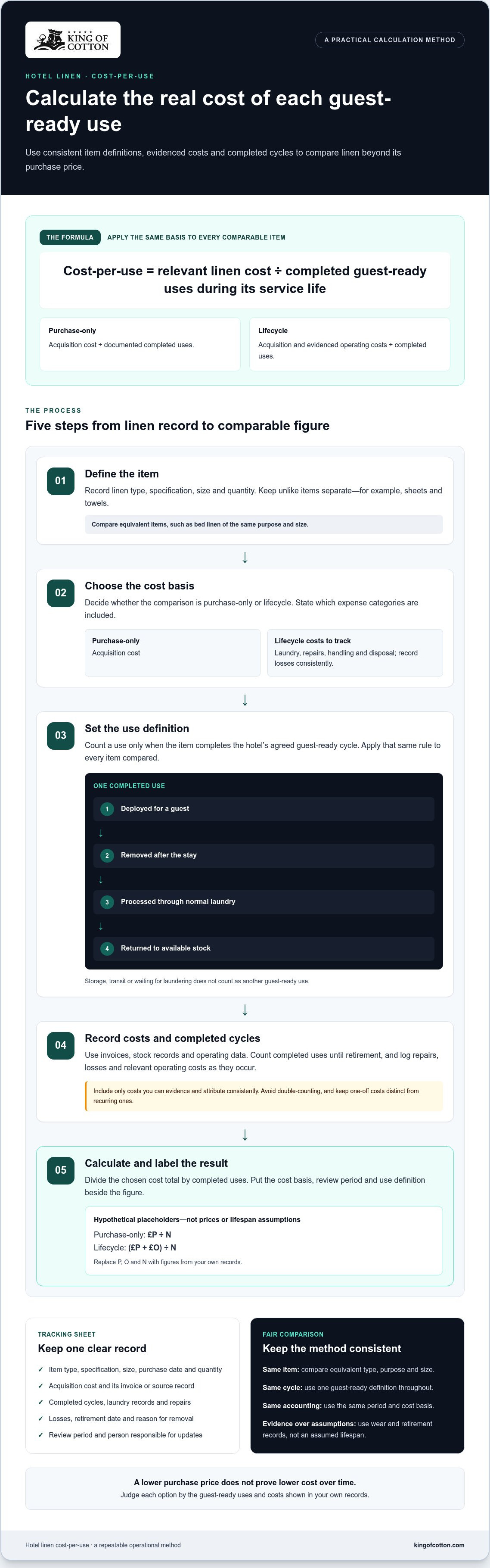
Cost-per-use is the relevant cost of a linen item divided by the number of completed guest-ready uses it provides. A purchase-only measure divides the acquisition cost by those uses. A broader lifecycle measure also includes the operating costs you choose to track, such as laundry processing, handling, repairs or losses. This applies cost accounting principles by organising expenses to support operational decisions.
For a short overview of how laundry economics and linen replacement can affect hospitality costs, watch this video:
What counts as one use in a hotel?
Set a clear rule for what counts as one completed use. For example, record a use when an item has been deployed for a guest, removed after the stay, processed through the hotel’s normal laundry routine and returned to available stock. Apply that same definition to every item being compared.
Occupancy and room turns affect how quickly linen moves through this cycle. A busy room may generate more deployments during a review period than one occupied less often, while housekeeping routines determine when items are removed and counted. Linen held in storage, in transit or awaiting laundering hasn’t completed another guest-ready use. Don’t count it simply because it has moved between locations.
When purchase price gives an incomplete picture
Two comparable linen options can have different purchase costs and different service lives. Durability, the standard guests expect and the frequency of replacement all influence the value an item delivers in practice. Material, construction and care instructions are useful comparison inputs, but actual wear and retirement records should guide your estimate rather than an assumed lifespan.
Keep comparisons consistent: use the same item type, use definition and accounting period, and decide whether you’re calculating purchase-only or broader lifecycle cost. A higher initial price isn’t automatically better value, just as a lower price doesn’t prove an item will cost less over time. For example, compare bed linen of equivalent purpose and size. King of Cotton’s hotel bed linen options can be assessed against your chosen criteria.
Apply the same approach to delivery charges in your purchasing records: Free Mainland Delivery on Orders Over £100*. UK mainland deliveries cost £3.95 at minimum.
How to calculate hotel linen cost-per-use step by step
Use one clear formula, then apply it consistently to each comparable linen item:
Cost-per-use = relevant linen cost ÷ completed guest-ready uses during its service life
For a purchase-only calculation, the relevant cost is the acquisition cost. For a lifecycle calculation, include evidenced operating costs as well. The result is only as reliable as the records behind it, so use your invoices, stock records and operating data rather than assumed prices or lifespan estimates.
- Define the item. Identify the linen type, specification, size and quantity. Keep unlike items separate, such as sheets and towels.
- Choose the cost basis. Decide whether you’re measuring purchase-only cost or broader lifecycle cost, and state which expense categories you’ll include.
- Set the use definition. Count one use when an item completes the hotel’s agreed guest-ready cycle. Apply the same rule throughout the review.
- Record costs and cycles. Log the acquisition cost and count completed uses until the item is retired. Record repairs, losses and relevant operating costs as they occur.
- Calculate and label the result. Divide the chosen cost total by the completed uses. Note the cost basis, review period and use definition beside the figure.
Choose the costs and uses included in the formula
For purchase-only cost-per-use, divide the acquisition cost by documented completed uses. For lifecycle cost-per-use, add separately recorded laundry, repair, handling and disposal costs to the relevant cost total. Include only costs you can evidence and attribute consistently. Avoid counting an expense twice if it is already included elsewhere, and keep one-off costs distinct from recurring ones so the comparison remains clear.
Hypothetical example: A hotel records an item’s acquisition cost as £P and its completed uses as N. Its purchase-only cost-per-use is £P ÷ N. If the hotel also records attributable operating costs totalling £O, the lifecycle calculation becomes (£P + £O) ÷ N. P, O and N are placeholders, not prices or lifespan assumptions. Replace them with figures from your own records.
Build a simple hotel linen tracking sheet
A shared spreadsheet or stock record can make the calculation repeatable. Use one row per item type or clearly defined batch, with fields for:
- Item type, specification, size, purchase date and quantity
- Acquisition cost and the invoice or record it came from
- Completed cycles, laundry records and any repairs
- Losses, retirement date and reason for removal from service
- Review period and the person responsible for updating the record
Keep the recording rule steady, even when staff or housekeeping routines change. Use your comparison criteria alongside King of Cotton’s hotel bed linen options. Record purchasing terms separately: Free Mainland Delivery on Orders Over £100*. UK mainland deliveries cost £3.95 at minimum.
How to compare hotel linen options fairly
A cost-per-use figure is useful only when each option has been assessed on the same basis. Compare equivalent items, not simply the lowest number in a spreadsheet. A flat sheet and a bath towel serve different purposes, while different sizes, materials and guest expectations can affect both suitability and how often an item is used.
A useful comparison requires the same cost boundary and the same definition of a completed use. If one option includes laundry costs and another includes only purchase cost, the results aren’t like for like. The same applies if one hotel counts each guest-ready cycle while another estimates service life from assumptions.
| Comparison field | Option A | Option B |
|---|---|---|
| Item type and specification | Record item, size and material | Record equivalent details |
| Purchase cost | Use invoice figure | Use invoice figure |
| Tracked uses | Count completed cycles | Count completed cycles |
| Care process | Record actual laundering routine | Record actual laundering routine |
| Replacement record | Log date and reason for retirement | Log date and reason for retirement |
Compare material, construction and guest expectations
Material and construction can influence how linen feels, how it suits a property’s service style and how it performs under the care routine actually used. Compare the intended guest experience as well as the textile specification. Egyptian cotton and Giza cotton are material distinctions to record, not proof of a particular service life. Use the same selection criteria for every option, including material, construction, guest comfort and care requirements.
Keep size and purpose aligned too. A hotel comparing towels might assess the 800 Gram Per Square Metre Ultimate Cotton Towel alongside MILANO 700gsm Egyptian Giza Cotton Towels, then consider each against its guest expectations, tracked uses and replacement history. A higher GSM alone doesn’t establish a lower cost-per-use; the recorded operating result matters.
Include care and laundry in the comparison
Record the laundering process actually used for each option, including any differences in handling or labour requirements that your records can evidence. Add documented repairs and their associated costs if they fall within your chosen cost boundary. Follow the care instructions specific to each product rather than assuming that all cotton or all towels should be treated alike.
Inconsistent cycle counts can distort the result. If one item’s uses are counted from room deployment to return to stock and another’s are estimated from purchase date, their denominators don’t match. Assumed service-life figures can create the same problem. Use your own tracked records and compare items over a consistent accounting period. Keep purchase cost and delivery charge treatment consistent too: Free Mainland Delivery on Orders Over £100*.
How to collect reliable data and interpret the result
A cost-per-use figure is only as dependable as the records behind it. Set a regular review period, such as each month or quarter, and keep it consistent when comparing linen groups. Assign a role to update movement and retirement records so an item isn’t counted differently depending on who is on shift. Clear ownership also makes missing information easier to follow up.
Reconcile the linen record against related evidence rather than relying on one source. Compare housekeeping counts with purchasing invoices, laundry records, repair notes and disposal logs. These records may use different descriptions or dates, so agree how to match an item or batch across them. If a figure can’t be verified, mark it as missing or estimated. Don’t present an assumption as a confirmed result.
Track cycles, losses and replacements consistently
Give staff straightforward rules for recording events that change the calculation. Define what counts as a completed use, how to log an item found damaged, and when a missing item is recorded as a loss rather than temporarily unavailable. Record retirement when an item leaves service, with a reason where known. Keep product specifications and supplier invoices attached to each tracked group so later reviews still identify what was purchased.
Review cycle patterns alongside room occupancy and seasonal demand. A period with more room turns may generate more recorded uses; a quieter period may not provide an equivalent basis for comparison. Note unusual operating conditions rather than treating every review window as identical. When calculating cost-per-use for hotel linen, this context helps explain the result without changing the underlying record.
Turn the calculation into a purchasing decision
Interpret results within the right category. Compare sheets with sheets, towels with towels, and equivalent specifications with one another. A figure for one type of linen shouldn’t be used to rank an unrelated item. Then consider what the number can’t show on its own: guest feedback, stock availability, the item’s suitability for the property and whether it meets the desired standard of comfort.
A low calculated cost-per-use may look attractive, but it isn’t a complete purchasing decision if the item doesn’t meet guest expectations or creates operational difficulties. Check the evidence behind the figure, including missing records and estimates, before using it to guide a replacement choice. If reviewing bed linen, compare hotel bed linen options with your recorded specifications and operational criteria.
Keep a short decision note with each review: the comparison period, data sources, any limitations and the reason for the final choice. This creates a useful reference point for the next purchasing cycle. Include delivery charges consistently in your purchasing records: Free Mainland Delivery on Orders Over £100*.
Apply cost-per-use to your next hotel linen order
Turn the figures into a purchasing decision with a consistent sequence: define what counts as a use, choose the costs to include, compare equivalent items, then assess whether each option suits your hotel’s operational and guest requirements. Treat the calculation as evidence to inform the decision, not as a verdict on comfort or suitability by itself.
Once your criteria are clear, assess hospitality linen against them. King of Cotton supplies linen to hotels and other hospitality businesses, including bed linen and towels. Its Exceptional Quality Guarantee is a relevant trust point to consider alongside product specifications and the performance measures in your assessment.
Prepare a clear brief for a commercial linen order
A concise brief keeps purchasing discussions focused on the needs behind your calculation. Include the linen categories required, specifications such as size and material, intended guest use, and the care process your hotel follows. Add the tracking assumptions used in your comparison, including how you define a completed use and which costs form part of your calculation.
For a commercial bulk order, call 020 8332 7999. A clear brief gives the discussion useful context and helps align the order with your hotel’s requirements.
Keep delivery charges visible in your purchasing records so your cost comparisons use a consistent basis. Free Mainland Delivery on Orders Over £100*.
Make the next comparison with King of Cotton
With your comparison criteria established, explore King of Cotton’s hospitality linen range by category and specification. Match the options to your hotel’s needs, then assess the relevant material, construction and care information against your recorded operational evidence. This keeps the next purchase grounded in the guest experience you want to provide as well as the cost-per-use results you’ve calculated.
King of Cotton’s Price Promise excludes sale items. Keep that distinction in mind when reviewing purchase figures, and compare like for like using the same cost boundary and tracking assumptions. A considered decision weighs the calculated result alongside comfort, stock needs and how well the linen fits your hotel’s routines.
Explore King of Cotton for hotel linen and use your purchasing brief to guide the comparison.
Make your next linen decision count
A consistent approach to calculating cost-per-use for hotel linen can turn your next replacement review into a clearer purchasing brief. Use what you’ve learned from your own operation to set priorities for guest comfort, textile specification and day-to-day suitability, then carry those criteria into your next order.
King of Cotton has an Exceptional Quality Guarantee and is rated Excellent on Trustpilot. These trust points can sit alongside your own evidence as you assess hospitality linen options. Account for delivery terms in your purchasing records too: Free Mainland Delivery on Orders Over £100*.
Use your established criteria to guide a considered choice for your property. Explore hotel linen from King of Cotton.
Frequently Asked Questions
How do you calculate cost-per-use for hotel linen?
Divide the relevant linen cost by the completed uses recorded during its service life. For a purchase-only calculation, use the acquisition cost and documented uses; for a lifecycle figure, include evidenced operating costs as well. Keep a separate calculation for each item or defined batch. If you combine stock, make sure the cost and use totals cover the same items and dates, or the result may be misleading.
What costs should be included in hotel linen cost-per-use?
Start with the acquisition cost, then add only operating expenses you can measure and attribute consistently. Depending on your chosen cost boundary, these may include laundry, handling, repairs, losses and disposal. If a laundry invoice covers several linen categories, use a consistent allocation method and record how you applied it. Label estimated amounts clearly, and keep purchase-only and lifecycle results distinct so decision-makers can see what each figure represents.
How do hotels track linen usage and replacement?
Use a stock record that identifies each linen category or batch, then log purchases, movements, completed cycles, repairs, losses and retirement. A batch reference can help staff match physical stock to its invoice and specification. Agree what staff should do when an item is damaged or temporarily missing, and train relevant housekeeping or laundry colleagues in the process. Periodically compare recorded quantities with a physical count and investigate discrepancies.
Is a more expensive hotel linen option always cheaper per use?
No. A higher purchase price doesn’t establish whether an option will cost more or less over its useful life. The answer depends on actual completed uses and, for a lifecycle comparison, the operating expenses recorded for that item. A more expensive sheet that meets your guest-comfort requirements but is retired early may not deliver the value you expect. Review the calculation alongside guest feedback and replacement reasons before deciding.
Does higher GSM mean hotel towels have a lower cost-per-use?
No. GSM measures fabric weight per square metre; it doesn’t by itself show how a particular towel will perform in your hotel or what each completed use costs. Compare actual cycle and retirement records, and follow the care instructions for the specific product. For example, the 800 Gram Per Square Metre Ultimate Cotton Towel should be machine washed at 60 °C, tumble dried on medium heat, not bleached, and washed without fabric softener.
How often should a hotel review its linen cost-per-use?
Choose a review schedule that fits your stock and purchasing routines, then use the same schedule for comparisons. Revisit the calculation when new usage or replacement records make the result more informative, or when a product specification or care routine changes. If an item has only partial records, mark the result accordingly rather than treating it as final. A brief note explaining changes between reviews helps distinguish real performance shifts from recording differences.
Can hotels compare bed linen and towels using the same cost-per-use figure?
Use the same calculation method, but don’t rank bed linen and towels as though they were interchangeable. Their functions and operating patterns differ, so separate results by category. Define a relevant completed use for each: for instance, track a bed linen item’s guest-ready deployment separately from a towel’s deployment. Then compare alternatives within the same category and specification, using the same cost boundary and review period.