

What Is Zero-Twist Cotton? A Clear Guide to Towel Yarn
What if a towel’s soft, plush feel came down to how its yarn is made, not simply the cotton named on the label? If you’ve wondered what is zero-twist cotton, the term describes yarn made with little or no conventional twist. It is not a guarantee that a towel is better in every way.
Zero-twist towels can appeal because their open cotton loops may feel exceptionally soft and absorbent. But softness, absorbency and lasting performance also depend on fibre quality and the towel’s construction. Marketing language can also make zero-twist sound much the same as low-twist, although the terms describe different levels of yarn twist.
This guide explains what zero-twist means, how it compares with low-twist and ring-spun yarn, and what those differences may mean when choosing a towel. You’ll also find practical ways to assess product descriptions, feel and care instructions, so you can look beyond one label and choose bathroom textiles with greater confidence.
Key Takeaways
- Learn what is zero-twist cotton and why the term describes yarn construction rather than a cotton variety.
- Compare zero-twist, low-twist and ring-spun yarn by understanding what each label tells you, and what it leaves unclear.
- Start your towel check with the manufacturer’s exact description of the yarn and fibre.
- Assess weight, pile, dimensions and intended use alongside the yarn label to find a towel suited to your routine.
- Check care instructions before choosing, so the towel’s upkeep suits your preferences as well as its feel.
What is zero-twist cotton, and what does the term mean for towels?
Zero-twist cotton describes cotton yarn made with little or no conventional twist; it names a yarn construction, not a variety of cotton. If you’re asking what is zero-twist cotton, that distinction is the clearest place to start. The phrase appears most often in towel descriptions. It refers to how the yarn is assembled, not the fibre’s origin, and does not guarantee a particular feel.
A towel described this way may feel soft or lofty, but the label alone can’t tell you exactly how it will feel in use. Manufacturers may use different constructions and terminology, so look for a precise description of the yarn and fibre. Don’t assume every “zero-twist” towel is made in the same way.
For a visual introduction to the term, watch this short explanation:
Is zero-twist a type of cotton or a way of making yarn?
Cotton is the fibre; twist is one way of binding fibres together to form a usable yarn. Conventional spinning methods, including those used with traditional cotton-spinning machinery, use twisting to help fibres cohere into a continuous strand. Zero-twist terminology describes a construction with little or no conventional twist, but it doesn’t specify one universal manufacturing method. Some constructions may use a supporting thread to help hold fibres in place during manufacture. Check the maker’s explanation before assuming how a particular towel is made.
The yarn is only one part of the finished textile. Fibre quality, the way the pile is formed and the wider fabric construction all influence how a towel feels and performs. “Zero-twist” can be a useful clue, but it isn’t a complete quality grade.
Why is zero-twist most often discussed in connection with towels?
Towels are commonly woven with raised loops, called pile, which create a textured surface that meets the skin and helps take up water. The yarn used in those loops can affect their softness, loft and feel against the skin. A less-twisted construction may contribute to a more open, plush hand-feel, but results vary between towels and aren’t assured by the label.
Consider the whole towel, too. Pile height and density, weight, finishing and dimensions can all shape the experience, from how substantial it feels to how it suits your routine. These details put a yarn description into context.
How is zero-twist cotton yarn made, and why can it feel different?
To understand what is zero-twist cotton, it helps to look at the role of twist in making yarn. Cotton fibres are relatively short, so spinning usually twists them together. The twist helps the fibres hold as a continuous strand that can be handled and woven. Its level affects the yarn’s character, but doesn’t determine towel quality on its own.
What does twist do in conventional cotton yarn?
Twisting draws fibres together and helps them grip one another, creating a more stable yarn. Different yarns use different amounts of twist to suit their intended construction. A tightly twisted yarn isn’t automatically rough or less absorbent, just as a softer-feeling yarn isn’t automatically more durable. The finished towel depends on several factors, including its fibre, pile and fabric construction.
How can zero-twist fibres stay together?
“Zero-twist” doesn’t always mean loose cotton fibres can be woven without any support. Some methods use a temporary supporting or wrapping thread to help the fibres hold together during production. One documented example, the production method of towel yarn of zero twist, describes combining cotton with a water-soluble fibre, which is later dissolved. This illustrates one approach, not a universal recipe for every towel marketed as zero-twist.
Think of the support as a temporary scaffold around the cotton: it helps the yarn stay workable during manufacture, while the final construction may leave the cotton fibres less compacted than in a conventionally twisted yarn. The process can vary, so check whether the manufacturer explains how its yarn is made. Don’t assume the same method applies to every product.
Reduced twist may help create a loftier, softer hand-feel, but the fibre and pile matter just as much.
With less conventional twist holding fibres tightly together, a towel’s loops may feel more open and plush. That is a possibility, not a promise: yarn construction alone can’t predict the feel of every finished towel. Pile height and density, finishing and the towel’s overall build also shape how it feels against the skin. A soft first impression is useful, but it’s only one part of assessing a towel.
When comparing descriptions, look for details about both the yarn construction and the finished towel. To explore bathroom textiles, browse the bathroom collection and check the information provided for each towel.
Zero-twist, low-twist and ring-spun cotton: what is the difference?
These terms describe different aspects of towel yarn. Zero-twist and low-twist refer to the amount of twist used in the yarn construction, whilst ring-spun describes a spinning method that twists and draws out fibres to form yarn. They aren’t interchangeable quality ratings. Use the label as a starting point, then consider the whole towel rather than assuming one term guarantees a particular feel or performance.
| Term | What it describes | What to verify |
|---|---|---|
| Zero-twist | Yarn described as having little or no conventional twist. Some constructions may use a supporting thread. | Ask what the manufacturer means by zero-twist and how the yarn is constructed. |
| Low-twist | Yarn with reduced twist, but not necessarily none. | Look for a clear description. The term may be used differently by different suppliers. |
| Ring-spun | A spinning method in which fibres are twisted and drawn into yarn. | Check the fibre, pile and other towel specifications; ring-spun alone doesn’t state how the finished towel will feel. |
Is low-twist cotton the same as zero-twist cotton?
No. In general, low-twist signals that some twist remains, while zero-twist signals little or no conventional twist. Suppliers may define these terms differently, and product titles don’t always explain the construction. Don’t assume a specific twist level from the wording alone. Look for the manufacturer’s detailed description, including whether it explains how any supporting thread is used.
Does ring-spun cotton mean a towel is less soft or absorbent?
No single yarn label can settle that question. Ring-spun identifies how yarn is made, not a complete measure of softness, absorbency or longevity. A ring-spun towel may feel different from one described as low-twist or zero-twist, but fibre characteristics, pile design and finishing also shape the result.
For a useful comparison, look at towels with similar dimensions and overall construction. Then assess their fibre descriptions, pile and weight alongside the yarn terminology. Without comparable product details or test evidence, it isn’t sound to declare one construction universally softer, more absorbent or longer-lasting. Knowing what is zero-twist cotton is useful context, but it shouldn’t replace a considered look at the whole towel.
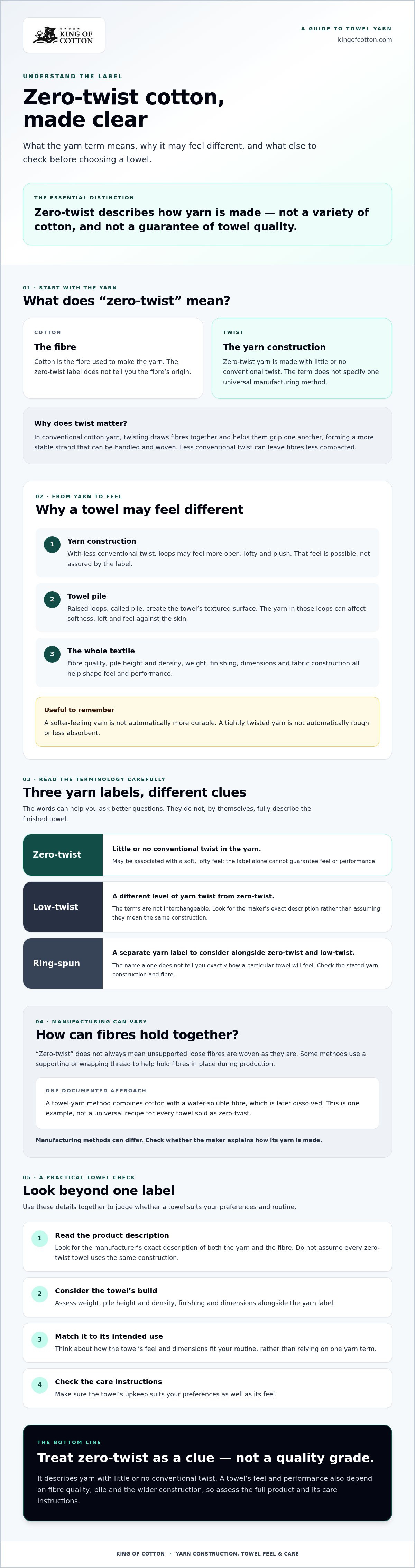
How to assess a zero-twist cotton towel before choosing one
A label is a starting point, not a verdict. If you’re wondering what is zero-twist cotton in a product description, check the exact yarn and fibre information first, then weigh it against the towel’s construction, size and care needs. This helps you judge whether it suits your bathroom, rather than relying on a single comfort claim.
Which details should you check on a towel description?
- Read the yarn and fibre description. Look for the stated fibre composition and a clear explanation of whether the yarn is zero-twist or low-twist. If the wording is vague, don’t assume the two terms mean the same thing.
- Compare weight and dimensions. GSM means grams per square metre, a measure of fabric weight. It can help you compare towels, but it doesn’t guarantee softness or absorbency. Consider the towel’s size and how substantial you want it to feel as well.
- Look at the pile and intended use. A towel for everyday use in a busy guest bathroom may need to suit different routines from one chosen for a quieter home bathroom. Consider the pile and overall construction alongside the yarn label.
- Check care instructions. Read the product’s washing and drying guidance before choosing, especially if you have particular preferences for caring for towels.
Compare like with like where details are available. Similar dimensions, stated weight and fibre composition make product descriptions easier to assess. If you can consider the feel in person, notice the pile as well as the surface softness; a plush first impression is only one part of the decision.
How should you care for a zero-twist cotton towel?
Follow the care label for washing, drying and any temperature guidance. Instructions can differ between finished towels, even when their yarn descriptions sound similar. The yarn term alone doesn’t establish whether a particular towel is suitable for a specific machine or tumble-drying setting. Use the manufacturer’s directions for the finished product rather than applying a rule based on the words “zero-twist”.
For more selection advice, see the luxury bath towel guide and use its recommendations alongside the details on the individual towel. To compare options, explore bathroom towels and check each product’s specifications and care information.
Choosing zero-twist cotton: the right next step for a softer bathroom
Zero-twist can be worth considering if you’re drawn to towels with a soft, lofted feel. Treat it as one detail of the yarn construction, not a promise of a particular experience or a shortcut to judging quality. Fibre composition, pile, weight, finishing and care requirements all help determine whether a towel is right for your bathroom.
When might zero-twist be worth considering?
If plush hand-feel is high on your list, a clearly described zero-twist construction may be one feature to compare. Feel varies with the materials and construction of the finished towel, as well as personal preference. One person may prefer a loftier pile; another may favour a different texture. Read the full product description and compare stated details, rather than choosing by the words “zero-twist” alone.
As you compare, consider how you’ll use the towel. A larger or heavier towel may feel different in everyday use from a smaller, lighter option. Check stated fibre, pile, weight and dimensions where supplied, and make sure the care instructions suit your routine. No single label can tell you how all those details come together.
What should you do if product details are unclear?
Pause before relying on an ambiguous product title. Check the seller’s specification for the precise fibre composition and yarn construction, along with the towel’s dimensions, weight and care information. If the description doesn’t explain what it means by zero-twist, avoid assuming it means the same thing as low-twist or guarantees a particular level of softness or absorbency.
For care, follow the instructions for the finished towel. Washing and drying guidance may differ between products, even when they use similar yarn terminology, so don’t infer suitable settings from the label alone.
The clearest way to choose is to match your preference for softness with the information the seller actually provides. Look at yarn, fibre, pile, weight and care together, then decide which combination suits your bathroom and daily routine. If you’re ready to compare options, explore the bathroom towel collection at King of Cotton and review the details available for each towel.
Choose a towel by looking beyond the yarn label
Understanding what is zero-twist cotton starts with one useful distinction: it describes yarn construction, not a cotton variety or a complete measure of towel quality. Low-twist and ring-spun describe different aspects of yarn-making, and none of these terms alone can promise a particular level of softness, absorbency or longevity.
For a confident choice, consider the whole towel. Check the stated fibre and yarn construction, then compare the pile, weight, dimensions and care instructions with your preferences and everyday needs. If details are unclear, use the seller’s product information rather than relying on a title or marketing claim.
King of Cotton supplies bathroom textiles to homes and hospitality customers. When you’re ready to explore towel options, browse bathroom towels and review the details provided for each product. A little attention to construction and care can help you choose a towel that feels right for your bathroom and routine.
Frequently Asked Questions
What is zero-twist cotton?
Zero-twist cotton is cotton yarn made with little or no conventional twisting, depending on the manufacturer’s construction. The term describes how fibres are formed into yarn, not a separate cotton variety. Some constructions may use a supporting thread to help hold the fibres together. Since suppliers may describe the term differently, check the product details for an explanation of the yarn construction rather than relying on the label alone.
Is zero-twist cotton softer than regular cotton?
It can feel softer or loftier than some more tightly twisted yarns, which is why the term often appears in towel descriptions. But zero-twist doesn’t guarantee softness. Fibre quality, pile, finishing and laundering all influence how a towel feels. If you can, compare the full product specifications and handle the fabric before choosing. A towel’s feel can vary even when two products use the same yarn description.
Is zero-twist cotton the same as low-twist cotton?
Not necessarily. The terms suggest different stated levels of twist: zero-twist indicates little or no conventional twist, whilst low-twist indicates reduced twist. Suppliers may use the descriptions inconsistently, and there’s no universal threshold to apply without a manufacturer’s specification. Look for a clear explanation of the construction. If a product title says zero-twist but the details only mention reduced twist, ask the seller to clarify.
Does zero-twist cotton absorb water better?
Zero-twist construction may contribute to a lofty towel surface, but yarn twist alone can’t establish absorbency. Fibre characteristics, pile construction, finishing and any treatments can also affect how a towel takes up water. Check the manufacturer’s stated composition and construction, and treat performance claims as product-specific. A description of softness or plushness isn’t proof that a towel will absorb water better than another towel.
Can zero-twist cotton towels be tumble dried?
Some towels may be suitable for tumble drying, but the correct care depends on the finished product. Follow the towel’s care label for washing and drying instructions, including any temperature guidance. Don’t assume all zero-twist towels can be dried in the same way or apply settings recommended for a different towel. If the label is missing or unclear, check with the seller before choosing a drying method.
Are zero-twist cotton towels less durable?
Durability can’t be judged from the zero-twist label alone. Yarn structure is one consideration, whilst fibre characteristics, the towel’s construction, how often it’s used and how it’s laundered can all influence wear. Softness doesn’t automatically mean a towel is fragile, just as a particular yarn description doesn’t guarantee a longer lifespan. Look for product-specific construction and care information, and compare towels with similar specifications.
What happens if a towel is labelled zero-twist but uses low-twist yarn?
The wording may reflect the seller’s interpretation, as suppliers don’t always use these terms in exactly the same way. Read the detailed description to see whether it explains the yarn construction, and ask the retailer if the information remains unclear. Don’t assume the product title guarantees a particular construction or feel. Clear specifications are more useful for comparing towels than relying on the label alone.
Ready to compare towels? Explore King of Cotton’s bathroom towel collection and review the product details and care information for each option.