

The Best Way to Store Spare Bedding: A Guide to Preserving Luxury Linens
What if the very space you use to protect your finest linens is actually the reason they lose their crisp, elegant finish? We often assume that closing the cupboard door is enough to safeguard our investment, but luxury textiles require more than just a dark shelf. Finding the best way to store spare bedding is a delicate balance of breathability, rotation, and meticulous preparation. It's the difference between a set of sheets that feels aged and one that offers a fresh, five-star experience the moment it touches the skin.
You likely appreciate the serene comfort of high-quality materials, yet you've probably faced the frustration of musty odors or stubborn yellowing that appears after months of storage. This guide will show you how to transform your linen cupboard into a curated sanctuary that preserves the life and beauty of every thread. We'll explore professional organization systems and archival preservation standards, such as maintaining stable temperatures and using acid-free materials, to ensure your spare sets remain as inviting as the day you first unfolded them.
Key Takeaways
- Master the "bone-dry" rule to prevent mildew and understand why avoiding starch is essential for preserving high-thread-count fabrics during long-term storage.
- Learn why breathable natural cotton bags are the best way to store spare bedding, outperforming plastic alternatives that can trap damaging moisture.
- Discover professional folding techniques, such as the "Pillowcase Bundle," to keep matching sets together and eliminate chaotic linen cupboards.
- Implement a "First-In, First-Out" rotation system and natural scenting methods to ensure your linens remain fresh and fragrant for months.
- Adopt elite hospitality standards by standardising your collection; this allows for effortless management and a consistently sophisticated aesthetic.
Preparation: The Secret to Long-Term Linen Freshness
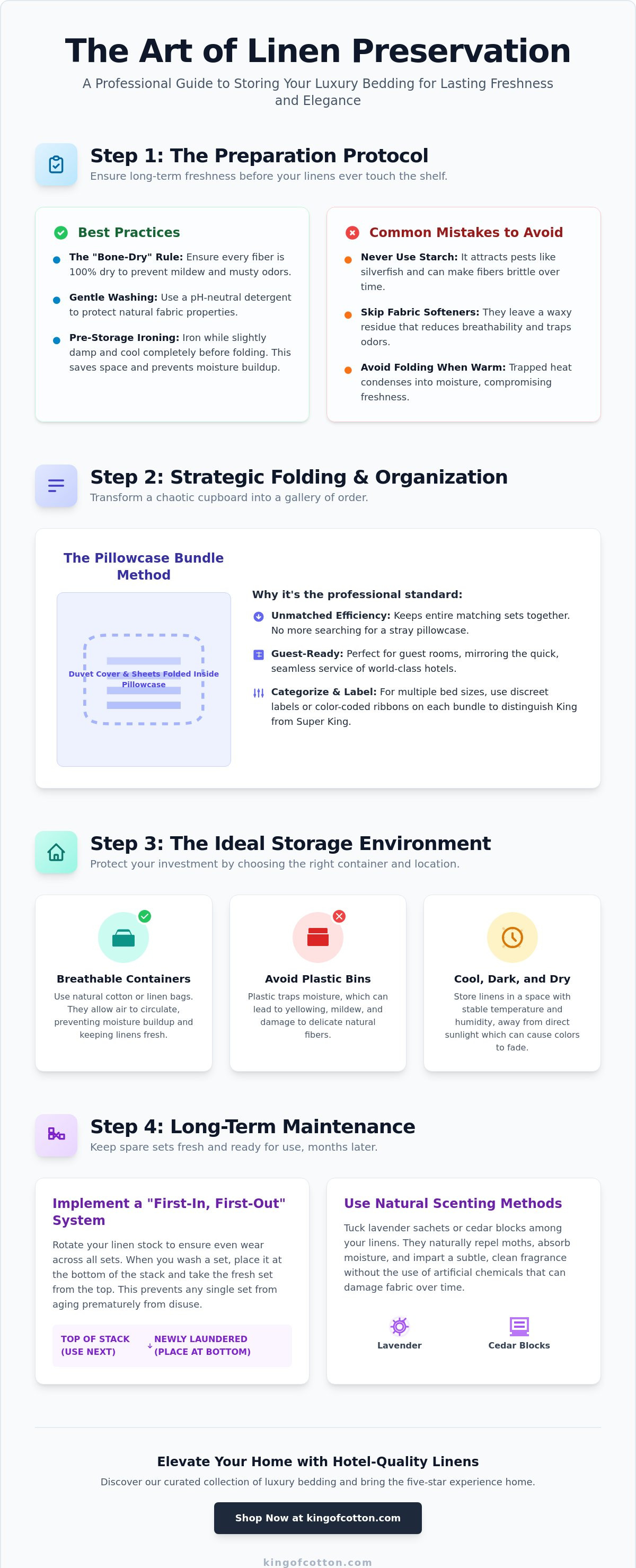
Preserving the integrity of luxury textiles begins long before they reach the shelf. Many homeowners focus on the best way to store spare bedding by searching for the perfect container, yet the true secret lies in the preparation phase. High-thread-count cotton and linen are incredibly dense. This density traps microscopic moisture deep within the weave. If you fold your sheets while they're even slightly damp, you're inviting mildew and that unmistakable musty odor that ruins a guest's experience. Professional preservation relies on the bone-dry rule; every fiber must be entirely devoid of moisture before it's tucked away.
Professional standards also dictate that you should never use starch for items intended for long-term storage. While starch provides a crisp finish for immediate use, it acts as a food source for silverfish and other pests over time. It can also make natural fibers brittle, leading to permanent cracks along fold lines. For pristine whites, consider professional laundering to ensure the complete removal of body oils and perspiration. These organic residues are the primary cause of the unsightly yellowing that often appears after months of inactivity.
To better understand the visual process of preparing your sets for the cupboard, watch this helpful video:
Washing and Drying for Storage
Maintain the long-term health of your textiles by choosing a gentle, pH-neutral detergent. Harsh chemicals strip away the natural properties of linen fabric and high-quality cotton, leading to premature thinning of the material. Total moisture removal is your most important goal. While it's tempting to use fabric softeners for a temporary scent, these products often coat the fibers in a waxy residue. This coating reduces the breathability of the fabric and can actually trap odors within the weave during storage.
The Case for Pre-Storage Ironing
Ironing is more than a vanity project; it's a functional necessity for a curated linen cupboard. Heat helps set the fibers, which creates a smoother surface area and allows for significantly flatter, space-saving folds. When you're managing large luxury bed linen sets, iron them while they're still slightly damp to glide through deep creases with ease. Always allow your linens to cool completely on a flat surface before you begin folding. Folding warm fabric traps residual heat, which can condense into moisture and compromise the freshness of the entire stack.
Strategic Folding: The Professional Way to Organise Sets
Precision in folding is the hallmark of a sophisticated home. While many view it as a chore, mastering the best way to store spare bedding transforms a chaotic linen press into a gallery of order. The choice between the "Pillowcase Bundle" and the "Flat Stack" depends entirely on your lifestyle. For most, the bundle offers unmatched efficiency. It ensures every component of a set is retrieved simultaneously, eliminating the search for a stray pillowcase during a late-night guest arrival. This level of preparation mirrors the efficiency of world-class hospitality, where time and presentation are equally valued.
Organisation systems should ideally reflect the layout of your residence. In larger homes with multiple bed dimensions, categorising by size is often more effective than by room. You might use discreet labeling or elegant color-coded ribbons to distinguish between King and Super King sets. This small investment in detail prevents the frustration of unfolding a heavy duvet cover only to find it's the wrong size for the mattress. By adopting professional textile storage techniques, you protect the structural integrity of the fabric while maintaining a visually calm environment. Proper folding reduces the surface area exposed to dust and light, preserving the vibrancy of your linens for years.
The Refined Pillowcase Method
The pillowcase method is the gold standard for guest room management. To execute this perfectly, fold your duvet cover and flat sheet into small, uniform rectangles. Slide these, along with one matching pillowcase, inside the second pillowcase of the set. Tuck the open end of the outer pillowcase neatly underneath the bundle. This creates a flat, stackable unit that remains secure even if shifted. It's an exceptionally tidy solution that makes the most of limited shelf depth, ensuring your luxury bed linen stays together as a complete, ready-to-use set.
Folding Extra Deep Fitted Sheets
Extra-deep fitted sheets often present a challenge due to their generous proportions and elasticated edges. To achieve a perfectly rectangular finish, use the pocket-tuck technique. Turn the sheet inside out and tuck each corner into the one adjacent to it until you have a manageable square. This method hides the elastic and creates straight edges that align with the rest of your stack. Managing the specific dimensions of premium King of Cotton sheets requires this level of care to ensure uniform stack heights. A consistent height across your shelves creates a sense of serenity and makes it easier to assess your inventory at a glance. If your current collection feels mismatched, consider refreshing your staples with a cohesive set of high-quality bedroom linens to simplify your organisation routine.
Choosing the Right Storage Environment and Containers
The environment in which you keep your linens is just as critical as the way they are laundered. For those seeking the best way to store spare bedding, the golden rule is absolute: breathability is non-negotiable. Natural fibers like cotton and linen are living materials that require consistent air circulation to maintain their strength and softness. Restricting this airflow leads to the degradation of the fabric and the development of unpleasant, stagnant scents. While modern storage "hacks" often suggest vacuum-sealed bags to maximize space, these are often detrimental to high-quality textiles. They trap residual moisture and prevent the fabric from breathing, which can cause permanent creasing and fiber breakdown.
A curated linen cupboard should function as a sanctuary for your textiles, protecting them from the elements while allowing them to rest between uses. This requires a shift away from convenient plastic solutions toward materials that respect the integrity of the weave. By choosing the correct vessels and optimizing the climate of your storage area, you ensure that your investment in quality remains protected for years to come.
Container Materials: Cotton vs. Plastic
Choosing natural cotton storage bags over plastic alternatives is a hallmark of professional linen care. Plastic containers often emit chemical vapors, a process known as "off-gassing," which can cause white linens to yellow over time. In contrast, breathable cotton bags act as a shield against dust while allowing air to move freely through the weave. For your most cherished heirloom pieces or exceptionally high-thread-count bed linen, consider wrapping them in acid-free tissue paper before placing them in their bags. This extra layer of protection prevents acid migration and ensures the fabric remains in pristine condition.
Optimising Your Airing Cupboard
The ideal climate for a linen sanctuary is cool, dark, and dry. Exposure to direct sunlight is a silent enemy of luxury textiles, as UV rays can bleach whites and fade the rich pigments of colored sets. Ensure your storage space is shielded from light to maintain the vibrancy of your collection. Airflow within the cupboard itself is equally vital. Avoid overstuffing shelves; instead, leave small gaps between stacks to encourage a healthy atmosphere.
If your storage involves traditional wooden shelving, be mindful of the natural oils present in the timber. These oils can seep into fabrics, causing localized staining and fiber damage. Using high-quality shelf liners creates a necessary barrier between the wood and your bedroom essentials. This meticulous attention to the storage environment ensures that every guest experience begins with the tactile pleasure of fresh, well-preserved linens.
Maintenance: Keeping Spares Fresh for Months
The best way to store spare bedding is not a passive act of "folding and forgetting." It's a continuous cycle of care that ensures your linens remain as evocative and fresh as the day they were purchased. Without a maintenance strategy, even the finest sets can develop a dormant, stale quality. To prevent this, implement a "Quarterly Refresh" ritual. Every three months, remove unused sets from the cupboard and allow them to air in a well-ventilated room for an hour. This simple act displaces stagnant air and prevents fibers from becoming compressed or brittle over time.
Protecting your investment also means guarding against pests like moths and silverfish. These visitors are attracted to organic residues and dark, undisturbed spaces. Avoid toxic mothballs; they leave a pervasive chemical scent that is nearly impossible to remove from high-quality cotton. Instead, rely on natural deterrents that complement the luxury of your home. These methods protect the fabric's integrity without compromising the sensory experience of a freshly made bed.
Natural Scenting Techniques
Natural scenting offers a sophisticated alternative to synthetic sprays. Dried lavender sachets are a classic choice for a reason; they provide a calming, traditional aroma that promotes deep relaxation. For a more modern, woody profile, use aromatic cedar blocks. Cedar is naturally hygroscopic, meaning it helps absorb trace amounts of moisture while repelling insects. If you prefer liquid fragrances, apply linen sprays correctly by misting the air around the fabric rather than saturating the fibers directly. This prevents potential staining on delicate, high-thread-count materials.
The Rotation Framework
A common mistake is repeatedly using the same "favorite" set of sheets. This leads to uneven wear and tear, eventually thinning the fibers of one set while others remain untouched. The most effective strategy is the First-In, First-Out (FIFO) system. When you return freshly laundered linens to the cupboard, place them at the bottom of the stack. By drawing from the top, you force a natural rotation that extends the lifespan of every item in your collection.
Implementing this rotation framework is arguably the best way to store spare bedding for those who value long-term fabric integrity. This methodical approach is a key component of textile longevity. For a deeper understanding of how material choice impacts the life of your linens, consult our Ultimate Guide to Buying Luxury Bed Linen. Mastering these small habits ensures your cupboard remains a curated resource of comfort. To begin building a rotation of world-class quality, explore our full range of premium bed linen.
The Hospitality Standard: Hotel-Style Linen Management
Professional hospitality standards are defined by a commitment to consistency and excellence. World-class hotels don't simply hide their spares; they manage them with a precision that ensures every guest feels the same level of rejuvenation. Adopting these methods is the best way to store spare bedding for those who wish to replicate that five-star experience at home. The secret lies in standardisation. By streamlining your collection, you remove the complexity of matching disparate sets and ensure your linen cupboard remains a visual extension of your home's aesthetic.
Knowing when to retire your linens is equally important. Even the most carefully preserved fibers eventually lose their luster. Look for signs such as thinning of the weave, loss of the fabric's original "hand," or persistent graying that professional laundering can no longer rectify. Retiring these items to secondary use ensures your guest rooms always feature the highest tier of comfort. A disciplined approach to your inventory guarantees that every set in your rotation meets the authoritative standards of luxury your home deserves.
Standardisation and Inventory
The most efficient way to manage a high-volume linen collection is to adhere to a specific colour palette. Sticking to a classic all-white aesthetic allows for effortless matching; if a single pillowcase is damaged, it's easily replaced without rendering the entire set obsolete. This approach simplifies your laundry routine and creates a cohesive, professional look across all bedrooms. We recommend keeping a simple inventory count to ensure you always have at least two spare sets per bed. This prevents the stress of last-minute laundry cycles when hosting multiple visitors. To begin standardising your home's aesthetic, view our full bedroom collection.
Creating the Guest Experience
A truly refined hosting experience involves preparing a "Guest Ready" kit. This goes beyond just sheets. Store matching sets of premium towels and bathrobes alongside your bedding to create a complete suite feel. This level of preparation allows you to transform a room in minutes, providing a seamless transition for your visitors. It's a hallmark of the seasoned expert to have these essentials curated and ready for immediate use.
Before your guests arrive, perform the "Final Fluff." Even with the best way to store spare bedding, linens can develop light compression creases over several weeks. Placing your stored bedding in the tumble dryer for five minutes on a low heat setting revitalises the fibers and restores that plush, airy volume. This simple step ensures the fabric feels as crisp and inviting as a fresh hotel arrival. To maintain this standard of excellence, invest in hotel-quality bedding that is designed to stand the test of time, offering enduring elegance for your home.
Mastering the Art of Linen Preservation
Implementing a professional approach to textile care ensures your investment remains a source of enduring comfort. You've discovered that the best way to store spare bedding involves more than just a tidy shelf; it requires meticulous moisture control and the rejection of suffocating plastic containers in favour of breathable natural cotton. By adopting a "First-In, First-Out" rotation system and standardising your collection, you streamline your household management while maintaining the impeccable standards of a luxury hotel.
Refining your storage habits is the final step in creating a sanctuary of relaxation for yourself and your guests. As premium Egyptian cotton experts with over 25 years of British textile heritage, we understand the nuances of material integrity. We are proud suppliers to the finest hotels worldwide, providing that same excellence to your private residence. Upgrade your linen cupboard with our hotel-quality bed linen collections and experience the difference that professional-grade textiles make. Your journey toward a more refined lifestyle begins with the very first thread.
Frequently Asked Questions
Is it better to store bedding in fabric or plastic bags?
Fabric bags are significantly better for luxury bedding because natural cotton allows air to circulate freely. This breathability prevents the build-up of moisture and gases that lead to yellowing or musty odours over time. Plastic containers, especially vacuum-sealed bags, can trap residual moisture and compress fibres. This potentially damages the natural loft of duvets and the crispness of high-thread-count sheets, leading to a less luxurious feel when they are eventually used.
How do I stop my spare bedding from smelling musty?
The best way to store spare bedding while maintaining freshness is to ensure every piece is 100% dry before it enters the cupboard. Store your sets in a well-ventilated area and use natural desiccants like cedar or lavender sachets to maintain a clean aroma. Implementing a rotation system ensures no set remains at the bottom of a stack for too long without being aired out or used, preventing stagnant air from settling.
Should I iron my bedding before storing it?
Ironing before storage is a functional necessity for luxury linens. It compresses the fabric, which allows for flatter, more stable stacks that save valuable shelf space. The heat from the iron also ensures any microscopic traces of moisture evaporate completely. This is a critical step for preventing mildew during long-term storage in an airing cupboard. It ensures your linens remain in pristine, hotel-ready condition for your next guest.
How many sets of spare bedding should I own?
We recommend the "rule of three" for a well-managed household. This involves having one set on the bed, one in the wash, and one spare in the cupboard. This system ensures you're never caught short by unexpected guest arrivals or spills. It also allows you to rotate your linens frequently to prevent uneven wear on your favourite sets, extending the lifespan of your entire collection through balanced use.
Can I store bedding in a vacuum bag to save space?
Vacuum bags are excellent for bulky winter duvets but aren't ideal for fine bed linens. The intense compression can create deep, permanent creases in high-quality cotton or sateen weaves. If you must use them for space reasons, don't fully vacuum all the air out. Leaving some room allows the fibres to breathe and maintain their structural integrity. This prevents the fabric from feeling crushed or losing its natural softness.
How do I prevent white sheets from turning yellow in storage?
Yellowing is typically caused by body oils that weren't fully removed or by acid migration from wooden shelves. To find the best way to store spare bedding without discolouration, always perform a thorough wash cycle before storage. Avoid fabric softeners, which can trap residues, and use shelf liners or cotton storage bags to create a barrier between the fabric and the wooden surface. This protects the pristine white finish of your luxury sets.