

How to Justify Buying Expensive Bedding: The Real Value of Luxury Linens
Have you ever wondered why we happily spend £1,000 on a smartphone that lasts two years, yet hesitate to invest in the very fabric where we spend 2,920 hours every year? It's a strange paradox, especially when you consider that poor sleep quality due to overheating or scratchy, low-grade fabrics can ruin your focus the following morning. If you're tired of 'disposable' high-street sheets that thin and bobble after just three washes, learning how to justify buying expensive bedding becomes a matter of logic rather than luxury. You deserve a sleep environment that mirrors a serene, five-star hotel experience every single night.
We agree that the initial price tag of premium Egyptian cotton can seem high compared to mass-market alternatives. However, when you look at the cost-per-use over a decade of restful nights, the financial argument is undeniable. This guide shares the logical, health-based, and financial reasons why choosing premium linens is a superior choice for your physical well-being. We will explore how specialist materials like Giza cotton support deep physical recovery and explain why a single investment in quality craftsmanship can last for ten years, rather than just one season.
Key Takeaways
- Understand the structural superiority of long-staple fibres and why Giza and Egyptian cotton remain the gold standard for enduring luxury and strength.
- Learn how to justify buying expensive bedding by applying the 'Cost-Per-Sleep' framework, proving that premium linens offer better value over a ten-year period than frequent high-street replacements.
- Discover the technical specifications behind 'hotel quality' linen and how professional-grade durability ensures your bedding survives rigorous laundering while maintaining a crisp, five-star finish.
- Explore the vital connection between tactile comfort and wellness, including how high-quality, Oeko-Tex certified materials can help lower cortisol levels for a more restorative sleep.
- Identify the essential core items to invest in first to curate a sophisticated sleep sanctuary at home, focusing on the pieces that offer the highest return on your well-being.
The Material Difference: Why High-End Fibres Command a Premium
Understanding how to justify buying expensive bedding starts with the raw materials hidden within the weave. While a standard high-street set might use short-staple cotton, luxury linens rely on long-staple and extra-long-staple fibres. These fibres, often sourced from the Nile Delta, represent the pinnacle of textile engineering. Throughout the history of bedding materials, cotton has remained the preferred choice for its versatility, yet the quality gap between industrial-grade and premium crops is vast.
Cheap cotton sets often use short, broken fibres spun together. This creates a yarn with thousands of tiny ends sticking out, which leads to a scratchy texture and inevitable pilling after just 5 or 6 washes. In contrast, Giza cotton, which accounts for less than 1% of the world's total cotton production, offers a tensile strength that ensures your sheets last for a decade rather than a single season. The choice between a crisp, matte Percale weave and a silky, lustrous Sateen weave also impacts the price and tactile experience. Percale uses a tight one-over, one-under pattern for maximum breathability, while Sateen uses a four-over, one-under structure to create a heavier, warmer feel with a signature sheen.
To better understand this concept, watch this helpful video:
The Science of Long-Staple Cotton
Long-staple cotton is defined as any cotton fibre that exceeds 32 millimetres in length. This extra length allows the spinner to create a finer, more uniform yarn with significantly fewer interruptions. Because there are fewer "ends" in the weave, the fabric resists pilling, which is the formation of small, annoying bobbles on the surface. When you invest in luxury bed linen, you're paying for a fibre that remains smooth against your skin for years. Long-staple cotton serves as the essential foundation of true textile luxury.
Thermoregulation and Breathability
Synthetic blends or low-quality cotton often trap heat, leading to night sweats and interrupted rest. Premium natural fibres possess a porous structure that wicks moisture away from the body 50% more effectively than polyester. This airflow is vital for maintaining a consistent core body temperature, which directly supports the transition into deep REM sleep cycles. Research into sleep hygiene suggests that a stable microclimate under the duvet can increase the duration of deep sleep by up to 15%. By regulating your temperature naturally, high-end linens can actually reduce reliance on electric fans or central heating, potentially lowering household energy bills during peak seasons. This efficiency is a key factor when considering how to justify buying expensive bedding for the long term.
Calculating the Real Value: The 'Cost-Per-Sleep' Framework
Understanding how to justify buying expensive bedding starts with shifting your perspective from the initial price tag to long-term utility. Most people view bedding as a consumable product that needs frequent replacing, but luxury hotel-grade linen is an investment in durability. When you adopt a 'buy it once, buy it right' philosophy, the financial logic changes completely. Instead of looking at the checkout total, consider the cost spread across every night of rest you'll receive over the next decade.
Durability vs. Disposability
High-street bedding sets often rely on short-staple fibres and heavy chemical finishes to feel soft on the shelf. These treatments wash away quickly. After 20 to 30 laundry cycles, budget sheets frequently show signs of pilling or "thinning," a phenomenon where the fabric becomes translucent and loses its structural integrity. In contrast, premium linens are designed to withstand the rigorous laundering standards of five-star hotels. Much like investing in quality home goods that serve you for decades, luxury bedding often improves with age, becoming softer with every wash without losing its strength. You can explore the technical reasons why certain materials outlast others in our analysis of Egyptian Cotton Bedding: Is It Worth The Investment?.
The 3,650 Night Test
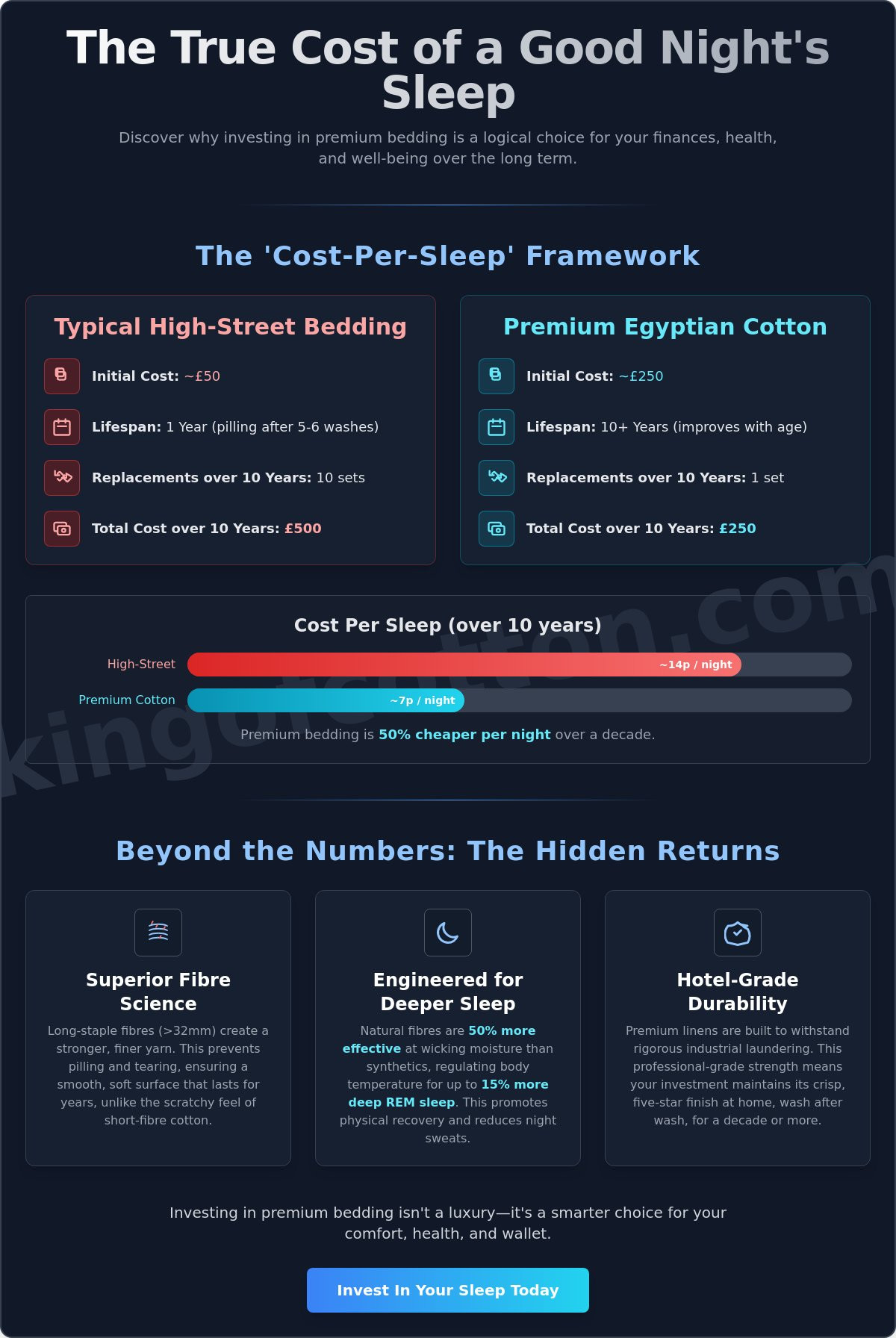
To truly see the value, let's look at the numbers. A high-quality bed set costing £200 might seem steep initially. However, when spread across a decade of use, or 3,650 nights, the cost is approximately 5.5p per night. Compare this to a daily takeaway coffee at £3.50 or a standard monthly streaming subscription at £10.99. You spend roughly eight hours every day in direct contact with your sheets, making them the most-used item in your home. There's no other product that offers such a low cost-per-use for something so vital to your wellbeing.
Cheap bedding usually requires replacement every 18 to 24 months as it becomes scratchy, loses its shape, or tears. Over ten years, you might buy five budget sets at £50 each, totalling £250. In this scenario, you've actually spent more money over time for a significantly inferior experience. By choosing professional-grade quality, you ensure that your 3,650th night feels just as indulgent as your first. It's the most practical way to understand how to justify buying expensive bedding while simultaneously elevating your daily routine. You can browse our hotel-standard bed linen collections to find a set that provides this lasting value.
The Hotel Secret: Why Professional Durability Matters for Your Home
Most people use the term "hotel quality" to describe a vague feeling of luxury, but in the textile industry, it represents a specific technical benchmark. Five-star hotels don't just buy soft sheets; they invest in linens engineered to survive 200 or more industrial laundry cycles. This involves high-temperature sterilization and heavy-duty drying programmes that would shred standard domestic bedding in weeks. When you are looking for how to justify buying expensive bedding, the most compelling argument is this professional-grade resilience.
Commercial Grade vs. Domestic Grade
Commercial grade linens possess a significantly higher tensile strength than those found on the high street. This measurement determines how much force a fabric can withstand before it tears or thins. Hotel suppliers prioritize a permanent "crispness" that resists pilling even after years of use. While domestic sheets might feel incredibly soft on the shelf due to chemical softeners, they often lose their integrity after ten washes.
If you're wondering how to justify buying expensive bedding, consider the cost-per-use over a decade rather than a single season. High-end linens maintain their structure and hand-feel long after cheaper alternatives have become translucent. For detailed advice on selecting the right thread counts and weaves, you can explore The Ultimate Guide to Buying Luxury Bed Linen.
The Craftsmanship of Fine Linens
True luxury is found in the finishing processes that mass-market brands skip to save costs. Professional linens often undergo mercerization, a treatment that swells the cotton fibres to increase lustre and affinity for dye. This process doesn't just make the fabric look better; it makes it much stronger and smoother to the touch. King of Cotton brings over 25 years of experience to the loom, ensuring every product meets these exacting hospitality standards.
- Expert Stitching: High density stitching prevents seams from puckering or pulling apart under tension.
- Hand-Finished Hems: Expertly finished edges ensure the fabric doesn't fray after repeated laundering.
- Heritage Quality: As a long-standing supplier to the world's finest hotels, our linens are designed for longevity first.
There is also a vital psychological component to professional bedding. Stepping into a bed with crisp, high-tensile linens triggers a mental "reset" similar to checking into a boutique suite. It's the combination of the fabric's weight and the cool touch of the pillowcase against your skin. By bringing these standards into your bedroom, you aren't just buying fabric; you're investing in a nightly ritual of rejuvenation that lasts for years.
Wellness & Recovery: The Hidden Health Benefits of Premium Linens
Investing in your sleep environment is a direct investment in your physiological recovery. When you consider how to justify buying expensive bedding, the conversation often starts with aesthetics, but it truly belongs in the realm of wellness. High-quality fabrics provide a specific type of 'tactile comfort' that triggers the parasympathetic nervous system. Research into sleep science shows that the sensation of smooth, premium fibres against the skin can lower cortisol levels. This reduction in stress hormones is essential for transitioning the brain from a state of alertness to deep, restorative sleep.
Better sleep hygiene doesn't just make you feel less tired. It fundamentally alters your cognitive performance. According to data from 2023 sleep studies, consistent high-quality rest improves memory retention by up to 20% and significantly stabilises mood. When your bedding regulates your temperature and provides a friction-free environment, you spend more time in REM cycles. This is the mental health ROI of luxury linens; you're buying a sharper mind and a more resilient emotional state.
Sleep Hygiene and Skin Health
Luxury bedding often utilises long-staple Egyptian cotton or pure silk, which are naturally smoother than standard high-street alternatives. These long fibres don't fray or pill, meaning they're much gentler on sensitive skin and hair follicles. For the 1 in 5 people in the UK who suffer from eczema or skin sensitivities, the chemical-free processing of premium textiles is a necessity rather than a luxury.
You should always look for the Oeko-Tex Standard 100 certification. This global standard ensures that every thread and button has been tested for over 1,000 harmful substances. In high-end manufacturing, this means no toxic dyes or harsh pesticides remain in the fabric. It's a primary way how to justify buying expensive bedding, as you're ensuring your largest organ, your skin, isn't absorbing industrial chemicals for eight hours every night.
The Psychology of the Sanctuary
Your bedroom should function as a sanctuary that signals to your brain that the day's work is over. The ritual of bed-making becomes a meditative practice when you're handling heavy-weight, high-thread-count fabrics that drape perfectly. A crisp, well-made bed acts as a powerful psychological cue. It tells the brain it's time to switch off.
To achieve this hotel-standard sanctuary at home, the fit of your linens is just as important as the material. Poorly fitted sheets that bunch up during the night can disrupt sleep cycles. You can consult The Definitive UK Bed Size Guide to ensure your luxury linens provide that taut, professional finish that defines a high-end sleep environment.
Ready to transform your bedroom into a professional-grade recovery suite? Explore our full range of luxurious bed linen to find your perfect match.
Curating Your Haven: How to Invest Wisely
Building a personal sanctuary doesn't require a massive, immediate outlay. You can easily learn how to justify buying expensive bedding by viewing it as a curated collection rather than a single, daunting expense. This gradual approach allows you to appreciate the superior quality of each piece as you add it to your bedroom, ensuring every addition serves a specific purpose in your sleep routine.
What to Buy First
The pillowcase is your most critical touchpoint. Your face spends roughly 2,900 hours a year against this fabric, so it's the most logical place to begin your upgrade. A high-quality Egyptian cotton pillowcase reduces friction on your skin and hair, providing immediate, tangible benefits that cheaper synthetics cannot match. After the pillowcase, focus your investment on the fitted sheet. This piece endures the most friction and body heat throughout the night. Choosing a high-thread-count fitted sheet from our Luxury Bed Linen Collection ensures a smooth, cool surface that won't pill or thin after a few months. These core items provide the essential foundation for a five-star sleep experience.
Maintenance for Longevity
Protecting your investment is essential for ensuring lasting value over many years. Most premium cottons thrive when washed at 40°C using a gentle, liquid detergent. You should avoid harsh chemicals and fabric softeners, as these can coat the natural fibres and significantly reduce breathability. Air-drying is the best friend of expensive cotton; it prevents the structural heat damage and shrinkage often caused by industrial tumble dryers. To extend the lifespan of your linens, always maintain a rotation of at least two sets. This rotation gives the natural fibres time to recover their shape between uses and halves the washing frequency for each individual set.
Once your core linens are established, you can layer your bed for ultimate comfort using these steps:
- Add a Mattress Topper: A thick cotton or down-filled topper provides the "cloud-like" depth found in luxury hotels.
- Select the Right Duvet: Choose a high-fill-power natural duvet that offers warmth without weight.
- Layer with Throws: Use natural wool or cotton throws to add texture and adjustable warmth.
By upgrading one piece at a time, the cost is distributed over several months, making it much easier to see the long-term savings. High-quality linens from specialists often last over a decade, whereas budget alternatives frequently need replacing every 12 to 24 months. This remarkable durability is a primary factor in how to justify buying expensive bedding for your home. It's a shift in mindset from disposable consumption to long-term heritage quality.
Invest in Your Nightly Recovery
Choosing high-quality linens is a decision that pays dividends every single night. When you apply the cost-per-sleep framework, a premium bedding set becomes a savvy financial choice rather than a mere indulgence. If a £250 set lasts for five years of nightly use, your investment in superior rest costs less than 14p per evening. This perspective clarifies how to justify buying expensive bedding; it's a commitment to long-term durability and your physical wellness. You're securing the same professional-grade materials that world-class 5-star hotels rely on to keep their guests comfortable year after year.
King of Cotton has spent over 25 years perfecting the art of fine linens. As trusted suppliers to the world's most prestigious hotels, we bring that same level of luxury and resilience to your home. Our collections are crafted from the finest fibres and are currently rated Excellent on Trustpilot by discerning sleepers. You don't have to settle for average sleep when a hotel-standard sanctuary is within reach.
Take the first step toward a more restorative sleep and enjoy the lasting elegance your home deserves.
Frequently Asked Questions
Is a higher thread count always better for luxury bedding?
No, a higher thread count doesn't guarantee superior quality. Once you exceed a 600 or 800 thread count, manufacturers often use multi-ply yarns or thinner, weaker threads to inflate the numbers. This results in a heavier, less breathable fabric. For the ultimate hotel-style experience, a 300 to 600 thread count made from single-ply, long-staple cotton offers the best balance of softness and durability.
How many years should a set of expensive bed sheets last?
A high-quality set of luxury linens should last between 5 and 10 years with proper care. In contrast, standard retail sheets typically begin to thin or pill after just 2 years. Egyptian cotton fibres are roughly 35% stronger than regular cotton, meaning they withstand frequent laundering without losing their structural integrity. Investing in premium linens reduces the frequency of replacements, saving you money over a decade.
Can expensive bedding really help me sleep better if I have insomnia?
Understanding how to justify buying expensive bedding often starts with its impact on sleep hygiene and temperature regulation. The Sleep Foundation recommends a bedroom temperature of approximately 18°C for restorative rest. Luxury linens, particularly those with a percale weave, promote significantly better airflow than synthetic blends. This prevents the night sweats and physical discomfort that frequently disrupt the sleep cycles of those with insomnia.
What is the difference between Egyptian cotton and regular cotton?
The primary difference lies in the staple length of the individual cotton fibres. Egyptian cotton is renowned for its extra-long staples, which often exceed 30mm in length. These longer fibres are spun into much finer, stronger yarns than regular cotton. This process creates a smoother surface area with fewer joins; this results in a fabric that's incredibly soft to the touch and remarkably resistant to pilling.
How do I know if I'm paying for quality or just a designer brand name?
Focus on technical specifications rather than the label to understand how to justify buying expensive bedding without overpaying for a logo. Look for "100% Long-Staple Cotton" and "Single-Ply" construction on the care label. Designer brands often apply a 300% markup to standard materials. True quality is found in the heritage of the manufacturer and certifications like OEKO-TEX, which ensure the absence of harmful chemicals.
Is it worth buying luxury bedding if I have pets or children?
Luxury bedding is actually more practical for busy households because the dense weave is more resilient. A high-quality 400 thread count percale is tightly woven, making it less likely to snag on pet claws or fray during the heavy-duty washing required for family life. While the initial cost is higher, the fabric's ability to maintain its appearance after 50 or more washes makes it a sensible choice.
How should I wash expensive bedding to make sure it lasts?
Wash your luxury linens on a gentle cycle at 30°C or 40°C using a mild, liquid detergent. Avoid using chlorine bleach or fabric softeners, as these chemicals coat the natural fibres and reduce their inherent breathability. Line drying is the best way to preserve the fabric's life. If you must use a dryer, select a low heat setting; high temperatures can cause up to 5% shrinkage and weaken the cotton fibres.
What is the best thread count for someone who sleeps hot?
A thread count between 200 and 400 in a percale weave is ideal for hot sleepers. Percale uses a "one over, one under" structure that allows air to circulate freely around your body. This is the standard choice for 5-star hotels in warmer climates. Avoid sateen weaves or thread counts above 600, as the denser construction traps more heat and can lead to an uncomfortably warm sleeping environment.