

Calculating ROI on Hotel Linen Investment: A Strategic Guide for 2026
What if your linen cupboard functioned as a high-yield asset instead of a persistent drain on your quarterly margins? Many hospitality leaders feel the weight of rising laundry operations, which can cost mid-size hotels up to $200,000 annually, while simultaneously battling guest complaints regarding coarse towels. It's a frustrating cycle that often stems from the false economy of budget textiles. However, mastering the art of calculating ROI on hotel linen investment allows you to move beyond short-term savings and toward a model of enduring value and refined comfort.
This strategic guide promises to shift your perspective from simple procurement to sophisticated asset management. You'll learn how to extend replacement cycles to 36 months and utilize the latest 2026 textile standards to reduce your operational overhead. We'll preview a clear ROI formula and explore how smart technology and premium material specifications can transform your bed linen and towels into drivers of guest satisfaction and fiscal strength.
Key Takeaways
- Understand why low-cost procurement often results in higher annual expenditures and how textile degradation directly impacts your property's brand prestige.
- Master the Cost per Wash metric to move beyond initial purchase prices when calculating ROI on hotel linen investment.
- Discover why specific material choices, like long-staple Egyptian cotton and high-GSM towels, offer superior tensile strength and long-term durability.
- Implement refined protection protocols for housekeeping and laundry teams to safeguard your high-quality textiles from chemical damage.
- Learn how to match specific linen technical specifications to your property's unique occupancy patterns and laundry infrastructure for maximum yield.
The False Economy of Low-Cost Hospitality Linens
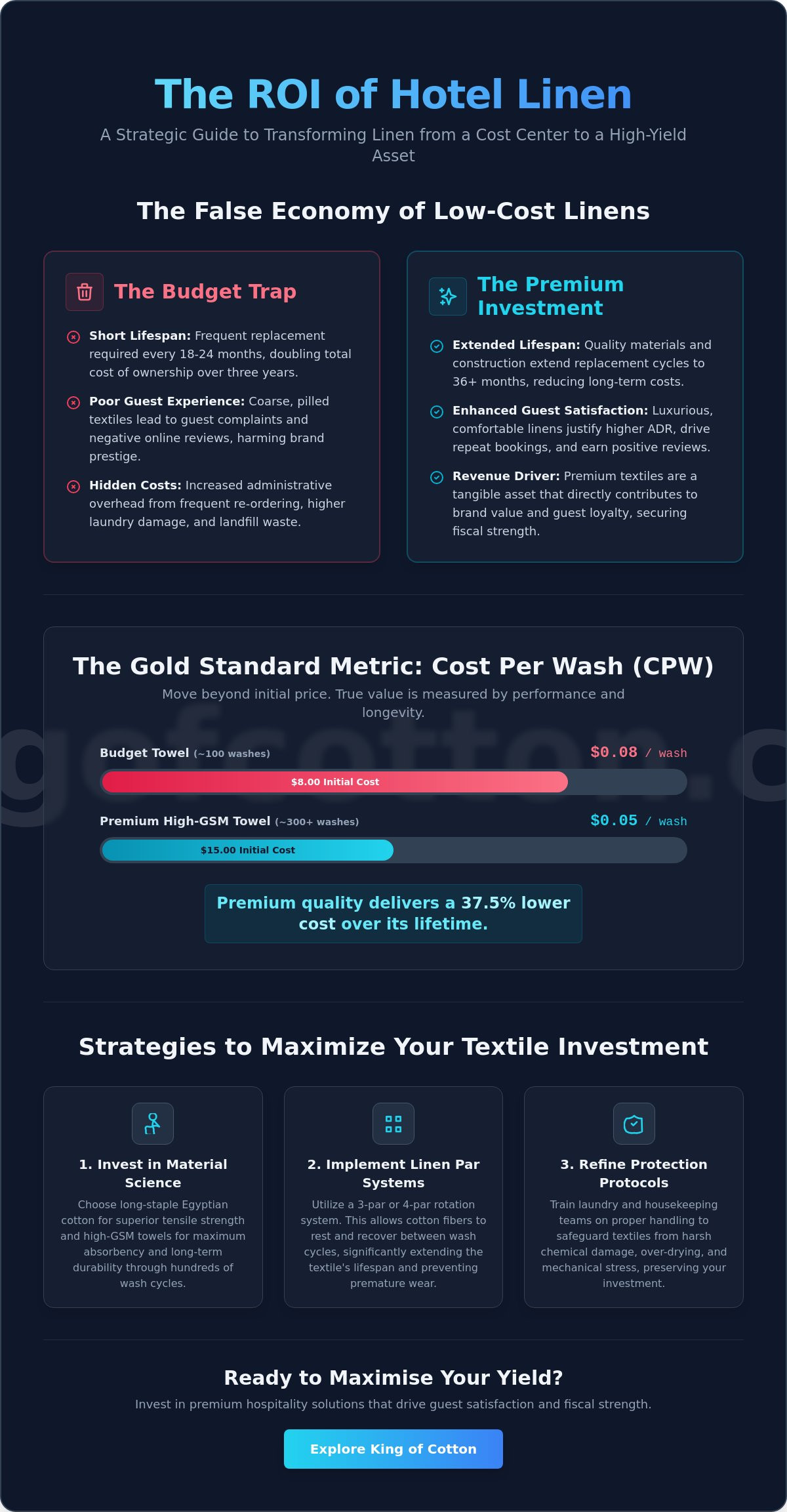
Choosing linens based solely on the initial purchase price creates a financial trap known as the false economy. While a lower unit cost might seem appealing on a quarterly budget sheet, it often triggers a cycle of rapid degradation and frequent replacement. When Return on Investment (ROI) is viewed through a lens of longevity rather than acquisition, the true cost of budget textiles becomes clear. In the demanding hospitality environment of 2026, mid-scale hotels typically replace their linens every 18 to 24 months. When calculating ROI on hotel linen investment, hoteliers must account for these frequent procurement cycles which often double the total cost of ownership over a three-year period.
This constant churn does more than just deplete your capital. It erodes the foundation of your guest experience. A single interaction with a thin, abrasive towel or a pilled sheet can dismantle years of careful brand positioning. Guests don't just notice the lack of quality; they remember it. This negative sensory experience directly impacts your ability to maintain premium room rates and secure guest loyalty. Calculating ROI on hotel linen investment requires a shift in mindset, moving from a procurement-based expense to a strategic asset management approach where durability and elegance converge.
To better understand the fundamentals of these financial metrics, watch this helpful video:
Hidden Costs of Budget Textiles
Budget textiles carry heavy administrative burdens. Frequent re-ordering consumes management time and increases logistical overhead. Short-life textiles also contribute to landfill waste, contradicting the sustainability standards expected by 2026 travelers. Perhaps most damaging is the financial weight of 'poor sleep' reviews. In an era where OTA rankings dictate visibility, a decline in guest satisfaction can lead to revenue loss that far outweighs any initial savings.
Guest Satisfaction as a Revenue Driver
Investing in premium bed linen is a calculated revenue strategy. Superior textiles justify a higher Average Daily Rate (ADR) by meeting the heightened expectations of luxury travelers. When guests encounter high-quality materials, their perception of value increases instantly. This is vital for securing repeat corporate bookings, where professionals prioritize consistent sleep quality. Choosing textiles with superior tensile strength ensures this luxurious experience remains consistent through hundreds of wash cycles.
The Hotel Linen ROI Formula: Beyond the Initial Purchase
Traditional hospitality metrics like RevPAR and occupancy rates often overlook the silent depreciation of physical assets. To master the art of calculating ROI on hotel linen investment, you must look past the invoice and focus on the lifecycle of the textile. The most sophisticated operators utilize a specific formula to determine value: (Total Life Cycles x Guest Experience Premium) divided by the Total Cost of Ownership. This equation shifts the focus from a one-time expense to a multi-year performance metric, ensuring that every thread contributes to the bottom line.
A critical component of this calculation is the 'Linen Par' system. Operating with a standard 3-par or 4-par rotation isn't just about availability; it's a financial preservation strategy. By allowing cotton fibers to rest and recover between industrial wash cycles, you significantly extend the textile's lifespan. When your inventory is stretched thin, the accelerated wear-and-tear forces premature replacement, which instantly devalues your initial investment. Tracking loss and damage through regular audits or RFID technology further refines this data, allowing you to identify exactly where your margins are slipping.
Calculating Cost Per Wash (CPW)
The industry gold standard for textile valuation is the Cost per Wash (CPW) metric. This provides a granular view of the investment's efficiency over time. You can determine your CPW through these four definitive steps:
- Step 1: Identify the initial purchase price per unit, including shipping and taxes.
- Step 2: Establish the expected wash-life. While budget linens may fail after 150 cycles, premium textiles often endure 400 or more successful washes.
- Step 3: Factor in operational laundry costs. Industry benchmarks for 2026 suggest processing costs range between $0.50 and $1.50 per pound.
- Step 4: Divide the total lifetime costs by the number of successful wash cycles to find the true price of every guest interaction.
Measuring the 'Soft ROI' of Guest Experience
While CPW handles the hard data, the 'Soft ROI' captures the emotional and reputational value of your textiles. Premium towels and bathrobes act as silent ambassadors for your brand. High-quality linens correlate directly with improved Net Promoter Scores (NPS), as guest comfort is a primary driver of positive sentiment. In a digital-first market, the aesthetic appeal of a perfectly dressed bed also serves as a marketing multiplier, encouraging social media shares that function as organic advertising.
Quantifying this impact involves tracking the reduction in guest compensation requests. If upgrading your textile quality leads to fewer complaints about room comfort, the savings in refunded fees and "make-good" amenities add directly to your profit. To begin optimizing your property's fiscal performance, consider exploring a comprehensive hospitality range designed for longevity and elegance. By selecting materials engineered for the professional environment, you ensure that your guest experience remains as resilient as your balance sheet.
Material Science: Why Egyptian Cotton and High-GSM Win
Success in calculating ROI on hotel linen investment requires a deep understanding of textile engineering. The physical composition of a sheet or towel determines how many industrial laundry cycles it can survive before the fibers degrade. While standard cotton blends might appear sufficient at the point of purchase, they often lack the structural integrity required for the high-temperature laundering processes standard in 2026. Investing in superior materials isn't a luxury; it's a technical strategy to reduce your annual replacement rate.
Operational efficiency also hinges on material choice. Technical specifications like 'easy-iron' finishes and 'fast-dry' weaves directly impact your labor costs, which currently account for 35% to 55% of total laundry expenses. By selecting textiles that require less mechanical processing, you protect the fabric's tensile strength while simultaneously lowering energy consumption. This intersection of material science and fiscal discipline is where true hospitality profitability is found.
Egyptian Cotton: The Durability King
The secret to the longevity of Egyptian cotton lies in its extra-long staple length. These longer fibers allow for the spinning of a much finer, stronger yarn with fewer joins. In a commercial setting, this translates to exceptional resistance against pilling and thinning. Standard short-staple cotton often begins to show signs of distress after 100 washes, whereas long-staple Egyptian cotton maintains its smooth, lustrous handle for significantly longer. To understand the full financial scope of this material, read our detailed analysis: Egyptian Cotton Bedding: Is It Worth The Investment?
When choosing between weaves, consider your property's specific tier:
- Percale: A plain, matte weave that is exceptionally crisp and durable. It's the workhorse of the luxury industry, offering the highest ROI for high-occupancy hotels due to its breathability and wash-resistance.
- Sateen: A four-over-one weave that provides a silky, lustrous finish. While it offers a more indulgent guest experience, it requires careful handling to maintain its signature sheen over multiple years.
Towel ROI: Weight vs. Drying Time
For bathroom textiles, calculating ROI on hotel linen investment involves finding the 'sweet spot' in Grams per Square Metre (GSM). While a 900 GSM towel feels incredibly indulgent, it carries a heavy operational burden in terms of drying time and water retention. Most prestigious properties now favor 600 to 800 GSM towels. This range provides the plush, sensory experience guests demand while remaining efficient enough to process in high-volume industrial dryers.
Durability in towels is also found in the details. Double-stitched hems are a critical specification; they prevent the fraying and 'border shrinkage' that often force premature retirement of stock. By investing in towels with reinforced edges and high-quality cotton loops, you ensure the product remains in guest-ready condition for 24 to 36 months, even under the rigors of resort-level usage. This longevity is the cornerstone of a sustainable and profitable textile inventory.
Operational Strategies to Protect Your Textile Investment
Strategic procurement is merely the first step. To ensure the financial projections made when calculating ROI on hotel linen investment actually manifest, you must implement rigorous operational safeguards. High-quality textiles are resilient, but they are not indestructible. In the high-pressure environment of professional hospitality, the difference between a sheet lasting 200 washes or 400 washes often comes down to the precision of your laundry and housekeeping protocols. Establishing a culture of textile care is essential for protecting your bottom line.
Chemical dosing is a primary area where margins are lost. Excessive use of bleach or harsh detergents might achieve instant whiteness, but it accelerates fiber degradation at an alarming rate. By 2026, automated dosing systems have become a standard requirement to preserve the tensile strength of premium Egyptian cotton. Correct chemical balance protects the fabric's molecular integrity; this ensures that your "Cost per Wash" remains low while the guest experience stays consistently high. Labor costs in hotel laundries remain high, accounting for 35 to 55 percent of total operational expenses, making efficiency in every wash cycle a fiscal necessity.
Laundry Best Practices for Longevity
Temperature control is a vital lever for textile preservation. While high heat is necessary for hygiene, 60°C represents the 'goldilocks' zone for professional laundering. This temperature effectively sanitizes while avoiding the extreme fiber stress that leads to thinning and pilling. Over-drying is equally hazardous. Subjecting premium cotton to excessive heat in the final stages of the cycle makes the fibers brittle and prone to snapping. For more insight into maintaining that signature plushness, explore our guide on How Do Hotels Keep Towels So Soft?.
Staff Training and Damage Prevention
Housekeeping teams serve as the frontline guardians of your textile assets. Training staff to identify and treat stains immediately prevents permanent damage and reduces the "discard" rate. Safe transportation is another critical factor. Using correctly lined trolleys prevents snags and tears during room transitions, protecting the delicate weave of your sateen or percale sheets. Implementing a 'first-in, first-out' (FIFO) rotation in your linen cupboard is also vital. This practice ensures that each set of linens receives adequate rest between uses, allowing the cotton fibers to recover their natural elasticity.
Beyond the wash cycle, protective layers are essential. The ROI of using waterproof mattress protectors cannot be overstated. These silent protectors safeguard your expensive duvets and pillows from moisture and stains, significantly extending their service life. Finally, adopt a formal 'Discard and Re-purpose' program. Retiring linens from guest rooms doesn't mean they've lost all value; re-purposing them as cleaning cloths or spa-use rags ensures you squeeze every possible cent of utility from your investment. Refined operational protocols ensure that the figures established during the initial phase of calculating ROI on hotel linen investment remain accurate throughout the product's entire lifecycle.
To secure your property's long-term profitability, browse our full range of professional hospitality textiles.
Maximising Yield with King of Cotton’s Hospitality Solutions
Achieving the fiscal benchmarks discussed in this guide requires a partner that understands the delicate balance between opulence and endurance. When calculating ROI on hotel linen investment, the choice of supplier becomes the most significant variable in your long-term success. King of Cotton has established itself as a trusted purveyor to the world's most prestigious residential and commercial sectors globally, offering a level of material expertise that transforms textiles into high-performing assets. Our heritage is built on providing consistent, international standards of excellence to properties that refuse to compromise on quality.
Our approach to hospitality supply is rooted in serene confidence and technical mastery. We don't just provide products; we offer a strategic upgrade to your property's lifestyle and operational efficiency. By selecting materials engineered for the professional environment, you ensure that your guest experience remains as resilient as your balance sheet, allowing you to focus on the art of hospitality while we manage the science of the thread.
Tailored Solutions for Different Hotel Tiers
We recognize that a boutique hideaway in the city has different operational needs than a sprawling coastal resort. For boutique properties, the focus often lies in creating high-impact sensory touchpoints through unique textures and indulgent bathrobes & gowns. Conversely, large-scale resorts require bed linen and towels that prioritize standardization and extreme durability to withstand back-to-back industrial wash cycles. By leveraging our Hotel Linen Suppliers expertise, you can match specific technical data to your property's unique occupancy and laundry setup, ensuring your yield is maximized across every room.
Securing Your 2026 Supply Chain
In the hospitality landscape of 2026, consistency is the ultimate luxury. Partnering with a supplier that maintains a robust, global supply chain protects your property from the volatility of short-term market shifts. Our Corporate & Hotel Supplies service is designed to streamline your investment through bulk purchasing efficiencies and a reliable flow of premium stock. This ensures that whether you are replacing duvets & pillows or restocking hotel amenities, the quality remains identical to your initial specification. This continuity is essential for maintaining the brand standards that drive repeat bookings and corporate loyalty.
Calculated procurement is not just about the first order; it's about a multi-year relationship based on trust and performance. We invite you to move beyond generic solutions and consult with our experts to develop a bespoke textile strategy. By aligning your procurement with your specific ROI goals, you transform your linen cupboard from a cost center into a driver of profitability and guest acclaim. Request a professional quote for your hotel supply today to see how our mastery of materials can refine your balance sheet.
Securing Your Property's Future Value
Mastering the art of calculating ROI on hotel linen investment is the hallmark of a discerning hospitality leader. By shifting from a mindset of short-term procurement to one of long-term asset management, you ensure that every towel and sheet contributes to your property's prestige. It's a transition that pays dividends in both reputation and revenue. The integration of superior material science with rigorous operational protocols creates a virtuous cycle of guest satisfaction and reduced replacement costs.
As you refine your strategy for 2026, remember that true luxury is found in the intersection of elegance and endurance. King of Cotton brings decades of expertise in material durability and specialized B2B hospitality support to your property. As established suppliers to the world's finest hotels, we're dedicated to helping you achieve a superior yield on your textile assets. Partner with King of Cotton for your hotel linen needs and transform your guest experience into a lasting financial asset. Your property's future deserves the serene confidence that only the highest quality materials can provide.
Frequently Asked Questions
What is a good ROI for hotel linen investment?
A favorable return is achieved when the lifespan of your textile assets extends to 36 months while maintaining top-tier guest satisfaction scores. Success in calculating ROI on hotel linen investment isn't just about the initial spend; it's about reducing the frequency of replacement cycles. By investing in premium materials, properties can lower their annual procurement costs compared to budget alternatives that degrade rapidly and require constant reordering.
How often should a 5-star hotel replace its bed linen?
Luxury properties using premium long-staple cotton typically replace their bed linen every 24 to 36 months. This extended lifecycle is possible because high-quality fibers withstand the rigors of industrial laundering far better than standard blends. While mid-scale hotels might retire stock after 18 months, 5-star establishments focus on the cost-per-use to justify the higher initial investment in superior textiles that maintain their luster.
Is 100% Egyptian cotton durable enough for high-turnover hotels?
Absolutely. The extra-long staple length of authentic Egyptian cotton creates a stronger, finer yarn that resists pilling and thinning. For high-turnover hotels, this durability is essential. It ensures that sheets remain smooth and indulgent even after hundreds of commercial wash cycles. This material specificity is what allows prestigious hotels to maintain a refined atmosphere without the administrative burden of frequent stock replacement.
How do I calculate the 'Cost per Wash' for my current inventory?
To find your Cost per Wash, add the initial purchase price to the total operational costs, then divide by the total number of successful cycles. Operational costs must include labor, which accounts for 35 to 55 percent of laundry expenses, plus energy and chemicals. This granular approach to calculating ROI on hotel linen investment reveals the true value of your inventory, highlighting the efficiency of durable, high-GSM materials.
Does thread count affect the ROI of hotel sheets?
Thread count impacts ROI when it's aligned with fiber quality and weave type. For most professional hospitality settings, a thread count between 250 and 400 offers the best balance of luxury and durability. Extremely high thread counts can sometimes trap heat and become brittle in industrial dryers. Choosing a 300 to 400 count sateen or percale ensures a refined guest experience while maintaining the structural integrity needed for longevity.
What are the most common ways hotels lose money on their linens?
Hotels primarily lose margins through "false economy" purchasing and poor inventory management. Using inadequate par levels forces staff to wash and dry linens too quickly, which snaps the fibers and shortens their life. Additionally, the lack of stain treatment protocols leads to high discard rates. Implementing better staff training and using protective items like mattress covers can significantly reduce these avoidable financial drains on your budget.
Can high-quality linens actually reduce my laundry energy bills?
Premium linens with fast-dry technical specifications can noticeably lower energy consumption. High-quality towels in the 600 to 800 GSM range are designed to release moisture more efficiently than heavier, lower-quality alternatives. This reduces the time required in industrial dryers, which are often the most energy-intensive machines in the building. Over a year, these small efficiencies in the laundry cycle add up to substantial savings on utility bills.
How does the 'Par' system influence hotel linen ROI?
A robust par system, ideally 3-par or 4-par, is vital for protecting your investment. It allows cotton fibers to rest and recover their natural elasticity between guest stays. When you rotate stock correctly, you prevent the accelerated wear that occurs when linens are laundered and returned to rooms within the same day. This rest period is a key factor in extending the product's total wash-life and maximizing your yield.