

Sustainable Practices in Hotel Linen: An Expert Guide
Commercial laundry accounts for up to 60% of a hotel’s total water consumption, yet the greatest environmental toll often stems from prematurely discarding worn-out fabric. Mastering sustainable practices in hotel linen is no longer merely an ethical gesture; it is an operational imperative for discerning properties worldwide.
Every general manager recognises the friction between refined guest expectations and environmental stewardship. Discerning travellers demand crisp, sumptuous comfort, whilst housekeeping teams face rising utility overheads and legitimate concerns that eco-friendly fabrics will falter under rigorous industrial wash cycles. True hospitality sustainability does not require sacrificing luxury. Discover how leading hotels implement sustainable linen practices to cut resource consumption, elevate guest satisfaction, and safeguard commercial durability. This guide examines high-tensile fibre sourcing, low-temperature wash chemistries, and circular textile management to help your estate balance ecological credentials with commercial resilience.
Key Takeaways
- Discover why investing in high-tensile, long-staple natural cotton weaves forms the true foundation of commercial fabric longevity and textile waste reduction.
- Learn how implementing low-temperature wash chemistries embeds sustainable practices in hotel linen whilst cutting utility overheads and protecting fibre integrity.
- Explore closed-loop strategies that divert retired bed sheets and towels from landfill through structured upcycling and textile recycling partnerships.
- Master lifecycle procurement frameworks that align rigorous third-party eco-certifications with heirloom-calibre guest comfort.
Sustainable Hotel Linen Practices: Why Do They Matter?
Sustainable linen practices represent an integrated framework that unites ethical raw fibre cultivation, energy-efficient commercial laundering, and circular lifecycle strategies to maximise textile durability whilst conserving natural resources. In hospitality, soft furnishings are not merely decorative items. They are continuous operational assets that experience relentless turnover. As corporate tenders and discerning private travellers actively evaluate properties against established green hotel standards, hoteliers face mounting scrutiny regarding their environmental footprint. Scope 3 supply chain emissions and institutional textile waste now command board-level attention across the United Kingdom and Europe.
Adopting rigorous sustainable practices in hotel linen protects commercial margins from volatile utility tariffs while satisfying guest appetite for uncompromised luxury. Properties can no longer rely on superficial gestures. Enduring ecological stewardship requires a forensic examination of every link in the linen lifecycle, from agricultural origin to final decommissioning.
The Environmental Toll of Conventional Hospitality Textiles
Standard institutional textiles carry a severe environmental burden long before reaching the guest room. Conventional cotton agriculture accounts for substantial global pesticide deployment and intense freshwater depletion. Chemically aggressive dyeing stages frequently discharge toxic effluents into vulnerable aquatic ecosystems, compromising regional biodiversity.
Once inside the hotel, the environmental impact intensifies:
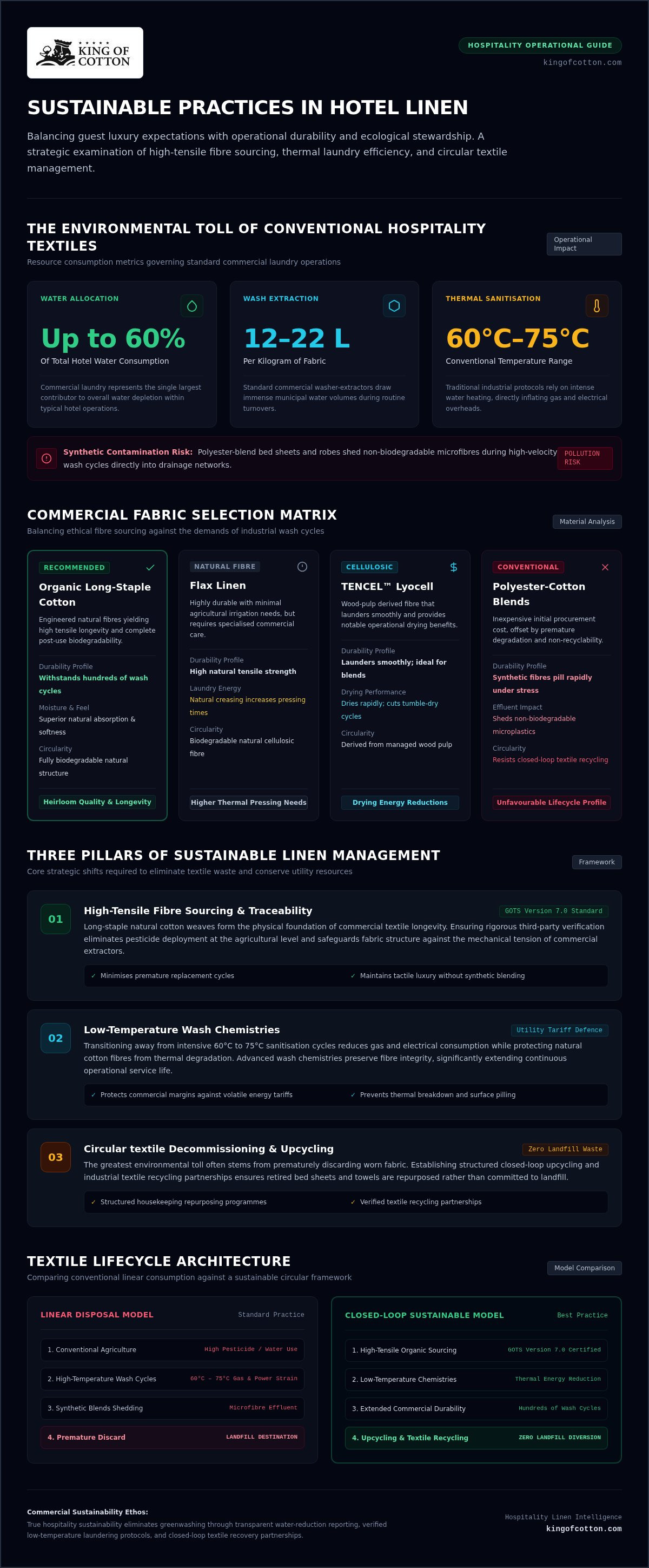
- Excessive Water Consumption: Standard commercial washer-extractors draw between 12 and 22 litres of water per kilogram of fabric, draining municipal reserves during daily turnovers.
- Thermal Energy Strain: Traditional industrial laundry protocols demand water heated to 60°C to 75°C to achieve sanitisation, driving sustained gas and electrical consumption.
- Synthetic Contamination: Polyester-blend sheets and robes shed non-biodegradable microfibres during high-velocity washing cycles, carrying synthetic particulates straight into municipal drainage networks.
Meeting Modern Guest Expectations for Eco-Luxury
Eco-conscious hospitality never requires diminishing guest comfort. Discerning guests do not view sustainability as a compromise; they perceive it as an authentic indicator of superior craftsmanship and refined care. Outdated perceptions that sustainable textiles feel abrasive or look dingy dissolve when properties procure high-tensile, long-staple organic weaves.
Modern travellers quickly identify surface-level marketing. Hoteliers eliminate greenwashing accusations by adopting verified protocols, including transparent water-reduction reporting and traceable fibre origins. Communicating tangible metrics, such as transitioning to low-temperature wash chemistries or partnering with circular recyclers, builds profound trust. Sustainable luxury reinforces brand prestige, proving that thoughtful environmental stewardship elevates the sensory experience of every stay.
Eco-Friendly Material Selection: Balancing Sourcing Ethics with Commercial Longevity
Procuring textiles for prestigious hospitality environments is an exacting engineering challenge. Sourcing teams cannot simply select an ecological label; the chosen fabric must withstand relentless mechanical tension, friction, and commercial laundering. Successful sustainable practices in hotel linen begin at the agricultural source, where fibre staple length dictates both resource efficiency and commercial longevity.
Evaluating commercial fabric options reveals clear operational distinctions:
- Organic Long-Staple Cotton: Exceptional tensile strength, superior moisture absorption, and full biodegradability. Its enduring structure withstands hundreds of commercial wash cycles without surface degradation.
- Flax Linen: Highly durable with minimal irrigation needs, yet its natural propensity to crease increases pressing times and laundry energy.
- TENCEL™ Lyocell: A wood-pulp cellulosic fibre that launders smoothly and dries rapidly, helping reduce tumble-drying cycles when blended strategically.
- Polyester-Cotton Blends: Inexpensive initially, but synthetic fibres pill rapidly, shed non-biodegradable microplastics, and resist circular recycling.
Organic Cotton and Certified Natural Fibres
Rigorous transparency requires dual verification. GOTS Version 7.0 certifies that raw fibres contain at least 95% certified organic content cultivated without toxic defoliants, whilst OEKO-TEX Standard 100 confirms finished goods remain free from harmful chemical residues. Long-staple cotton fibres possess fewer exposed fibre ends, which prevents surface fuzzing and seam slippage. This dense structural cohesion ensures natural breathability, delicate thermoregulation, and serene skin comfort across hundreds of guest stays.
The Longevity Argument: Why Durability is the Ultimate Green Metric
Replacing prematurely degraded linen creates an enormous carbon and waste footprint. Discarding sheets after 100 wash cycles doubles agricultural resource consumption compared to investing in fabrics engineered for 250 cycles or more. Structural indicators like combed long-staple yarns and balanced percale or sateen weaves provide optimal tensile resilience without restricting airflow. By pairing durable construction with operational frameworks such as the EPA WaterSense commercial building guidance, properties actively reduce utility strain and textile churn.
For hoteliers seeking to elevate bedroom suites whilst eliminating unnecessary waste, exploring professional-grade bed linen collections offers a tangible path towards commercial durability and responsible luxury.
Sustainable Commercial Laundering: Optimising Water, Heat, and Chemistry
Commercial laundry operations represent the largest ongoing operational resource drain across hospitality textile management. Traditional wash formulas rely on scalding heat and aggressive caustic alkalis, but modern facilities don't need to destroy fibres to guarantee hygiene. Implementing continuous batch tunnel washers equipped with counterflow reclamation reduces water usage to between 1.5 and 4.5 litres per kilogram of fabric. That is a fraction of standard washer-extractors. Realising true resource efficiency depends on calibrating the precise interplay between water volume, mechanical action, thermal energy, and cleaning chemistry.
Low-Temperature and Ozone Washing Technologies
Injecting dissolved ozone into wash water accelerates oxidation, destroying bacteria and viral pathogens effectively at ambient temperatures between 30°C and 40°C. Coupled with targeted enzymatic chemistries that break down protein and lipid stains, laundries bypass the fabric-weakening thermal shocks of traditional high-heat cycles. This gentler process cuts thermal energy consumption by 20% to 35% whilst preserving delicate cotton cuticles, significantly extending the service life of high-thread-count sheets.
Water Recycling and Efficient Wastewater Treatment
Advanced laundry engineering employs ceramic microfiltration and reverse osmosis to purify rinse water for re-use in earlier wash stages. Pairing closed-loop mechanics with biodegradable, phosphate-free detergents prevents toxic chemical runoff from entering local water tables. Eliminating harsh chlorinated bleaches also removes the need for excessive acid neutralisers during extraction, leaving textiles free from chemical residues that could irritate sensitive guest skin.
Executing sustainable practices in hotel linen requires structured operational changes across on-premises laundries and contracted laundry partnerships:
- Audit Wash Temperatures: Shift baseline thermal sanitisation cycles to 35°C-40°C formulas powered by peracetic acid or dissolved ozone.
- Upgrade Water Reclamation: Retrofit rinse-water recovery tanks or contract commercial partners running continuous batch washers.
- Reformulate Wash Chemistry: Eliminate caustic builders and optical brighteners in favour of biodegradable enzyme detergents that rinse cleanly.
- Track Fibre Degradation: Align fabric turnover with the circular textiles economy framework, monitoring tensile strength to retire linen before unrecoverable tears develop.
Circularity, Upcycling, and Eliminating Landfill Waste in Hotel Housekeeping
European luxury hotels discard approximately 10 million kilograms of institutional textiles annually. Linens are frequently withdrawn from circulation not because the core weave has failed, but because of isolated cosmetic blemishes, edge wear, or minor tears. Discarding these materials into residual waste streams squanders the energy and craftsmanship embodied in each sheet. Modern hospitality operations must move past single-use disposal habits. Adopting closed-loop textile practices keeps valuable natural fibres in productive circulation whilst drastically curbing Scope 3 disposal figures.
Embedding circularity into sustainable practices in hotel linen requires a disciplined, multi-tiered retirement strategy. Rather than viewing worn items as waste, luxury estates manage retired cotton as a versatile operational asset, cascading fabrics through deliberate stages of internal reuse before pursuing external reclamation.
Repair, Repurposing, and Tiered Internal Reuse
Proactive housekeeping teams maintain dedicated mending stations to address frayed hems and loose border stitching before minor faults ruin entire sheets. When high-thread-count bed linen eventually wears thin in the centre, the outer borders remain pristine. Housekeeping artisans re-tailor these intact sections into cot sheets, staff aprons, laundry bags, and protective dust covers. Bath towels follow a similar path; damaged towels are sheared and overlocked into colour-coded cleaning cloths, eliminating the need for synthetic microfibre dusting rags across back-of-house operations.
Textile Recycling and Community Donation Partnerships
Fabrics that have completed their internal lifecycle should transition into verified community and recycling streams. Visually imperfect yet clean sheets and robes provide substantial social value when donated to domestic shelters, rescue operations, and charitable organisations. Linens damaged beyond repair are directed to industrial mechanical shredders, transforming cotton fibres into acoustic insulation, car upholstery, and carpet underlay. Documenting these diversions ensures auditable waste reduction metrics that satisfy corporate governance standards.
A resilient circular strategy begins with textiles engineered to endure years of intensive rotation. To fortify your estate with durable natural fibres, invest in luxury bath towels and guest linens engineered to withstand commercial laundering without compromising tactile elegance.
How to Build and Execute a Sustainable Hotel Linen Procurement Strategy
Sustainable procurement demands moving beyond upfront purchase price to evaluate Total Cost of Ownership (TCO). In hospitality textile management, calculating cost-per-wash-cycle reveals true financial and ecological efficiency. A lower-grade sheet needing replacement after 80 cycles inflates linen expenditure and multiplies agricultural waste, whereas an heirloom-calibre weave surviving 250 cycles dramatically reduces both. Aligning strategic procurement with sustainable practices in hotel linen ensures capital efficiency while delivering the exquisite comfort luxury guests expect.
Executing an effective strategy requires evaluating prospective manufacturing partners against rigorous operational standards:
- Total Lifecycle Costing: Prioritise initial fabric tensile strength and wash durability over entry purchase prices.
- Comprehensive Supply Chain Tracing: Require chain-of-custody documentation tracing fibres from ginning and spinning to final weaving.
- Circular Packaging Standards: Mandate recyclable cardboard or compostable bio-films, eliminating single-use transit plastics across hotel deliveries.
Supplier Due Diligence and Environmental Certifications
Evaluating vendor claims requires verifiable third-party evidence. Sourcing directors should audit independent credentials such as Sedex for ethical labour practices, ISO 14001 for environmental management, and OEKO-TEX Made in Green or Fairtrade verification. Genuine supply chain accountability requires transparency across each wet-processing phase, confirming that bleaching, finishing, and mercerisation occur without hazardous chemical compounds.
Guest Communication: Elevating the Green Story Without Sacrificing Service
Service-led storytelling transforms backend operational diligence into memorable guest experiences. Traditional, guilt-inducing plastic cards placed on bathroom vanity tops feel outdated and performative. Discerning hotels replace these with thoughtfully designed bedside literature printed on FSC-certified card, quietly sharing the estate's dedication to natural fibres, low-energy laundering, and circular textile redistribution.
Training front-of-house teams and concierges to share these environmental milestones builds meaningful rapport with guests. When guests understand that crisp, breathable sheets reflect conscious environmental stewardship rather than cost-cutting, their appreciation deepens. To establish an uncompromised standard of responsible comfort across your suites, explore how King of Cotton's hospitality collections combine verified provenance with enduring commercial resilience.
Elevating Hospitality Through Enduring Textile Stewardship
Embedding sustainable practices in hotel linen is not about lowering standards; it’s about refining operational craft. By shifting procurement towards long-staple natural fibres, calibrating laundry cycles with low-temperature enzymatic chemistry, and establishing circular redistribution, hoteliers significantly lower their environmental footprint while enriching the guest experience.
As suppliers to the world's most prestigious luxury hotels and boutique retreats, King of Cotton proves that durability remains the ultimate ecological metric. Our collections feature the finest long-staple cotton engineered to withstand hundreds of commercial wash cycles, supported by rigorous ethical sourcing and internationally recognised textile safety accreditations. Ready to unite commercial resilience with responsible indulgence? Explore King of Cotton's sustainable hospitality bed linen today and curate an unforgettable, low-impact sanctuary for your guests.
Frequently Asked Questions
What are the most effective sustainable practices in hotel linen management?
The most effective sustainable practices in hotel linen management combine procuring durable long-staple natural cotton, adopting low-temperature wash formulas, and executing closed-loop repurposing. Instead of treating textiles as disposable commodities, leading properties track wash-cycle counts, repair minor seam defects, and partner with commercial laundries that recycle rinse water. This holistic framework dramatically curtails Scope 3 waste whilst preserving fabric touch.
How do sustainable linen practices reduce hotel operating costs?
Sustainable linen practices reduce operating costs by slashing utility consumption and extending textile lifecycles. Ambient-temperature wash chemistries and ozone sanitisation cut laundry thermal energy demands by up to 35%. Concurrently, investing in high-tensile natural weaves prevents premature tearing. By doubling or tripling the wash lifespan of sheets and towels, properties drastically diminish their annual replacement expenditure.
Does organic cotton hotel bedding last as long as conventional poly-cotton blends?
High-grade organic cotton matches or exceeds the durability of poly-cotton blends when crafted from combed long-staple fibres. While cheap polyester resists initial tearing, it pills rapidly, thins, and traps grey discolouration over repeated washings. In contrast, premium organic cotton percale or sateen retains structural integrity, softens with laundering, and delivers heirloom-calibre longevity across hundreds of commercial cycles.
What certifications should hoteliers look for when sourcing eco-friendly linens?
Hoteliers should demand stacked certifications that verify both agricultural origins and chemical safety. Look for Global Organic Textile Standard (GOTS) Version 7.0 for certified organic fibre harvesting and social compliance. Combine this with OEKO-TEX Standard 100 or Made in Green to confirm the finished textile contains zero harmful substances. Sedex and ISO 14001 audits provide additional assurance regarding ethical working conditions.
How can hotels implement low-temperature laundering whilst maintaining strict hygiene standards?
Hotels maintain hospital-grade sanitisation at 30°C to 40°C by pairing low-temperature water with peracetic acid chemistry or dissolved ozone injection. Ozone acts as a potent biocide that neutralises bacteria and viruses faster than chlorine bleach without degrading natural cotton yarns. Complementing this with tailored bio-enzymatic detergents effectively lifts stubborn proteins and oils without relying on fabric-damaging thermal shocks.
What happens to hotel bed sheets and towels when they reach the end of their usable life?
Progressive properties operate tiered retirement programmes rather than discarding textiles into residual waste bins. Linens with minor edge fraying are mended in-house, while stained items are repurposed into cot bedding, aprons, or housekeeping cleaning cloths. Wholesome surplus linens are donated to regional shelters, whilst condemned natural cotton fibres are dispatched to industrial recyclers for conversion into acoustic insulation and underlay.
How can boutique hotels implement sustainable linen policies on a limited budget?
Independent boutique properties should focus their capital on procurement longevity rather than rapid replacement cycles. Purchasing robust long-staple cotton bed linen reduces recurring reorder costs over time. Operators can instantly lower laundry overheads by adopting refined guest opt-in linen reuse programmes, switching to concentrated eco-detergents, and training housekeeping teams to mend hems promptly, establishing impactful sustainability without capital expenditure strain.