

Long-Staple Cotton Explained: The Secret to Hotel-Quality Bedding
Why do your 1,000-thread-count sheets feel like sandpaper after just four washes at 40 degrees? It's a common frustration for anyone trying to upgrade their bedroom, especially when you've spent a significant sum on what promised to be premium bedding. You likely agree that trying to understand the difference between Egyptian, Pima, and Giza cotton feels more like a technical exam than a shopping trip. Many brands use inflated thread counts to mask the use of short, brittle fibres that inevitably pill and scratch your skin.
In this guide, we've got long-staple cotton explained to help you look past the marketing jargon and identify the true secret to 5-star comfort. You'll discover why fibre length is the most critical factor in luxury linens and how to choose bedding that stays soft for a lifetime. Drawing on over 25 years of experience as specialists in fine Egyptian cotton and suppliers to the finest hotels, we'll show you exactly how to decode technical labels so you can recreate a professional sleep experience in your own home.
Key Takeaways
- Understand why the individual length of a cotton fibre is the fundamental secret behind the strength and silkiness of world-class linens.
- Discover the structural differences in our long-staple cotton explained section to see how longer fibres create a smoother surface that resists pilling.
- Learn why investing in premium long-staple bedding ensures unrivalled softness and breathability that actually improves with every wash.
- Uncover the marketing myths surrounding thread count and why a 200TC long-staple sheet often outperforms an 800TC short-staple alternative.
- Master the art of shopping for luxury by identifying the differences between a crisp Percale and a silky Sateen weave for your home.
What is Long-Staple Cotton? Understanding the 'Staple' in Fine Linens
When you browse for high-end bed linen, the term 'staple' appears frequently on the labels of the world's finest products. To grasp why certain sheets feel significantly smoother than others, we must look at Understanding the 'Staple' in Fine Linens, which refers to the individual length of a single cotton fibre. In the textile industry, the longer the fibre, the higher the quality of the resulting fabric. This is why long-staple cotton explained in simple terms often focuses on the physical durability and silk-like finish that shorter fibres cannot replicate.
Fibre length serves as the primary indicator of cotton quality and market price because it dictates how the yarn is spun. Longer fibres allow for a tighter, more uniform spin with fewer exposed ends. This creates a yarn that's both stronger and softer, reducing the likelihood of pilling or fraying over years of use. Long-staple cotton is defined as fibres exceeding 32mm in length. By choosing these extended fibres, manufacturers can produce higher thread count fabrics that remain breathable and exceptionally durable.
To better understand this concept and how it impacts your sleep quality, watch this helpful video:
The Anatomy of a Cotton Boll
Cotton grows within a protective casing known as a boll. This structure shields the delicate fibres from environmental damage until they're ready for harvest. While standard Upland cotton (Gossypium hirsutum) accounts for about 90% of global production, premium species like Gossypium barbadense thrive in specific climates like the Nile River Valley. These regions provide the consistent heat and moisture required to grow longer, finer fibres. Many luxury producers insist on hand-picking these bolls. Unlike mechanical harvesting, hand-picking ensures the fibres aren't broken or stressed, preserving the natural integrity and length of the staple.
Staple Length Categories: Short, Long, and Extra-Long
Understanding the categories of cotton helps you identify true luxury when shopping for bed linen. The industry typically segments cotton into three distinct tiers based on the length of the individual fibres:
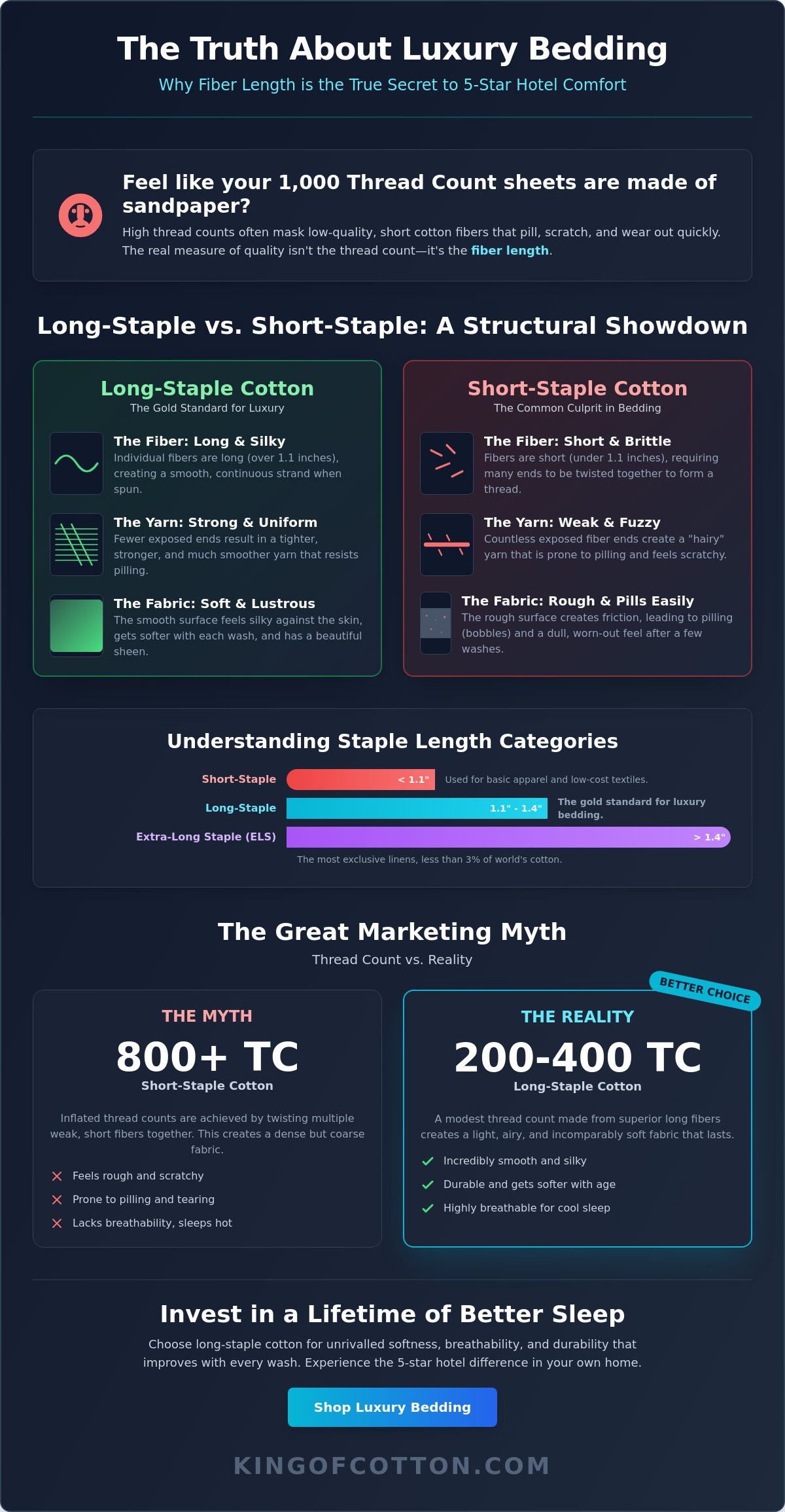
- Short-staple (Standard): These fibres are under 1.1 inches. They're commonly used for basic apparel and lower-cost household textiles where softness isn't the primary concern.
- Long-staple: Measuring between 1.1 and 1.4 inches, this is the gold standard for luxury bedding. It provides the perfect balance of strength and a smooth, lustrous handle.
- Extra-Long Staple (ELS): These fibres exceed 1.4 inches. Reserved for the most exclusive linens, ELS cotton represents less than 3% of the world's cotton harvest and commands the highest prices.
When you see "long-staple cotton explained" in a product description, it's a guarantee of a more refined weaving process. These longer strands create a continuous surface that reflects light better, giving your bedroom that unmistakable five-star hotel aesthetic.
Long-Staple vs. Short-Staple Cotton: A Structural Comparison
To understand long-staple cotton explained in a technical sense, we have to look at the microscopic structure of the plant's seed hair. Short-staple cotton fibres usually measure between 20mm and 25mm in length. In contrast, long-staple fibres reach lengths of 32mm to 35mm, while extra-long staples can exceed 38mm. This difference might seem small on paper, but it changes everything about how the yarn is spun and how the fabric behaves against your skin.
Longer fibres create a more continuous, uniform yarn surface. Because there are fewer "breaks" or join points in the fibre, the spinning process produces a thread that is remarkably smooth. This structural continuity is the secret behind the cooling, silky hand-feel that defines high-end bedding. Short fibres create a jagged yarn profile that feels scratchy and dull by comparison, as the numerous fibre ends create a rougher texture at the microscopic level.
Why Short Staples Lead to Pilling
Pilling is the primary enemy of a comfortable bed. The physics of pilling is simple: when you use short-staple cotton, the yarn contains thousands of tiny, loose fibre ends. Friction from your body moving during sleep causes these ends to poke out from the weave and tangle together. These tangles form the gritty little bobbles that make cheap sheets feel like sandpaper after a few months of use.
Long-staple fabrics remain smooth because the fibre ends are tucked deep within the yarn's core. This means your bedding stays soft and irritant-free even after 200 wash cycles. For sleepers with skin sensitivity, this lack of abrasion is essential for undisturbed rest. You won't find the same longevity in standard high-street options that rely on cheaper, shorter fibres.
Strength and Durability in the Weave
Tensile strength is directly tied to fibre length. During spinning, longer fibres wrap around each other more times than short ones do. This creates a much stronger bond that resists snapping under pressure. This extra strength allows manufacturers to spin much finer threads, which leads to a higher thread count without making the fabric heavy or stiff.
- The Tug Test: Long-staple bedding resists thinning and tearing at the seams, even with frequent daily use.
- Laundering: These fibres withstand the high temperatures required for hygienic cleaning in the UK hospitality sector.
- Fineness: Longer fibres result in a lighter, more breathable weave that doesn't sacrifice toughness.
This inherent durability is why luxury bed linen crafted from premium staples is a smarter long-term investment. While standard cotton might need replacing every year, a high-quality long-staple set can easily last a decade with proper care. If you're looking to upgrade your sleep environment, exploring our bedroom essentials is the first step toward lasting comfort.
The Performance Benefits of Long-Staple Bedding
Investing in premium linens is about more than just aesthetics; it's a commitment to better sleep health and long-term value. When we look at long-staple cotton explained through a performance lens, the primary advantage is the drastic reduction of fibre 'ends'. Because each individual fibre is significantly longer than standard cotton, there are fewer breaks in the yarn. This creates a surface that won't pill or become scratchy after six months of use. Instead, these high-quality threads actually soften with every laundry cycle, reaching their peak comfort after approximately five washes.
The structural integrity of these fibres allows for a variety of finishes that suit different preferences. The way long-staple cotton reflects light depends on the weave:
- Sateen Weave: Uses a four-over-one-under pattern to expose more of the long-staple surface, creating a signature lustrous sheen and a silky drape.
- Percale Weave: A classic one-over-one-under pattern that results in a matte finish and a crisp, breathable feel.
This hospitality-grade longevity means your bedding remains an asset to your home for years, rather than a disposable item that needs replacing every season. It's the same standard of durability required by the world's most prestigious hotels, now adapted for the modern British home.
Breathability and Temperature Regulation
Standard cotton often relies on thicker, coarser yarns to achieve strength, which can trap heat and lead to discomfort. Long-staple fibres are naturally stronger, allowing us to spin much finer, thinner yarns without sacrificing durability. This creates a fabric with millions of microscopic gaps that facilitate constant airflow. For the millions of people in the UK who identify as hot sleepers, this natural temperature regulation is essential. The moisture-wicking properties of these high-quality fibres ensure that perspiration is drawn away from the body, keeping the sleep environment dry and temperate throughout the night.
The 'Hotel Feel': Recreating 5-Star Luxury
The world's finest hotels exclusively use long-staple linens because they understand the psychological impact of sleep environment on guest satisfaction. A smooth, friction-free surface reduces skin irritation and helps lower cortisol levels, promoting faster sleep onset. This 'hotel feel' is characterized by a specific tactile weight and smoothness that standard cotton simply cannot replicate. For industry professionals looking to source these materials at scale, our comprehensive guide to hotel linen suppliers offers a deeper look into professional standards. By bringing these materials into your bedroom, you're not just buying sheets; you're recreating a sanctuary of elegance and rejuvenation that lasts.
Beyond Thread Count: The Great Marketing Misconception
For decades, shoppers have been conditioned to believe that a higher thread count automatically equals better quality. This is one of the most successful, yet misleading, marketing tactics in the textile industry. Thread count is the density of the weave, not the quality of the yarn. When long-staple cotton explained in its true context, it becomes clear that a 200-thread count sheet made from superior fibres will consistently outperform an 800-thread count sheet made from inferior, short-staple cotton.
The secret behind those impossibly high thread counts is often the "multi-ply" trick. Manufacturers take three or four weak, short-staple strands and twist them together to create a single "thread." They then count each individual strand in the weave, effectively quadrupling the advertised thread count without improving the fabric. These multi-ply yarns create heavy, coarse sheets that don't breathe well and are prone to pilling after just a few washes. In contrast, a single-ply, long-staple thread is smooth, strong, and fine, allowing for a breathable fabric that feels silkier against the skin and lasts for years.
The Truth About Egyptian and Giza Cotton
The "100% Egyptian Cotton" label is often used as a catch-all for luxury, but it refers to the provenance of the cotton rather than a specific quality standard. Cotton grown in the Nile Delta benefits from unique climatic conditions that produce extra-long fibres, with Giza cotton, specifically Giza 45 and Giza 94, representing the absolute gold standard of the industry. However, industry audits by organisations like the Cotton Egypt Association have previously found that up to 90% of products labelled as "Egyptian Cotton" contained no authentic Egyptian fibres at all. To protect our customers, we rely on rigorous standards and DNA testing to ensure that our linens meet the heritage and quality promised on the label.
How to Read a Bedding Label Like an Expert
To find true hotel-quality linens, you must look past the large numbers on the front of the packaging. Experts focus on the technical details found in the fine print. Look for the term "Single-ply" to ensure you aren't buying inflated thread counts. "Combed cotton" is another vital term; it refers to a process where shorter fibres and impurities are removed, leaving only the longest, strongest strands. Be wary of vague marketing terms like "Cotton rich," which usually indicates a blend containing up to 40% polyester, or "Super soft" labels that fail to specify the material origin. For a deeper look at why these details matter, read our Egyptian Cotton bedding guide.
When you understand how long-staple cotton explained by experts differs from marketing hype, you can make an informed investment in your sleep. True luxury isn't about the highest number; it's about the integrity of the fibre and the skill of the weaver.
Experience the difference of authentic, single-ply craftsmanship by browsing our luxury bed linen collection today.
Investing in Excellence: How to Shop for and Care for Long-Staple Cotton
Choosing the right bed linen is an investment in your daily well-being. Now that you've had long-staple cotton explained, you'll understand why these premium fibres are the gold standard for five-star hospitality. To replicate that hotel-style luxury at home, you must look beyond the thread count and focus on the integrity of the material and the expertise of the supplier.
When browsing, always check if the fabric is "combed." The combing process involves removing the shortest 15% of fibres and any remaining impurities. This ensures only the longest, strongest strands remain, preventing the pilling often found in budget alternatives. Since King of Cotton has been a specialist in fine Egyptian cotton for more than 25 years, we recommend sourcing from suppliers who have a proven history in the professional hospitality trade. This ensures your sheets withstand the test of time while maintaining their refined texture.
Choosing Your Weave: Sateen or Percale?
The weave you choose determines the tactile experience of your bed. Percale uses a traditional "one-over-one-under" structure. This creates a matte, breathable, and crisp finish that feels cool against the skin. It's the classic "freshly laundered" hotel feel that many prefer during warmer months. Sateen, however, uses a "four-over-one-under" pattern. This exposes more of the long-staple fibre's surface, resulting in a subtle sheen and a silky, heavier drape.
While both styles showcase the strength of long-staple cotton, sateen highlights the natural lustre of the fibre, whereas percale emphasizes its durability and breathability. Your choice depends on whether you prefer a cool, crisp touch or a warm, indulgent embrace. Both benefit from the reduced breakage associated with longer fibres, ensuring a smooth surface regardless of the weave.
Laundering for Longevity
The secret to keeping your linens soft is a gentle laundry routine. Harsh detergents and chemical fabric softeners actually coat the fibres, reducing their natural breathability and eventually making them brittle. You should opt for mild, biodegradable soaps to preserve the integrity of the cotton's "bloom," which is the way the fibres open up and soften over time.
- Temperature: Wash your linens at 30°C or 40°C. High temperatures can shrink the fibres and weaken the weave over time. For more specific seasonal advice, refer to our bedding wash temperature summer guide.
- Drying: Line drying is the best way to maintain fibre strength and achieve that fresh scent. If you must use a tumble dryer, select a low-heat setting and remove the sheets while they're still slightly damp to prevent permanent creasing.
- Storage: Keep your clean sets in a cool, dry linen cupboard. Avoid plastic storage bins, as these can trap moisture and lead to yellowing of the fabric.
By following these professional care steps, your long-staple cotton will actually become softer with every wash. It's a simple way to maintain a haven of elegance and comfort in your own home for years to come.
Elevate Your Sleep with the Ultimate Textile Investment
Investing in your sleep starts with understanding the materials that touch your skin every night. Now that you've had long-staple cotton explained, it's clear why these fibres are the gold standard for luxury linens. Unlike shorter alternatives, these extra-long fibres create a smoother, stronger surface that gets softer with every wash. They offer a structural integrity that lasts for years; this makes them a far more sustainable choice than standard cotton options.
King of Cotton has spent over 25 years as specialists in fine Egyptian and Giza cotton. We've earned our reputation as suppliers to the finest homes and hotels globally, maintaining an Excellent rating on Trustpilot through our commitment to craftsmanship. You don't have to settle for marketing gimmicks like inflated thread counts when you can choose genuine, professional-grade excellence.
Experience the difference of the world's finest fibres, shop our Long-Staple Bed Linen Collection.
Transform your bedroom into a sanctuary of elegance and comfort today.
Frequently Asked Questions
Is long-staple cotton the same as Egyptian cotton?
Not necessarily, although the two terms often overlap in the world of luxury bedding. Egyptian cotton refers to the plant's geographic origin, while long-staple refers to the actual length of the individual cotton fibers, which typically measure between 30mm and 35mm. While most authentic Egyptian cotton is long-staple, not all long-staple cotton comes from Egypt. Pima cotton grown in the US or Peru is another excellent example of this premium fiber category.
Does long-staple cotton wrinkle more than standard cotton?
Long-staple cotton actually wrinkles less than standard short-staple varieties because the fabric is naturally smoother and more resilient. Short-staple fibers have more ends that can catch and crease, whereas longer fibers create a supple, continuous surface that drapes elegantly. You'll find that a light steam or a quick tumble dry is usually enough to maintain a crisp, hotel-quality appearance. It's a practical choice for those who value a pristine bedroom aesthetic.
Why is long-staple cotton more expensive?
The higher price reflects the scarcity and the intensive harvesting process required for these elite fibers. Long-staple cotton represents only about 3% of the world's total cotton production and often requires hand-picking to preserve fiber integrity. While you might pay £20 to £50 more for a set of sheets, the investment pays off. These linens are 50% more durable than standard cotton, meaning they won't need replacing nearly as often as cheaper alternatives.
How can I tell if my sheets are truly long-staple?
You can identify genuine long-staple cotton by checking the product specifications for fiber length and looking for a lack of "pilling" after several washes. High-quality linens feel exceptionally smooth to the touch and possess a subtle, natural lustre. In this long-staple cotton explained guide, we recommend looking for brands with a 25-year history of supplying five-star hotels. If a price for a full set seems too low, it's likely a short-staple blend.
What is the best thread count for long-staple cotton bedding?
The ideal thread count for long-staple cotton usually falls between 300 and 600 for the best balance of breathability and softness. Some manufacturers claim counts of 1,000 or more, but these often use multi-ply yarns of lower quality to inflate the numbers. A 400-thread count single-ply percale or sateen made from long-staple fibers offers a silk-like feel that's far superior to high-count inferior blends. This is the standard choice for most luxury UK boutique hotels.
Can long-staple cotton be used for towels as well?
Long-staple cotton is an excellent choice for premium towels because it significantly increases both absorbency and durability. Longer fibers create more surface area to trap moisture, which means a 600gsm towel will dry you faster and stay plush for years. These towels don't shed as much lint as cheaper versions made from short fibers. This ensures your bathroom remains tidy while you enjoy a professional, spa-like experience every morning in your own home.
What happens to long-staple cotton if I wash it at high temperatures?
Washing long-staple cotton at temperatures above 60°C can damage the delicate fibers and lead to premature wear over time. While these fibers are stronger than standard cotton, excessive heat can cause up to 5% shrinkage and strip away the fabric's natural sheen. We recommend a 40°C cycle with a gentle detergent to preserve the integrity of the weave. This simple care routine keeps your bedding feeling luxurious and soft for well over 100 washes.
Is Pima cotton considered long-staple?
Pima cotton is a specific type of high-end long-staple cotton primarily grown in the United States, Australia, and Peru. It features fibers that are at least 35% longer than ordinary cotton, which results in a fabric that's incredibly soft and resistant to fraying. As this long-staple cotton explained overview shows, Pima stands out as a top-tier choice for those seeking ultimate comfort. It provides a luxurious feel and exceptional longevity without the specific branding of Egyptian origin.