

Why Are My Sheets Shrinking? An Expert Guide to Prevention and Care
What if the frustration of your fitted sheets popping off the corners isn't a sign of poor quality, but a manageable physical reaction to tension release? It's a question that often surfaces when you're left wondering, "why are my sheets shrinking," particularly after investing in premium linens designed for a refined lifestyle. We understand the disappointment of seeing luxury bedding lose its perfect drape. You shouldn't have to choose between a deep, hygienic clean and maintaining the elegant fit of your master suite.
This guide reveals the scientific reasons behind fiber contraction and shares the professional secrets used by high-end hospitality experts to keep linens perfectly sized for years. You'll explore how the latest 2026 industry standards, such as the updated AATCC Manual of International Test Methods, influence fabric performance. We'll help you master a laundry routine that preserves every millimeter and identify which materials naturally resist the cycle of shrinkage. By understanding these textile principles, you can protect your investment and ensure your sanctuary remains a place of serene, enduring comfort.
Key Takeaways
- Distinguish between initial relaxation shrinkage and the progressive contraction that occurs over multiple wash cycles.
- Identify the specific laundry habits, such as excessive heat and over-drying, that explain why are my sheets shrinking and how to avoid them.
- Learn why long-staple fibers and specific weave densities offer better dimensional stability for luxury bedding.
- Adopt professional hospitality techniques, including controlled moisture levels, to keep your linens supple and correctly sized.
- Master the art of selecting premium bedding by looking for pre-shrunk certifications and choosing dimensions that account for natural fiber movement.
The Science Behind Why Bed Sheets Shrink
Understanding the physics of textiles is the first step toward preserving your investment. When you ask, "why are my sheets shrinking," you're actually observing a complex release of energy stored within the fabric's structure. High-quality bed linen undergoes significant tension during weaving and finishing to achieve that pristine, smooth surface you admire in a boutique hotel suite. This tension isn't a flaw; it's a necessary byproduct of the craftsmanship required to create a refined finish.
Once those fibers encounter water and heat in your home laundry, they begin to return to their natural, relaxed state. This fundamental principle of The Science Behind Why Bed Sheets Shrink dictates how your bedding will fit your mattress over time. While thermal stress from a hot dryer is a common culprit, mechanical stress from high-speed agitation often causes more structural damage. The physical pounding in a washing machine forces fibers to rub and contract against one another, leading to a tighter weave than intended.
To better understand this concept, watch this helpful video:
Relaxation Shrinkage vs. Progressive Shrinkage
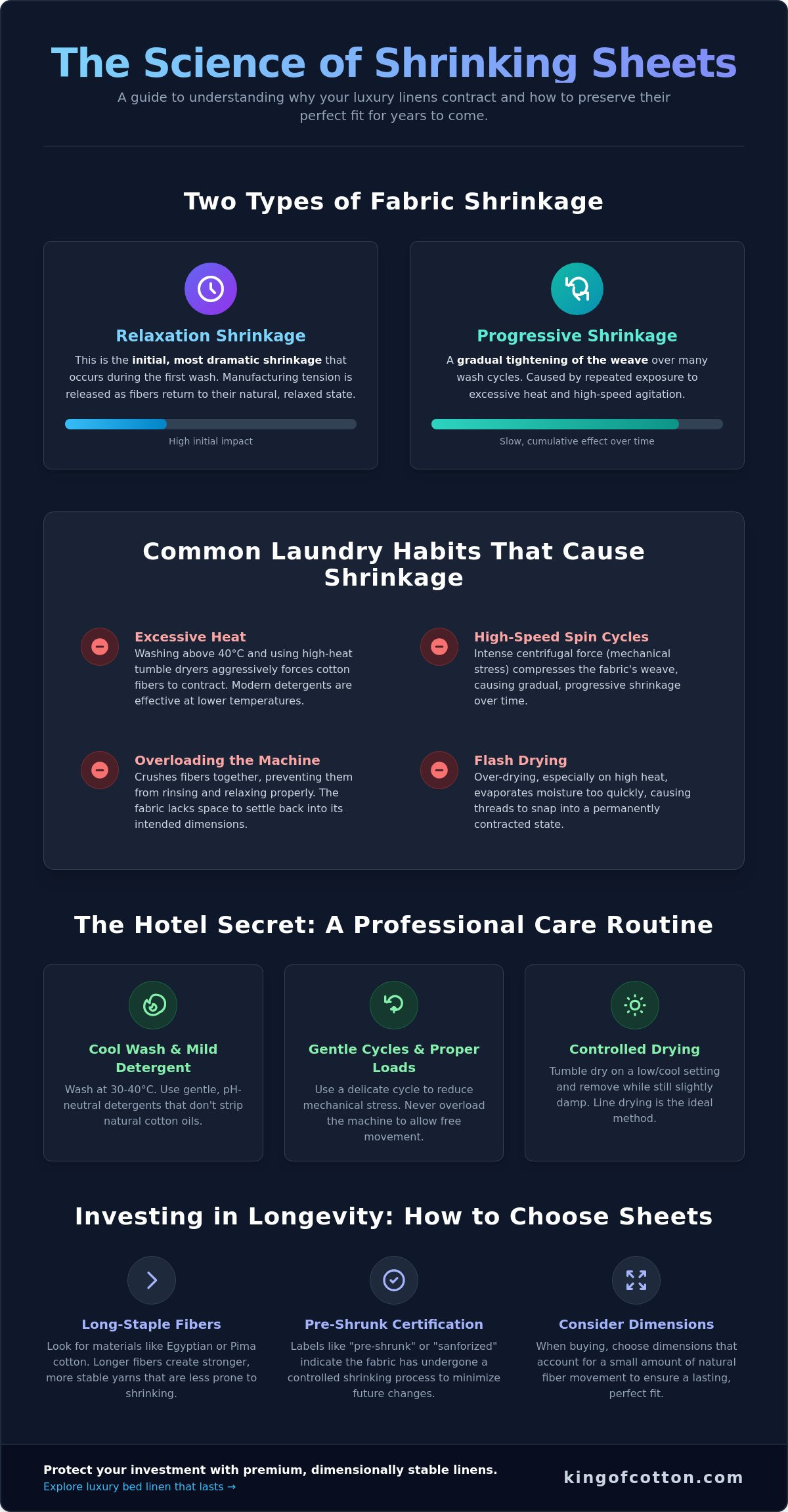
The first wash of new cotton linens is often the most dramatic. This is known as relaxation shrinkage. During manufacturing, yarns are pulled and stretched to create a uniform weave. When submerged in water, these fibers regain their original dimensions. If you've ever wondered why are my sheets shrinking despite a gentle cycle, it's often this necessary release of manufacturing tension. A quality sheet eventually reaches a point of equilibrium where it stops contracting. However, progressive shrinkage can occur over many months. This is a gradual tightening caused by repeated agitation and excessive heat that slowly pulls the weave closer together, bit by bit.
The Molecular Structure of Cotton
Cotton is composed of cellulose polymers held together by hydrogen bonds. When you wash your sheets, water molecules penetrate these fibers and break the existing bonds. This causes the fibers to swell, becoming shorter and fatter. It's a microscopic transformation that manifests as a smaller duvet cover or a tight fitted sheet. During the drying phase, the cellulose polymers form new, tighter hydrogen bonds as moisture evaporates, effectively locking the fibers into a more compact configuration.
Common Laundry Habits That Cause Bedding to Shrink
Many homeowners unknowingly compromise their linens through routine maintenance. If you've found yourself asking Common Laundry Habits That Cause Bedding to Shrink, the answer often lies in the settings of your appliances. Excessive heat is the primary catalyst for fiber contraction. Modern detergents are engineered to be effective at lower temperatures, making the traditional 60°C wash unnecessary for most residential needs. High heat doesn't just clean; it aggressively forces the microscopic fibers to tighten.
Mechanical stress is equally influential. High-speed spin cycles apply immense centrifugal force, compressing the fabric weave and leading to "progressive shrinkage" over time. Similarly, overloading the drum prevents the fabric from rinsing and relaxing properly. When fibers are crushed together during the cycle, they lack the space to settle back into their intended dimensions. Harsh detergents with high alkalinity further exacerbate this by stripping the natural oils from cotton, leaving it brittle. If you're looking to upgrade your sleep experience, exploring a collection of high-quality luxury bed linen can provide a more resilient foundation for your bedroom.
The Tumble Dryer: Friend or Foe?
Tumble drying is often where the most significant damage occurs through "flash drying." This happens when the surface moisture evaporates too quickly, causing threads to snap into a contracted state. This sudden loss of moisture is a key reason why are my sheets shrinking after only a few months of use. To maintain the supple feel of your bedding, always use a cool-down cycle. This gradual reduction in temperature prevents set-in shrinkage. Aim for a "damp-dry" state, where the fabric feels slightly cool to the touch, allowing it to air-dry for the final few minutes.
Washing Temperature Myths
The Victorian legacy of "boiling" linens to ensure hygiene is a relic of the past. Today's luxury textiles require a more sophisticated approach. Washing at 30°C to 40°C preserves the structural integrity of the fibers while still achieving a pristine clean. If you're concerned about bacteria, consider a dedicated sanitizing rinse rather than subjecting the entire fabric to high-thermal stress. This measured approach ensures your sanctuary remains both hygienic and perfectly sized without the risk of premature wear.
How Material Quality and Weave Influence Shrinkage
The architecture of the fabric itself often determines how it survives the laundry cycle. While laundry habits play a significant role, the inherent properties of the textile provide the foundation for dimensional stability. Discerning buyers often find themselves asking How Material Quality and Weave Influence Shrinkage when even careful washing results in a tighter fit. This happens because different weaves and fiber lengths react uniquely to the introduction of moisture and mechanical energy. Premium manufacturers understand this and often engineer a specific "shrinkage allowance" into their designs, cutting linens slightly larger than mattress dimensions to ensure a perfect fit after the initial relaxation wash.
Synthetic blends, such as polyester and cotton mixes, are frequently lauded for their dimensional stability. Polyester fibers don't absorb water in the same way natural cellulose does, which means they're far less prone to the swelling and contraction described in previous sections. However, these blends often sacrifice the breathability and indulgent feel of pure natural fibers. For those who prioritize the serene comfort of a luxury suite, understanding the nuances of cotton quality is essential to solving the puzzle of why are my sheets shrinking.
The Egyptian Cotton Advantage
Fiber length is perhaps the most critical factor in a sheet's longevity. Long-staple and extra-long-staple fibers, characteristic of authentic Egyptian varieties, possess fewer ends per square inch of yarn. This structural integrity means the fibers are less likely to pull apart or migrate during agitation. Investing in high-quality Egyptian cotton bedding is a superior investment for size retention because the inherent strength of the long-staple fibers resists the mechanical stress that causes shorter fibers to bunch and pill. When fibers are pure and long, the fabric maintains its smooth, expansive drape wash after wash.
Understanding Weave Density
The way threads are interlaced also dictates how much space they have to move. Percale, a classic one-over-one plain weave, is known for its crisp, matte finish and exceptional durability. Because the threads are tightly and evenly locked, there's less opportunity for the fibers to shift or contract significantly. In contrast, Sateen uses a four-over-one weave to create its signature lustrous sheen. While beautiful, this structure has longer "floats" of yarn on the surface, which require more delicate handling to prevent the fibers from pulling closer together. A higher thread count can act as a physical barrier to fiber migration; however, this only holds true if the quality of the yarn matches the density of the weave.
The Hotel Secret: Professional Care to Preserve Linen Dimensions
High-end hotels subject their linens to rigorous daily washing, yet these sheets consistently maintain a crisp, expansive fit that feels like a bespoke upgrade to the sleep experience. If you've struggled with the question of why are my sheets shrinking at home, the answer lies in the specialized techniques used by professional laundries. Unlike residential care, which often involves high-heat tumble drying until every drop of moisture is gone, professionals understand that bone-dry fibers are brittle and prone to contraction. By maintaining a level of controlled moisture retention, experts ensure that the cotton polymers remain supple and resilient.
Another cornerstone of professional care is the use of commercial-grade detergents that contain fiber lubricants. These specialized formulas reduce the friction during high-speed agitation cycles, preventing the mechanical stress that leads to progressive shrinkage. Additionally, prestigious establishments practice the art of "resting" their linens. By rotating three sets of bedding per room, fibers have time to recover their natural shape between uses, which significantly extends the lifecycle of the product. You can achieve this same level of endurance by exploring the professional-grade bed linen collections designed for both residential and commercial excellence.
Industrial Pressing and Calendering
The secret to that taut, oversized look in a five-star suite is the industrial calender. These are large, heated rollers that apply immense pressure and tension as they press the fabric. This process effectively "stretches" the fibers back to their intended dimensions, reversing any minor contraction from the wash. You can replicate this effect at home by using a high-pressure steam iron while the fabric is still slightly damp. For fitted sheets, employ the "Pull and Shape" method; gently stretch the elasticated corners while the material is moist to ensure they retain the depth required for your mattress.
Why Hotels Buy "Oversized"
Experienced hotel linen suppliers operate with the knowledge that all natural fibers will experience some degree of relaxation. The industry standard involves engineering products with a 2% to 5% anticipated shrinkage allowance. This means a sheet is technically "too large" when it first arrives, but fits perfectly after its initial encounter with water. A 2025-2026 report indicated that 44% of consumers cite "wrong size" as a primary frustration with home textiles, a statistic that underscores why are my sheets shrinking is such a common grievance. At King of Cotton, we apply these exact hospitality benchmarks to our residential products, ensuring your sanctuary maintains its elegant proportions for years to come.
Investing in Longevity: How to Choose Sheets That Keep Their Shape
Selecting luxury linens is an investment in your personal well-being and the aesthetic of your home. To ensure this investment provides years of comfort, you must look beyond the surface level of thread count and colour. High-end textiles often feature "Sanforized" or pre-shrunk labels. This specialized manufacturing process involves stretching and shrinking the fabric under controlled conditions before it's cut and sewn. It significantly reduces the mystery of why are my sheets shrinking after you get them home. By choosing bedding from specialists with a deep hospitality heritage, you're opting for products engineered to withstand the rigors of professional care while maintaining their elegant proportions.
Establishing a "three-set" rotation is another professional secret to longevity. One set remains on the bed, one stays in the wash, and one rests in the linen cupboard. This practice prevents the fibers from becoming overworked and allows the natural cotton polymers to settle between uses. It's a simple habit that mirrors the standards of the world's most prestigious hotels, ensuring your bedroom remains a sanctuary of rejuvenation. When you prioritize quality and proper rotation, you mitigate the mechanical stress that leads to premature wear.
Size Matters: The Case for Deep Pockets
A common error in bedding selection is purchasing a fitted sheet that matches the mattress depth exactly. If you have a 30cm mattress, a 30cm sheet will almost certainly become too small after the initial relaxation shrinkage. We recommend choosing extra deep fitted sheets, such as a 40cm pocket for a 30cm mattress. This provides a generous allowance for natural fiber contraction and prevents the "torn corner" syndrome caused by excessive tension. For precise measurement tips to avoid the frustration of why are my sheets shrinking, refer to our UK Bed Size Guide.
The King of Cotton Quality Guarantee
Our commitment to excellence begins at the fiber level. We select only the finest long-staple cotton to ensure minimal progressive shrinkage over years of use. This meticulous selection process guarantees that our linens retain their lustrous feel and perfect fit, wash after wash. You don't have to settle for bedding that loses its shape; instead, you can enjoy the enduring quality of a brand trusted by global hospitality leaders. Explore our full range of luxury bed linen designed to bring the five-star experience into your home. Ready to transform your sleep? Shop the Collection today and invest in the comfort you deserve.
Mastering the Art of Bedding Longevity
Understanding the science behind your linens transforms how you care for your sanctuary. You've discovered that the frustration behind why are my sheets shrinking stems from manageable factors; ranging from the physics of relaxation shrinkage to the impact of high-heat laundry habits. By prioritizing long-staple Egyptian cotton and adopting the professional techniques used in world-class hospitality, you ensure your bedding remains as expansive and inviting as the day it was first draped across your bed.
Investing in quality means selecting expertly engineered textiles that account for natural fiber movement. As a trusted provider to the world's finest hotels, we offer premium Percale and Egyptian cotton options designed for minimal progressive shrinkage and enduring elegance. It's time to bring that international standard of excellence into your own home through materials that refuse to compromise on size or softness.
Upgrade to Hotel-Quality Bed Linen That Lasts
Experience the serene confidence that comes with perfectly sized, luxurious linens. Your journey to a more refined lifestyle begins with the right materials and the expert knowledge to preserve them for years to come.
Frequently Asked Questions
Do 100% cotton sheets always shrink?
All 100% cotton sheets will experience some degree of shrinkage due to their natural composition. This initial contraction, known as relaxation shrinkage, occurs when the tension applied during weaving is released by water. While high-quality linens are expertly engineered to minimize this effect, you should expect a slight change in dimensions after the first few encounters with moisture. This is a hallmark of genuine natural fibers rather than a defect.
Can you un-shrink cotton sheets once they have contracted?
You can partially restore the dimensions of contracted sheets through moisture and tension. While you cannot truly "un-shrink" the fibers at a molecular level, using a high-pressure steam iron on damp fabric can stretch the weave back toward its original size. This process mimics the industrial calendering used in professional laundries. For best results, gently pull the fabric into shape while it is still slightly wet before finishing with a warm iron.
Does thread count affect how much a sheet will shrink?
Thread count does influence dimensional stability, but it is not the only factor. A higher thread count often creates a denser weave that provides more resistance to fiber migration. However, the length of the staple is more critical. Long-staple Egyptian cotton resists the mechanical stress that leads to pilling and contraction better than short-staple varieties, regardless of the specific thread count. A dense, high-quality weave remains the gold standard for size retention.
Is it better to air dry or tumble dry sheets to prevent shrinking?
Air drying is the superior method for preventing shrinkage and preserving the life of your linens. Tumble drying subjects fibers to "flash drying" and intense mechanical agitation, which are the primary reasons why are my sheets shrinking prematurely. If you must use a dryer, select a low-heat setting and remove the sheets while they are still slightly damp. This allows the fibers to settle naturally without becoming brittle or overly contracted.
Why does my fitted sheet no longer fit my mattress after one wash?
Your fitted sheet likely no longer fits because of the release of manufacturing tension during the first wash. This relaxation shrinkage is most dramatic during the initial cycle as the fibers return to their natural state. If the sheet was not designed with a generous shrinkage allowance or "extra deep" pockets, it may become too tight for the mattress. Ensuring you have a pocket depth that exceeds your mattress height by at least 10cm prevents this frustration.
What temperature should I wash luxury cotton sheets to avoid shrinkage?
Luxury cotton sheets should ideally be washed at 30°C to 40°C to avoid excessive thermal stress. While modern detergents are highly effective at these lower temperatures, high heat remains a leading cause for people wondering why are my sheets shrinking. Avoiding temperatures above 60°C protects the delicate hydrogen bonds within the cellulose fibers. This measured approach ensures your bedding remains hygienic without compromising the elegant fit and supple texture of the fabric.
Should I buy a larger size sheet to account for potential shrinking?
It is often wise to purchase slightly larger sheets or those labeled as "extra deep" to account for natural contraction. Premium hospitality-grade suppliers typically engineer their products with a 2% to 5% shrinkage allowance to ensure a perfect fit after the first wash. By choosing a generous size from the start, you avoid the strain on the elastic and corners that occurs when a sheet becomes too small for the mattress.
How many washes does it take for a sheet to fully shrink?
Most sheets reach a state of "equilibrium" after approximately three to five wash cycles. While the most significant change occurs during the first wash, progressive shrinkage can continue if the fabric is repeatedly subjected to high heat or aggressive agitation. Once the fibers have fully relaxed and settled into their permanent configuration, the dimensions should remain stable, provided you follow a gentle care routine that respects the integrity of the material.