

How to Stop a Duvet Cover Slipping: Professional Secrets for a Perfect Bed
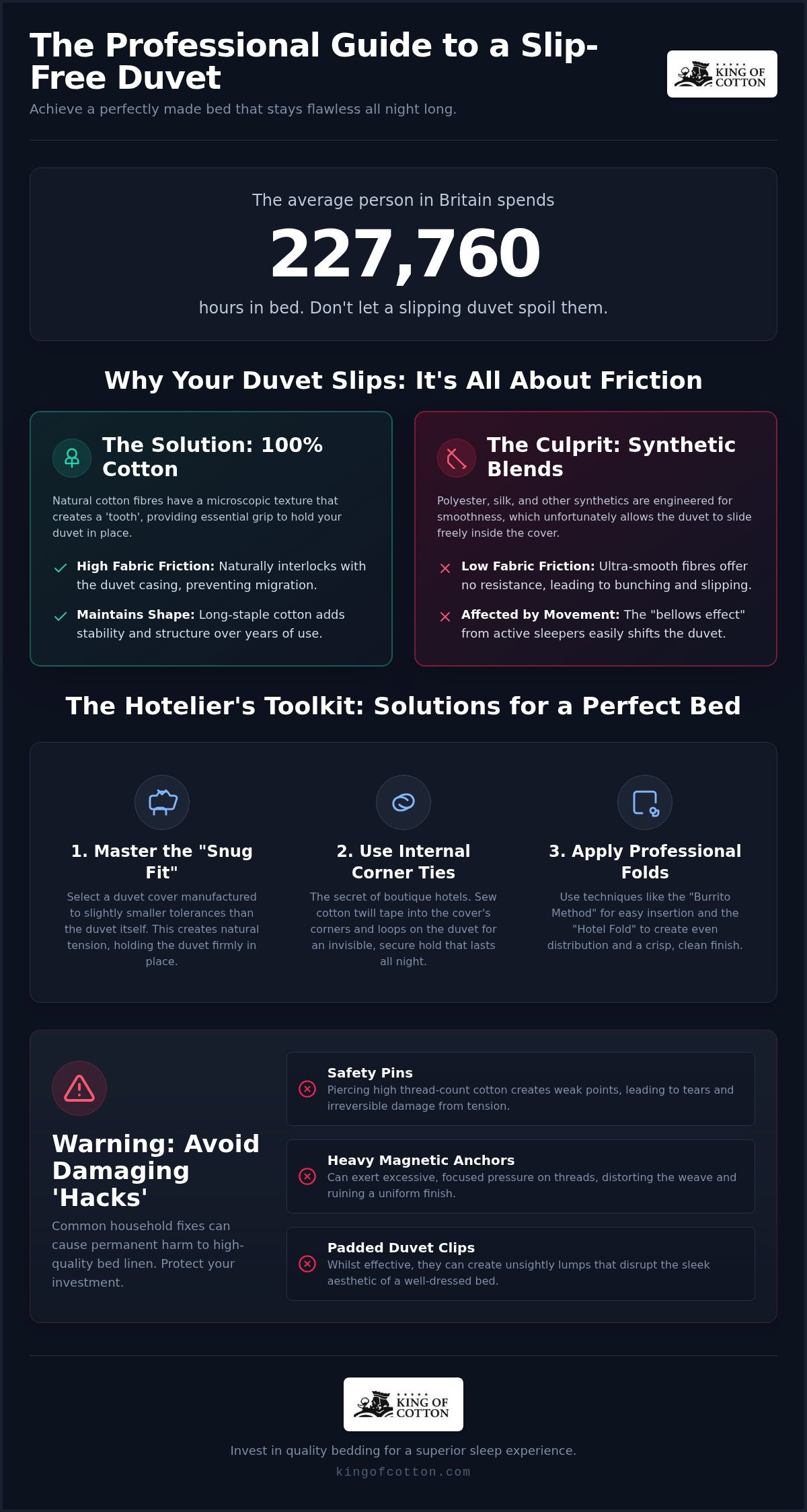
The average person in Britain spends 227,760 hours in bed during their lifetime, yet for many, those hours are marred by the midnight wrestle with a bunching duvet. It's incredibly frustrating to wake up cold because your duvet has migrated to the foot of the bed, or to spend every morning vigorously shaking out your linen to restore order. Learning how to stop duvet cover slipping isn't just about aesthetics; it's about reclaiming the restorative sleep you deserve. If you've ever feared that clips or pins might damage your expensive Egyptian cotton, you aren't alone.
We'll share the professional secrets and material insights used by five-star hotels to ensure a perfectly weighted, even bed all night long. You can achieve that serene, indulgent atmosphere at home by understanding the delicate balance of tension and friction. This guide explores why natural fibres like 100% cotton provide a superior grip compared to slippery synthetic blends. We'll also examine the importance of precision UK sizing and the latest 2026 trends in built-in fasteners, giving you the tools to maintain a crisp, refined bed that stays flawless until morning.
Key Takeaways
- Learn why 100% cotton fibres provide a natural "tooth" and grip that prevents the sliding often found in synthetic polyester blends.
- Master the "Snug Fit" rule to understand how to stop duvet cover slipping by selecting a cover manufactured to slightly smaller tolerances than the duvet.
- Discover the "Burrito Method" and the "Hotel Fold," professional techniques used by five-star housekeepers to maintain even distribution and tension.
- Understand the risks associated with household hacks like safety pins, which can permanently damage the structure of high-quality bed linen.
- Recognise the importance of long-staple cotton in maintaining the shape and stability of your bedding over years of use.
The Physics of Bedding: Why Your Duvet Bunches and Slips
To understand how to stop duvet cover slipping, we must first examine the mechanical forces at play within your bed. Bedding stability relies almost entirely on "fabric-on-fabric friction," which is the resistance encountered when two textile surfaces interact. Ideally, your duvet and its cover should move as a single, cohesive unit. However, if the friction between the inner duvet casing and the outer cover is too low, the duvet will inevitably begin to migrate towards the corners or the foot of the bed. What is a duvet? At its core, it is a quilted bag filled with insulating materials, and mastering how to stop duvet cover slipping starts with understanding this relationship.
Synthetic vs Natural Fibres: The Friction Factor
The primary culprit behind a bunching bed is often the material composition of the linen. Synthetic polyester blends are engineered for durability and smoothness, but this lack of surface texture means they lack the natural "tooth" required to grip the duvet casing. In contrast, 100% cotton fibres possess microscopic irregularities that allow them to naturally "interlock" with the duvet insert. Silk or high-polyester covers are the most prone to slipping because their surfaces are essentially too efficient, allowing the duvet to slide freely within the cover. Textile friction functions as a silent anchor that maintains the structural integrity of a well-dressed bed.
The Impact of Sleep Behaviour on Bedding Stability
Your physical behaviour during sleep plays a significant role in how well your bedding stays in place. "Active sleepers" who turn frequently create a "bellows effect," pushing air and "dead space" into the cover which encourages the duvet to shift. This issue is magnified in larger beds, such as King and Super King sizes, where the increased surface area provides more room for fabric migration. Gravity also exerts a constant pull; a high tog weight duvet is significantly heavier and more prone to sliding downwards if the cover isn't perfectly fitted. For those seeking a more stable and luxurious night's sleep, our Bedroom Collection offers high-friction cotton options specifically designed to minimise this movement and ensure your bed remains a sanctuary of order.
Immediate Fixes: From Duvet Clips to Household Hacks
When the physics of friction fail, many turn to external fasteners as a quick remedy. Padded duvet clips are a popular choice. These small, cushioned devices grip the corners of the duvet through the cover, providing a firm hold that prevents vertical slipping. Whilst they are effective, they can be bulky; they often create a visible lump that disrupts the sleek, flat aesthetic of a professionally dressed bed. They serve as a functional stop-gap, but they don't address the underlying issue of fabric quality.
The "Safety Pin Hack" is another common suggestion, but we strongly advise against it for high-quality bed linen. Piercing the intricate weave of 300 to 600 thread-count cotton creates structural weak points. Over time, the tension of the duvet pulling against the pin will lead to unsightly tears and permanent damage to your investment. We also suggest avoiding heavy magnetic anchors. These can exert excessive pressure on specific threads, distorting the weave and ruining the uniform finish of fine sateen or percale. Mastering how to stop duvet cover slipping requires a more sophisticated approach that respects the integrity of the fabric.
Using Internal Ties and Ribbons
Boutique hotels frequently utilise internal corner ties to maintain a flawless finish. This method involves sewing short lengths of cotton twill tape into the inside corners of the duvet cover and corresponding loops onto the duvet itself. To secure the bed, simply thread the tape through the loop and tie a firm bow. Cotton twill is the preferred material because its herringbone weave provides a non-slip surface that stays knotted throughout the night. This approach offers a secure, invisible solution that doesn't compromise the softness of the bed.
The Pros and Cons of Bedding Fasteners
If sewing isn't an option, various commercial fasteners can help you understand how to stop duvet cover slipping without permanent modifications. Plastic "mushroom" clips and snap buttons are inexpensive and widely available. However, these hard components can be uncomfortable if you happen to kick them during the night. For a more refined experience, look for soft-shell fasteners or silicone-based grips. These alternatives provide the necessary tension without the risk of scratching skin or damaging delicate fibres. If your current bedding continues to shift despite these efforts, it may be time to consider the superior structure of professional-grade textiles.
The Professional Solution: Precision Sizing and Weave Selection
The most effective way to understand how to stop duvet cover slipping is to address the fit before the bed is even made. A common misconception amongst homeowners is that bedding sizes are universal. In reality, a "Double" duvet from one manufacturer might measure 200cm x 200cm, whilst a "Double" cover from another could be cut to 205cm. This seemingly minor discrepancy creates five centimetres of slack, providing the perfect environment for the duvet to shift and bunch. Professional-grade linen, such as our Egyptian cotton bedding, is manufactured to strict size tolerances to ensure this "dead space" is eliminated from the outset.
To achieve a five-star finish, we recommend the "Snug Fit" rule. Choosing a duvet cover that is approximately 5cm smaller than the duvet itself creates internal tension. This pressure forces the duvet filling to expand fully into every corner, effectively locking it in place through volume alone. This method is a preferred secret of high-end housekeepers because it creates a plump, inviting aesthetic whilst naturally preventing the duvet from migrating during the night.
UK Bedding Size Matching Table
Matching your dimensions precisely is the foundation of a stable bed. For a comprehensive look at all available options, you can consult The Definitive UK Bed Size Guide. Below are the standard 2026 UK dimensions and their corresponding stability ratings when paired correctly.
| UK Size Name | Standard Duvet (cm) | Ideal Cover (cm) | Stability Rating |
|---|---|---|---|
| Double | 200 x 200 | 195 x 195 | Excellent |
| King | 230 x 220 | 225 x 215 | Excellent |
| Super King | 260 x 220 | 255 x 215 | High |
Weave Choice: Percale vs Sateen for Stability
The specific weave of your fabric dictates how much "grip" the cover has on the duvet insert. Percale is the industry standard for crisp, cool hotel linen. Its one-over-one-under weave creates a matte surface with a subtle texture that naturally adheres to the duvet casing. This increased friction makes it the most stable choice for active sleepers. Sateen, whilst incredibly luxurious and soft, features a four-over-one-under weave that produces a lustrous, silky finish. This smoothness makes sateen more "fluid," which can lead to more movement if the sizing isn't perfectly calibrated. For a duvet that refuses to budge, the matte finish of a high-quality Percale weave is an expert’s first choice.
By selecting high-quality natural fibres, you ensure the cover maintains its structural integrity over time. Cheaper synthetic blends often stretch after a few washes, leading to "cover sag" that no amount of shaking can fix. Investing in professional-grade cotton ensures your dimensions remain true, providing a permanent answer to how to stop duvet cover slipping.
How Five-Star Hotels Ensure a Flawless Bed Every Night
The world's most prestigious hotels rarely rely on external fasteners or plastic clips. Instead, they achieve a crisp, immobile finish through rigorous technique and specific material choices. Professional housekeepers often prefer 100% cotton "bag-style" covers. Unlike residential covers that may use bulky buttons or zippers, these feature an internal envelope closure. This design provides a tighter, more uniform fit that is central to how to stop duvet cover slipping. It effectively eliminates the gaps where fabric typically bunches at the edges.
Daily maintenance is a non-negotiable standard in luxury hospitality. Every morning, the bed is stripped of its pillows and the duvet is pulled taut towards the headboard before being smoothed down. The "Hotel Fold" is then applied at the foot of the bed. By tucking the excess cover firmly under the mattress, housekeepers create a point of tension. This acts as a natural anchor, preventing the duvet from sliding downwards during use. This simple act of creating tension addresses the "dead space" issues discussed earlier, ensuring the bed remains as stable as it is beautiful.
The Professional "Burrito" Fitting Technique
The "Burrito Method" is a trade secret that ensures even duvet distribution from the moment the bed is made. It effectively eliminates the "empty corners" that often lead to a sliding duvet. We suggest making this a weekly habit during every linen change.
- Turn your duvet cover inside out and lay it flat across the bed with the opening at the foot.
- Place your duvet directly on top, aligning all four corners precisely with the edges of the cover.
- Starting from the head of the bed, roll the cover and duvet together into a tight, uniform cylinder.
- Reach into the opening at the foot, pull the cover over the roll, and unroll it back towards the headboard.
Hospitality Standards: The "Triple Sheet" Alternative
For those who find traditional covers cumbersome, many luxury resorts utilise "triple sheeting." This involves sandwiching a duvet between two high-quality flat sheets. The bottom sheet is fitted, followed by a middle flat sheet, the duvet, and a final flat sheet on top. This method eliminates the "cover slip" problem entirely because the duvet is held in place by the weight and friction of multiple layers of crisp cotton. To achieve this look at home, you can find the necessary components in our Luxury Bed Linen collection. Using professional-grade flat sheets ensures the "sandwich" remains stable and looks impeccably refined.
If you're ready to upgrade your sleep experience with the same materials used by the world's finest hotels, explore our full range of professional-grade bed linen today.
Investing in Longevity: Why King of Cotton Bedding Stays Put
King of Cotton’s legacy is built upon the demanding standards of the global hospitality industry. For decades, we've supplied the world’s most prestigious hotels with textiles that must perform flawlessly night after night. This heritage is the foundation of our design philosophy; we understand that a luxury bed is only as good as its structural integrity. Whilst high-street linens often lose their shape after a few laundry cycles, our professional-grade Egyptian cotton is engineered to maintain its exact dimensions. This precision is a vital component in your quest for how to stop duvet cover slipping, as it ensures the "Snug Fit" remains constant for years.
The secret to this enduring stability lies in the use of long-staple cotton fibres. Unlike short-staple alternatives that can fray and weaken, long-staple fibres create a smoother, stronger yarn. This strength prevents the fabric from stretching or becoming "baggy" over time. When a cover stretches, it creates the very "dead space" that allows a duvet to migrate and bunch. By investing in superior materials, you're choosing a fabric that naturally grips the duvet insert and refuses to yield to the stresses of natural sleep movements. Our rigorous quality control ensures that every piece of linen meets the strict size tolerances required by professional housekeepers.
The Benefit of Professional-Grade Durability
Hotel linen is specifically designed to remain crisp and substantial even after hundreds of industrial washes. This durability is essential for maintaining a slip-free bed. Cheaper linens often become limp and thin as the fibres break down, resulting in a surface that is too smooth and lacks the necessary friction to hold a duvet in place. King of Cotton designs incorporate secure closures and reinforced stitching to ensure the cover remains a tight, protective envelope. This professional-grade construction is the most effective long-term answer to how to stop duvet cover slipping, providing a permanent solution rather than a temporary fix.
Completing the Hotel Experience at Home
A truly stable bed is a holistic system where every element works in harmony. We suggest pairing your stable duvet cover with luxury pillows that provide the correct loft to support the head of the duvet. Additionally, using extra deep fitted sheets helps to anchor the entire bed set, providing a firm, flat base that reduces the overall movement of the top layers. When every component is manufactured to the same exacting standards, the result is a sleep environment that remains as pristine at 4:00 am as it was when you first turned down the covers.
Ready to transform your bedroom into a sanctuary of refined comfort? Shop the professional Bed Linen collection at King of Cotton and experience the difference that heritage-grade quality makes to your sleep.
Achieve the Flawless Finish of a Five-Star Suite
Mastering the art of a perfectly dressed bed is a hallmark of a refined lifestyle. You've discovered that the definitive answer to how to stop duvet cover slipping lies in the union of precision UK sizing and the natural friction of 100% long-staple Egyptian cotton. By applying professional techniques like the "Burrito Method" and adhering to the "Snug Fit" rule, you can eliminate the dead space that leads to midnight bunching and restorative sleep interruptions.
As a trusted supplier to the world's most prestigious hotels, King of Cotton provides the same professional-grade durability and structural integrity used in five-star suites globally. Our linens are manufactured to strict tolerances, ensuring they maintain their crisp, grippy texture through countless laundry cycles. Upgrade to professional hotel-quality bed linen today and transform your bedroom into a sanctuary of serene, uninterrupted comfort. You deserve the indulgence of a bed that stays flawlessly in place until morning.
Frequently Asked Questions
What is the best thread count to stop a duvet slipping?
The ideal thread count for stability lies between 300 and 600. Whilst it's tempting to seek the highest number possible, thread counts exceeding 800 often utilise thinner yarns that create an ultra-smooth, almost slippery surface. A crisp 300 or 400 thread count Percale offers the perfect balance of luxury and "grip," providing enough textile friction to keep your duvet securely in place throughout the night.
Can I use safety pins to hold my duvet in place?
We strongly advise against using safety pins on premium bed linen. Although they offer a quick solution, the metal pins create structural weak points in the fabric. As you move during sleep, the tension will inevitably cause the pins to tear through the delicate cotton threads. This leads to permanent damage and unsightly holes that compromise the longevity and elegance of your investment.
Why is my duvet cover bigger than my duvet?
Manufacturing variances mean that a standard "Double" can vary by up to 10cm between different brands. If your cover is larger than the duvet, it creates "dead space" that encourages the filling to migrate and bunch. To understand how to stop duvet cover slipping, always verify the exact centimetre dimensions of both items. Aim for a "Snug Fit" where the cover is slightly smaller than the duvet.
Do silk duvet covers slip more than cotton?
Silk and high-polyester fabrics are significantly more prone to slipping than 100% cotton. Their ultra-smooth, lustrous surfaces lack the natural "tooth" or microscopic irregularities needed to anchor the duvet casing. For those who prioritise a bed that stays flawlessly in place, a matte Percale weave is the professional's choice. It provides the necessary friction to prevent the internal duvet from sliding towards the foot of the bed.
How do I add ties to a duvet cover?
You can easily add ties by sewing 15cm lengths of cotton twill tape into the four internal corners of your cover. Sew corresponding loops onto the corners of your duvet insert. This creates a secure, invisible anchor system that mirrors the standards found in boutique hotels. Cotton twill is preferred because its herringbone weave is naturally non-slip, ensuring the knots remain firm and don't come undone.
What is the "Burrito Method" for duvet covers?
The Burrito Method involves laying your cover inside out, placing the duvet on top, and rolling them together into a tight cylinder. Once rolled, you pull the cover opening over the ends and unroll it. This technique is a favourite amongst professional housekeepers because it ensures perfect alignment. It's a highly effective way to master how to stop duvet cover slipping by eliminating empty corners from the start.
Does a higher tog duvet slip more easily?
Heavier duvets, such as those with a 13.5 or 15 tog rating, are more susceptible to gravity-induced slipping. The increased weight exerts a constant downward pull, which is particularly noticeable in larger King or Super King sizes. When using high-tog winter bedding, it is essential to use a cover with a "Snug Fit" and high-friction natural fibres to counteract this extra weight and prevent migration.
How do hotels keep their duvets so flat and even?
Hotels achieve a flat, even finish through precision sizing and the "Hotel Fold." By tucking the excess cover tightly under the mattress at the foot of the bed, housekeepers create a point of tension that acts as a natural anchor. Daily maintenance, including pulling the duvet taut towards the headboard and smoothing it down every morning, prevents the filling from settling or bunching in one area over time.