

Best Towels That Dry Quickly: How to Choose the Right One
The thickest towel isn’t always the best choice if you want it ready to use again soon. The best towels that dry quickly balance weight, weave and absorbency, so a towel feels comfortable without staying damp between uses.
If yours takes ages to dry, or product descriptions leave you unsure what GSM really tells you, you’re not alone. GSM is a useful comparison point, but it doesn’t tell the whole story. Material, construction and the air around a hanging towel all affect how quickly it dries.
This guide explains how those factors work together, from airy weaves and lighter cotton towels to plush, heavier options. You’ll learn what to look for when choosing a towel for your bathroom, gym bag or travels, and how to compare GSM without treating it as the only measure of quality. We’ll also cover practical care and drying habits to help towels stay fresh and ready for the next use.
Key Takeaways
- The best towels that dry quickly balance drying speed with the softness and absorbency you want.
- Use GSM as one comparison point, then consider how the towel’s material and construction affect its feel and drying.
- Choose hand, bath and guest towels according to how they’ll be used and the space available to hang them.
- Spread towels out after use and check they dry fully to help keep them fresh between uses.
- Compare your bathroom conditions, priorities, towel specifications and care instructions before choosing.
What makes the best towels that dry quickly?
A towel that’s still damp when you reach for it again can make a simple daily routine feel less fresh. No single feature guarantees fast drying. Weight, pile, fibre and weave all influence how much water a towel holds and how readily air can move through it. How you hang it and the humidity in your bathroom matter too.
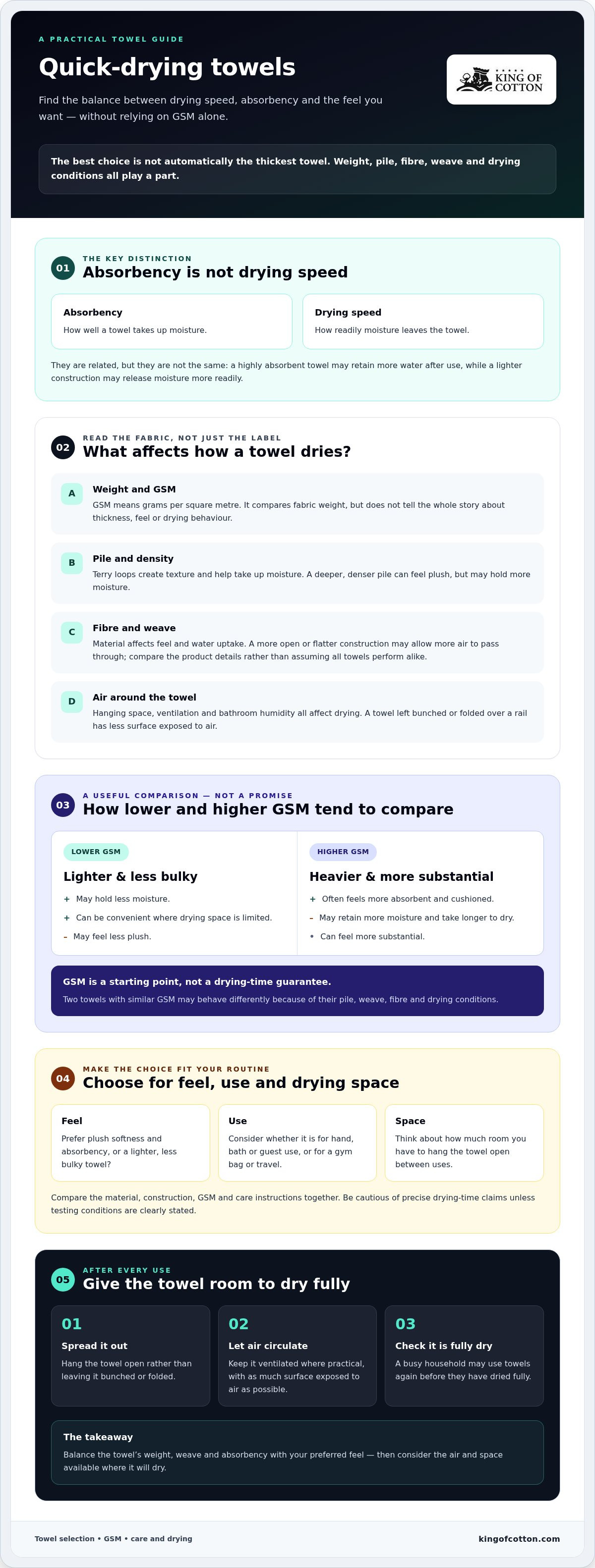
Absorbency describes how well a towel takes up moisture; drying speed describes how readily that moisture leaves the towel. They’re related, but they aren’t the same. A highly absorbent towel may retain more water after use, whilst a lighter construction may release moisture more readily. For an overview of common fibres, including cotton, linen and microfibre, see Towel.
The best towels that dry quickly suit both your drying conditions and the feel you prefer. A towel’s pile, or surface loops, affects its texture and can hold moisture; a more open construction may allow greater airflow. Fibre also shapes the feel and water uptake. Compare these details together rather than relying on a single product label.
Do quick-drying towels have to feel thin?
No. A lighter towel can be easier to handle and convenient if your bathroom has limited drying space, but lightness alone doesn’t determine comfort. Some shoppers prefer a soft, plush feel and greater absorbency, whilst others favour a less bulky towel that’s ready to use again sooner. Decide which qualities matter most, then compare the towel’s construction and care information. Drying time varies with conditions, so don’t treat an untested estimate as a promise.
Why can a towel stay damp for longer?
Some causes come from the towel itself: dense fabric or a deep pile can hold more moisture. Others are within your control. A towel folded over a rail or left bunched on a hook has less surface exposed to air than one spread out. Poor ventilation and a humid bathroom may also slow drying, as can a busy household where towels are used again before they’ve dried fully.
Separate the towel’s characteristics from the conditions around it. You may not want to compromise on softness or absorbency, but you can give a towel more room to dry by hanging it open and keeping the bathroom ventilated where practical. That helps you assess whether its weight and construction suit your routine, rather than assuming the towel alone is at fault.
How towel material, pile and GSM affect drying
GSM means grams per square metre, a measure of fabric weight. It helps you compare towels, but doesn’t reveal everything about their thickness, feel or drying behaviour. Fibre type, pile and weave also shape how much moisture a towel holds and how easily air circulates through it.
As a broad guide, lower-GSM towels tend to feel lighter and less bulky, whilst higher-GSM towels often feel more substantial and absorbent. These are tendencies, not guarantees. A towel’s construction and drying conditions can change the result.
| GSM | Typical feel | Absorbency and drying trade-off |
|---|---|---|
| Lower | Lighter and less bulky | May hold less moisture and feel less plush; can be more convenient where drying space is limited. |
| Higher | Heavier and often more substantial | May feel more absorbent and cushioned, but can retain more moisture and take longer to dry. |
GSM is a useful starting point, but construction and drying conditions determine how that weight feels and how readily a towel releases moisture.
Does lower GSM mean a towel dries faster?
Not necessarily. A lower GSM means less fabric weight per square metre, but it can’t guarantee a particular drying speed. Two towels with similar GSM may behave differently if one has a dense pile and the other a more open construction. Check the product description for material and weave details, and follow the care label. Be cautious of precise drying-time claims unless they’re supported by testing under clearly stated conditions.
Which materials and constructions should shoppers compare?
Cotton terry is a familiar towel construction, with loops that create its textured surface and help take up moisture. Pile height and density influence both feel and how much water a towel may retain. A deeper, denser pile can feel especially plush, whilst a more open surface may allow more air to pass through. Neither feature alone tells you exactly how quickly a towel will dry.
Compare the material alongside the construction. Lightweight or flatter weaves are alternatives if you prefer a less bulky towel, but check their details rather than assuming they all perform alike. The best towels that dry quickly balance your preferred feel and absorbency with your bathroom’s drying conditions. King of Cotton’s bathroom towel range includes cotton towels categorised by GSM, a practical starting point for comparing specifications.
How to compare towels for drying speed, comfort and everyday use
A useful comparison starts with more than a “fast-drying” label. Check the GSM, material, construction, intended use and care instructions together. Then consider your routine: a towel used several times a day in a humid bathroom has different demands from one used occasionally in a well-ventilated space.
- GSM: Use it to compare fabric weight, not as a guarantee of drying speed.
- Material: Check the stated fibre content and consider how you want the towel to feel.
- Construction: Look for details about pile or weave, which affect texture and how much moisture the towel may hold.
- Intended use: Consider the towel’s size, how often you’ll use it and where it can hang.
- Care: Read the care instructions to make sure the towel suits your household routine.
What should you look for on a towel product page?
Look for clear information about material, GSM, dimensions and care. These details let you compare like with like and judge whether the towel will suit your hanging space and preferred feel. Product photographs can help you assess colour and apparent texture, but can’t prove how quickly a towel dries. Treat “fast-drying” as a claim to investigate: check what construction or material details support it, and don’t assume the phrase guarantees a particular result.
Should you choose a different towel for travel or daily use?
Your priorities may change with the setting. A hand towel needs to fit its rail and cope with frequent use; an everyday bath towel calls for a balance of coverage, comfort and drying space. A guest towel might be chosen for occasional use and presentation, while travel can make compactness and ease of packing more important. There’s no single best option for everyone.
Plushness and convenient drying each have advantages. A fuller, softer towel can feel enveloping and absorbent, but may need more room and time to dry. A lighter towel can be easier to hang and manage, though it may feel less substantial. If a towel is used often, the chance to hang it fully open between uses can matter as much as its weight.
For a broader buying overview, see this guide to choosing luxury bath towels. Use its advice alongside the product specifications, then compare bathroom towels by the qualities that best fit your routine.
How to help towels dry faster after every use
A few simple habits can help a towel dry more effectively, whatever its weight. Airflow matters: a towel hung fully open, with air able to move around the fabric, is more likely to dry evenly than one left bunched or folded over a rail.
- Hang it straight after use. Don’t leave a damp towel in a heap or on the bathroom floor.
- Spread it out. Arrange the towel across a rail so as much fabric as possible is exposed to air.
- Leave space around it. Avoid crowding several towels together, which can limit airflow between them.
- Improve the drying spot. If the bathroom is humid or the rail is full, use another suitable, well-ventilated place to hang the towel.
- Check it has dried fully. Before using or storing it again, feel across the fabric, including thicker or folded areas.
How should you hang towels so they dry properly?
A rail usually gives a towel more room to spread out than a hook, where fabric can hang in overlapping layers. If hooks are your only option, open the towel as much as possible and make sure it isn’t pressed against other damp items. A crowded rail or a poorly ventilated, humid bathroom may slow drying. When space is limited, hang towels separately in another suitable area with better air circulation, if available.
Can laundry habits slow towel drying?
They can play a part. Detergent or fabric-conditioner residue may affect how a towel takes up water, although the impact can vary. If a towel seems less absorbent than before, check its care label and your washing machine’s guidance before changing your routine. Avoid overloading the machine, as a crowded wash can restrict movement and rinsing.
Follow the towel’s care label for washing and drying rather than applying one temperature or dryer setting to every fabric. The right care depends on the towel, and unsuitable heat or washing can affect how it feels over time. Good hanging habits and considered laundry care support the performance you want from the best towels that dry quickly.
Compare towel specifications for your routine in the bathroom towel range, and check each product’s details and care instructions.
Choose quick-drying towels that suit your bathroom and routine
The right towel is a considered balance, not simply the lightest option on the shelf. Start by assessing your bathroom: is it humid, well ventilated, or short on space to hang towels fully open? Then decide what matters most, whether that’s a plush feel, manageable weight, absorbency or easier drying between uses.
Which towel priorities matter most for your household?
- Limited hanging space: Prioritise a towel weight that feels manageable and think about where it can hang with air around it. Drying conditions matter as much as specifications.
- A plush feel: A fuller towel may feel more enveloping, but can take longer to dry. Consider whether your bathroom has enough airflow and hanging space to suit it.
- Frequent use: Balance comfort against care requirements and the time between uses. If towels are used again soon, the space and conditions for drying them become especially relevant.
These priorities can point to different choices for different households. There isn’t one towel that will feel ideal and dry quickly in every bathroom or routine.
How can you make a confident final choice?
Compare current product details before deciding. Check the stated material, GSM, dimensions and care guidance, then compare towels with similar specifications. GSM helps you understand fabric weight, but it won’t confirm drying performance on its own. Construction and your drying conditions still matter.
Be cautious with broad marketing phrases such as “fast-drying”. Look for supporting details about the towel’s material and construction, and don’t assume a claim promises a particular result in your home. Product photographs may help you judge appearance, but can’t show how a towel will feel after use or how quickly it will dry.
For a final check, assess your bathroom, choose your priorities, compare the specifications and read the care instructions. King of Cotton’s bathroom towel range includes cotton towels categorised by GSM, so you can compare fabric weight alongside other product information. For more ideas on choosing a bath towel, explore a broader buying guide before settling on the qualities that suit your home.
Explore King of Cotton’s bathroom towel collection and compare the details at your own pace.
Choose a towel that fits your daily routine
The best towels that dry quickly aren’t defined by GSM alone. Material, pile and construction influence how a towel feels and how much moisture it may hold, whilst airflow and how it’s hung affect drying between uses. Compare those details with your bathroom’s conditions and the softness and absorbency you prefer.
Before choosing, check the product specifications and care instructions, and think about how often the towel will be used and where it can dry fully. A plush towel may feel comfortable, while a lighter option may be easier to manage in a smaller space. The right balance is personal.
King of Cotton supplies towels to homes and hospitality businesses, with bathroom towels categorised by GSM to help you compare fabric weight alongside other details. Explore King of Cotton to compare the range and find towels suited to your home and routine.
Frequently Asked Questions
What are the best towels that dry quickly?
The best towels that dry quickly balance a comfortable feel and suitable absorbency with a construction that works for your drying conditions. Compare GSM alongside material and weave, then consider how much hanging space and airflow your bathroom offers. A lighter towel may be convenient, whilst a heavier one may feel plusher. Check product details and care instructions rather than relying on a single label or unverified drying-time claim.
Are lightweight towels more absorbent than heavier towels?
Not necessarily. A towel’s weight alone doesn’t determine how much water it absorbs; fibre and construction also play a part. A heavier towel may feel more substantial and hold more moisture, whilst a lighter one may be easier to handle and hang. Compare the stated material and construction, then decide whether you prioritise a plush, absorbent feel or a less bulky towel that suits your drying space.
Can cotton towels dry quickly?
Yes, cotton towels can dry efficiently, but the fibre alone doesn’t determine performance. GSM, pile and construction affect how much moisture a towel retains and how easily air can circulate through it. Drying conditions matter too. Hang a cotton towel fully open where air can move around it, and check the care instructions. King of Cotton’s bathroom range includes cotton towels categorised by GSM, helping you compare fabric weight alongside other details.
How can I make my towels dry faster between uses?
Hang towels as soon as you’ve finished using them, spreading them out on a rail rather than leaving them bunched or folded over. Give each towel space so air can circulate, and use a better-ventilated drying spot if the bathroom is humid or the rail is crowded. Check that the towel has dried fully before using or storing it again. Follow its care label for washing and drying.
Why do my towels stay damp after I hang them up?
Towels may stay damp if they’re folded, bunched or crowded together, leaving less fabric exposed to air. A dense pile can also retain moisture, whilst humidity and limited bathroom ventilation may slow drying. Try hanging the towel fully open with space around it. If your bathroom offers little room or airflow, use another suitable, better-ventilated spot where the towel can dry between uses.
Are quick-drying towels less soft?
Not always. A towel’s softness depends on its material and construction, not simply how quickly it dries. Some people prefer the lighter feel of a less bulky towel, whilst others value the plushness of a fuller pile. These qualities can involve trade-offs, and the result varies between towels. Check the product details and care guidance, then choose a balance of softness, absorbency and drying convenience that suits your routine.