

How to Wash Egyptian Cotton Sheets: The Definitive Luxury Care Guide 2026
Your finest Egyptian cotton sheets aren't just bedding; they're a living investment that should actually improve with every single wash. It's a common frustration to find that after a few cycles, your once-silken linens feel scratchy or begin to lose their brilliant white lustre. You might even fear that high-temperature washes or standard detergents are slowly shortening the lifespan of your favourite sets. Mastering how to wash egyptian cotton sheets doesn't require a professional laundry service, but it does demand a refined approach to care that respects the integrity of the long-staple fibres.
We understand that you value the serene confidence of a perfectly made bed and want to preserve that 'as-new' hotel feel for years to come. This definitive guide shares the expert secrets to maintaining the silken texture and longevity of your finest bedding, helping you extend its life to ten years or more. We'll explore the latest 2026 laundry innovations, from DNA-verified fabric care to the impact of new EU detergent regulations, ensuring your routine is both efficient and indulgent. You're about to discover how a few simple adjustments to your laundry ritual can transform your sleep experience into a nightly retreat of pure luxury.
Key Takeaways
- Understand why the extra-long staple fibres of Gossypium barbadense require specific care to maintain their signature silken lustre and prevent pilling.
- Master how to wash egyptian cotton sheets by using the 'Goldilocks' temperature of 40°C and avoiding harsh chemicals that degrade the fabric.
- Learn the professional drying techniques used by high-end hotels to achieve a crisp, wrinkle-free finish whilst protecting the integrity of the weave.
- Discover why chlorine bleach is the 'silent killer' of luxury linens and how to use natural alternatives like lemon juice for superior brightening.
- Implement expert storage and maintenance rituals that can extend the lifespan of your King of Cotton bedding to a decade or more.
The Anatomy of Luxury: Why Egyptian Cotton Requires Specialist Care
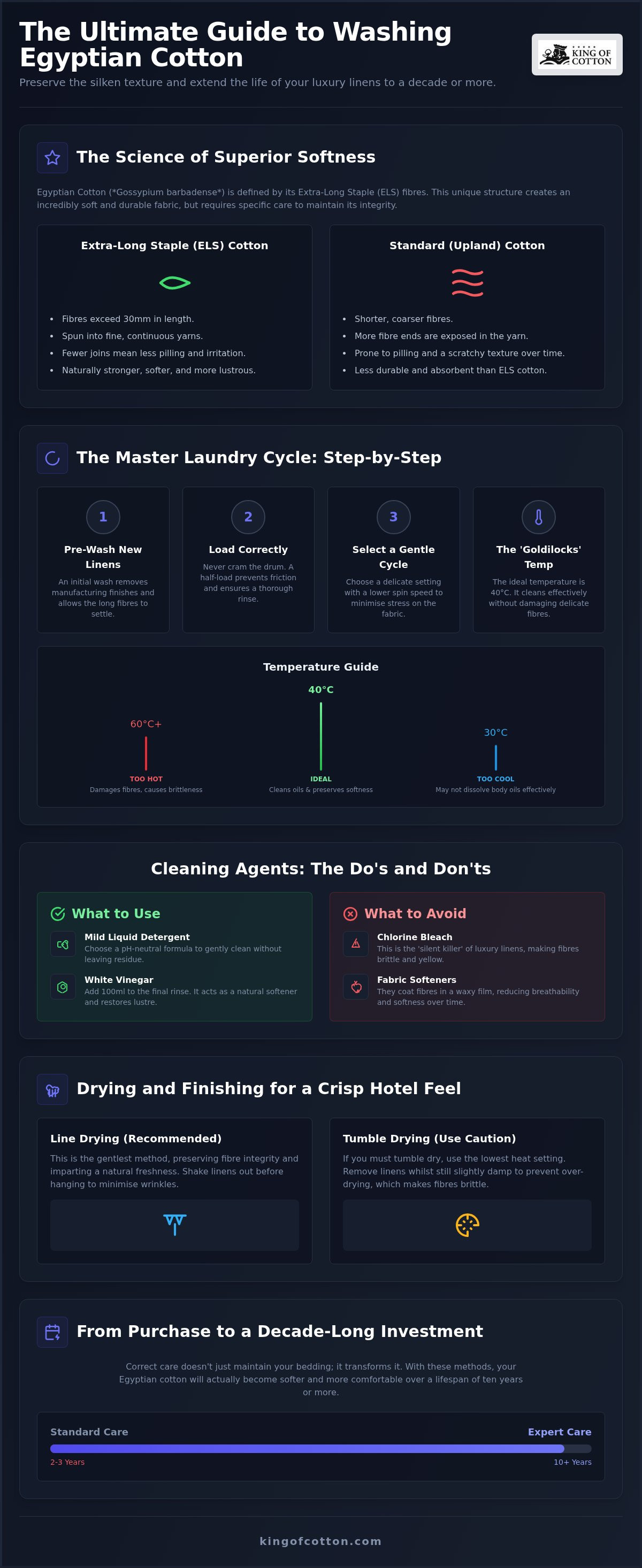
Egyptian cotton, specifically the Gossypium barbadense species, represents the pinnacle of textile excellence. Often referred to as the 'King of Cottons', it's distinguished by its extraordinary ability to produce Extra-Long Staple (ELS) fibres. The Anatomy of Luxury: Why Egyptian Cotton Requires Specialist Care begins with this biological superiority. Unlike standard Upland cotton which relies on short, coarse staples, the ELS variety allows for the creation of incredibly fine, uniform yarns. These yarns are spun into fabrics with a legendary silken touch, but this refinement necessitates a more considered approach to maintenance. Understanding the biological makeup of the fabric is the first step in learning how to wash egyptian cotton sheets effectively.
ELS Fibres and the Science of Softness
Extra-Long Staple fibres are defined by a length exceeding 30mm, which is significantly longer than conventional varieties. This length allows for a continuous yarn with fewer joins; fewer joins mean fewer exposed ends to irritate your skin or cause pilling over time. Whilst these fibres are exceptionally strong, they are also delicate. Excessive heat during the wash or dry cycle causes these fibres to become brittle and eventually snap, leading to a scratchy texture that ruins the refined feel of your linen.
The Impact of Thread Count on Laundering
Higher thread counts, such as those found in our premium Egyptian cotton bedding, create a denser and more luxurious fabric. This density increases the material's absorbency, which is excellent for comfort but requires precision during the laundry process. Dense weaves can trap detergent molecules between the tightly packed threads. If these are not rinsed away completely, the residues lead to a stiff, waxy feel that masks the natural softness of the cotton.
A common misconception is that a heavier, high-thread-count sheet is sturdier in the machine. In reality, the finer threads used in high-density weaves are more susceptible to friction damage than their coarser counterparts. Knowing how to wash egyptian cotton sheets involves respecting this density by avoiding overloaded drums. This ensures water and mild cleansers can flow freely through the weave, preserving the integrity of the fabric for years of indulgent use. Whether you prefer the matte crispness of percale or the lustrous drape of sateen, treating the fibre with restraint rather than rigour is the secret to lasting quality.
The Master Laundry Cycle: Step-by-Step Washing Instructions
Before you ever dress your bed with a new set, perform a 'pre-flight' wash. This initial cycle is essential; it removes any residual finishes from the manufacturing process and allows the long-staple fibres to settle into their permanent shape. For those seeking the ultimate sleep environment, learning how to wash egyptian cotton sheets begins with this foundational step. It ensures that the first night you slip between the covers, the fabric is at its most receptive and breathable.
Temperature selection is the most critical decision you'll make at the machine. While some suggest cold water to prevent shrinking, luxury linens require the 'Goldilocks' zone of 40°C. This temperature is warm enough to dissolve body oils and eliminate bacteria effectively, yet gentle enough to preserve the integrity of the fibres. High-heat settings are the primary cause of premature wear; they make the cotton brittle and lead to a scratchy texture. To ensure your investment lasts, always give your linens room to breathe. Never cram the drum. A half-load allows water and detergent to circulate freely, preventing the mechanical friction that causes pilling.
Choosing the Right Detergent for Fine Linens
The 'less is more' rule applies strictly to detergents. Opt for a mild, pH-neutral liquid detergent rather than harsh powders or pods, which often contain abrasive optical brighteners that can yellow white linens over time. Avoid fabric softeners entirely; they function by coating the fibres in a waxy film that reduces breathability and absorbency. For a natural alternative, add 100ml of white vinegar to the final rinse. This simple hack strips away any soap residue and naturally restores the silken lustre of your luxury bed linen.
Setting the Cycle for Success
Professional care involves more than just the right soap. Select a 'Gentle' or 'Delicates' programme to minimise the agitation that stresses the yarn. Following the guidance on Troubleshooting and Longevity: Stains, Softness, and Storage, always include an extra rinse cycle. This ensures every trace of cleanser is removed from the dense weave. Finally, reduce the spin speed to a lower RPM. While it leaves the sheets slightly damper, it prevents the deep-set, permanent creasing that makes ironing a chore. A slower spin treats the fabric with the respect it deserves, maintaining that coveted hotel-soft finish.
Drying and Finishing: Recreating the Crisp Hotel Finish
Achieving that elusive, crisp texture found in five-star suites requires more than just knowing how to wash egyptian cotton sheets; it demands a precise drying and finishing ritual. While air drying on a traditional line is the gold standard for preserving fibre longevity and capturing a natural freshness, the modern luxury lifestyle often necessitates the convenience of a tumble dryer. The secret lies in restraint. Natural fibres like Egyptian cotton are susceptible to 'heat shock', where excessive temperatures cause the long-staple fibres to tighten and lose their characteristic suppleness.
Safe Tumble Drying Practices
If you choose to machine dry, always select the lowest possible heat setting. High temperatures are the primary cause of shrinkage and the 'over-dried' trap, which creates deep-set, permanent wrinkles that are nearly impossible to remove. To enhance the process, introduce wool dryer balls into the drum. These act to naturally aerate heavy luxury bedding, reducing drying time and softening the fabric without the need for chemical-laden sheets. Crucially, you must remove your linens whilst they are still slightly 'cool-damp' to the touch. This residual moisture is the key to a professional finish.
The Art of Ironing Egyptian Cotton
Steam is absolutely essential for relaxing the dense weave of Extra-Long Staple cotton. The most effective way to achieve a mirror-smooth surface is to iron your sheets while they are still damp from the wash or the dryer. This 'Damp Ironing' technique allows the heat of the iron to evaporate the remaining moisture, effectively 'setting' the fibres in a flat, crisp state. For those with sateen weaves, always iron on the reverse side to protect and enhance the fabric's signature lustrous sheen. When handling sets with embroidered borders or delicate embellishments, place a clean, white cotton cloth over the detail to prevent direct heat damage whilst ensuring every corner is perfectly pressed.
Once pressed, allow the sheets to air for a few moments before folding. Professional hoteliers often use a 'mitered corner' technique when dressing the bed, pulling the fabric taut to eliminate any remaining slack. This attention to detail ensures that the effort invested in learning how to wash egyptian cotton sheets translates into a sleep environment that feels as indulgent as it looks. By treating the finishing process with the same reverence as the wash, you maintain the 'as-new' integrity of your linens for the long term.
Troubleshooting and Longevity: Stains, Softness, and Storage
Chlorine bleach is often viewed as a quick fix for dull whites, but it is the silent killer of luxury Egyptian cotton. The harsh chemicals in bleach aggressively break down the Extra-Long Staple fibres, leading to premature thinning and a yellowed, brittle texture. To maintain the pristine brilliance of your linens, embrace natural whitening alternatives. A half-cup of baking soda added to the wash or a splash of lemon juice in the rinse cycle provides a safe, effective lift. For the ultimate brightening effect, allow your sheets to dry in direct sunlight, where natural UV rays act as a gentle, organic bleaching agent without compromising the fabric's integrity.
If you encounter 'pilling', it is rarely a sign of poor quality in genuine long-staple cotton. Instead, these small bobbles are typically a care error, caused by friction during the wash or excessive heat in the dryer. Washing your sheets alongside rougher fabrics, such as towels, can abrade the delicate surface. To ensure your investment lasts a decade or more, adopt the 'Linen Rotation' strategy. We recommend owning at least three sets per bed: one on the mattress, one in the laundry, and one resting in the cupboard. This rotation prevents the accelerated wear that occurs when a single set is laundered and returned to the bed immediately.
Removing Stubborn Stains Naturally
Body oils and the resulting yellowing on pillowcases are best managed with oxygen-based bleaches. These are far kinder to the weave than traditional alternatives. For makeup or oil-based spills, immediate spot-treatment is vital. High-thread-count fabrics possess a dense weave that can lock in pigments if they are allowed to 'set' during a hot wash cycle. Always blot the area gently with a damp, white cloth rather than rubbing, which can push the stain deeper into the fibres and damage the smooth surface finish.
Professional Storage Solutions
Your linen cupboards should be cool, dry, and well-ventilated to preserve the health of the cotton. Never store your finest linens in plastic containers; these trap moisture and can cause the fibres to yellow or develop a musty scent over time. Instead, use breathable cotton bags or simply stack them neatly on the shelf. Adding sachets of lavender or cedar repels moths whilst imparting a delicate, clean fragrance. Implement a 'First-In, First-Out' rotation to ensure each set receives equal use and rest, maintaining a consistent level of softness across your entire collection.
To ensure your bedroom remains a sanctuary of comfort and style, invest in a third set of premium Egyptian cotton bed linen to perfect your rotation strategy.
Investing in Excellence: Maintaining Your King of Cotton Linens
Choosing Egyptian cotton bedding from King of Cotton is an investment in a refined lifestyle that prioritises quality over fleeting trends. Our linens are the preferred choice for the world's most prestigious residential and commercial sectors, appearing in the suites of five-star establishments globally. This preference isn't merely aesthetic; it's a testament to the commercial-grade durability engineered into every thread. By mastering how to wash egyptian cotton sheets using our professional secrets, you ensure these linens maintain their superior handle and lustre for a decade or more. You're not just buying sheets; you're securing years of restorative, high-end sleep.
High-street alternatives often rely on short-staple fibres and chemical finishes that provide a temporary softness that vanishes after just a few washes. In contrast, our high-GSM, Extra-Long Staple cotton represents a superior return on investment. While the initial cost reflects the premium nature of the material, the longevity of these natural fibres means you won't be replacing your bedding every year. It's a shift from a disposable mindset to one of curated excellence, where your bed becomes a permanent sanctuary of comfort. The 'restrained care' philosophy we've outlined is the final piece of the puzzle, allowing the cotton to age gracefully and become even softer over time.
The Hotel Quality Difference
Our linens undergo rigorous stress testing to meet international standards of excellence in the hospitality sector. This heritage as an industry authority allows us to offer products that combine the delicate feel of a boutique retreat with the resilience required for professional use. We invite you to view our full collection to find the perfect foundation for your bedroom upgrade. Every item we sell is backed by decades of textile expertise and a passion for the craft of fine linen.
A Commitment to Sustainability
A commitment to quality is inherently a commitment to sustainability. By extending the life of your textiles through proper care, you significantly reduce household waste and the environmental impact of frequent replacements. Our ethical sourcing ensures that the heritage of Egyptian cotton is preserved whilst providing you with a product that respects both the artisan and the environment. Learning how to wash egyptian cotton sheets correctly is a vital part of this eco-conscious journey. Invest in quality that lasts a generation.
Elevate Your Nightly Ritual
Mastering the art of linen care transforms a simple household chore into a ritual of refined indulgence. By embracing the 'less is more' approach to detergents and respecting the unique biology of Extra-Long Staple fibres, you ensure your bedding remains a sanctuary of softness. You now understand that knowing how to wash egyptian cotton sheets is fundamentally about restraint; choosing 40°C cycles over high heat and opting for natural brightening agents over destructive chlorine bleach. These small, deliberate choices preserve the silken lustre that makes high-quality cotton so coveted.
With over 30 years of expertise as a supplier to the world's leading 5-star hotels, King of Cotton provides the same commercial-grade durability for your home. Our collections are engineered to withstand professional laundering whilst maintaining an exquisite handle. When you invest in our heritage-backed linens, you're choosing a product designed to last a generation. We also offer free UK delivery on orders over a qualifying value to make your bedroom upgrade even more seamless.
Discover the world's finest Egyptian cotton bed linen at King of Cotton and begin your journey toward a lifetime of hotel-soft sleep. Your bed deserves nothing less than perfection.
Frequently Asked Questions
Can you put 100% Egyptian cotton sheets in the tumble dryer?
Yes, you can tumble dry 100% Egyptian cotton sheets, provided you use the lowest heat setting available. High temperatures are the primary cause of fibre damage and deep-set wrinkling. For the most luxurious results, remove them whilst they are still slightly damp to the touch. This prevents the 'heat shock' that makes fine yarns brittle, ensuring your bedding remains supple and indulgent for years.
What temperature should I wash my Egyptian cotton sheets at?
The ideal temperature for washing your Egyptian cotton sheets is 40°C. This 'Goldilocks' setting is warm enough to effectively dissolve body oils whilst remaining gentle enough to protect the delicate long-staple fibres. When learning how to wash egyptian cotton sheets, avoiding 60°C washes is crucial. Frequent high-heat cycles will eventually degrade the fabric's signature silken lustre and strength, leading to a coarser feel over time.
Why have my Egyptian cotton sheets gone bobbly or started pilling?
Pilling is usually caused by friction or excessive heat rather than a lack of quality. Washing your sheets with rougher items like towels or denim abrades the surface of the fine yarns. To prevent this, always wash your linens in a separate load and avoid overloading the machine. Ensuring the drum has plenty of space reduces the mechanical agitation that leads to those unwelcome bobbles.
Should I use fabric softener on high-thread-count Egyptian cotton?
You should avoid using fabric softeners on high-thread-count Egyptian cotton. These products work by coating the natural fibres in a waxy film, which significantly reduces the fabric's breathability and absorbency. Instead of enhancing softness, they can make the sheets feel heavy and greasy over time. A splash of white vinegar in the rinse cycle is a far superior, natural alternative for restoring the fabric's original silken handle.
How do I get my white Egyptian cotton sheets white again without bleach?
To restore the brilliance of white linens without using damaging chlorine bleach, try a combination of baking soda and lemon juice. Add 100g of baking soda to your usual detergent and use lemon juice in the final rinse. If possible, line dry your sheets in direct sunlight. The natural UV rays act as a gentle organic bleaching agent that brightens the fabric without weakening the delicate Extra-Long Staple fibres.
Is it necessary to iron Egyptian cotton bedding every time?
Ironing isn't strictly necessary, but it's the secret to achieving that crisp, five-star hotel finish. If you prefer a more relaxed look, you can skip the iron by hanging the sheets to dry immediately after the wash. However, a quick press whilst the fabric is still damp will flatten the fibres and enhance the natural sheen of the weave, providing a more indulgent and sophisticated sleep experience.
Do Egyptian cotton sheets shrink after the first wash?
Some minor shrinkage is normal after the first wash, as the natural cotton fibres settle into their permanent state. Quality manufacturers like King of Cotton cut their linens slightly larger to account for this initial contraction. To minimise shrinkage, always follow the recommended 40°C temperature guide and avoid high-heat drying cycles, which can cause the fibres to tighten excessively and permanently alter the fit of your bedding.
How often should I change and wash my luxury bed linen?
We recommend changing and washing your luxury bed linen once a week to maintain a fresh sleep environment. Regular laundering prevents the build-up of oils and skin cells that can eventually discolour the fabric. By following the correct steps for how to wash egyptian cotton sheets, you can maintain this frequent schedule without worrying about premature wear or the loss of that signature, hotel-soft finish.