

How Linen Quality Affects Hotel Laundry Costs: A Strategic Guide for Hoteliers
Could the pursuit of a lower purchase price actually be inflating your operational overhead? Many hoteliers find themselves trapped in a cycle of rising energy bills and frequent textile turnover, watching once-pristine sheets lose their luster and fray after only a few months. It's frustrating to manage guest complaints about texture while simultaneously battling the greyish tint that plagues inferior fabrics. We understand that maintaining an atmosphere of refined elegance requires a delicate balance between luxury and fiscal responsibility.
In this strategic guide, you'll discover exactly how linen quality affects hotel laundry costs by looking beyond the initial invoice to the more significant metric of cost-per-use. By investing in premium textiles characterized by superior craftsmanship and material heritage, you can achieve a more serene and efficient laundry operation. We'll show you how high-grade fibers reduce drying times and withstand the rigors of industrial processing, ultimately extending your replacement cycles. You'll learn how to transform your linen closet from a recurring expense into a sophisticated investment that lowers utility bills and enhances the guest experience.
Key Takeaways
- Understand why the initial purchase price is a deceptive metric that often masks significant operational inefficiencies in the laundry room.
- Discover how technical specifications like long-staple fibers and specific weave densities directly improve industrial laundry efficiency.
- Learn to utilize the cost-per-wash metric to evaluate exactly how linen quality affects hotel laundry costs over hundreds of cycles.
- Identify how superior material quality reduces moisture retention, allowing for shorter drying times and lower utility expenses.
- Master the strategic "laundry stress test" to verify that your textile investments will withstand the rigors of professional hospitality standards.
The Economics of Hotel Linen: Purchase Price vs. Lifetime Laundry Costs
Procurement is often viewed through the narrow lens of initial capital expenditure. However, discerning hoteliers recognize that the purchase price is merely the tip of the iceberg. To truly understand how linen quality affects hotel laundry costs, you must analyze the entire lifecycle of the textile. A lower upfront cost frequently hides systemic inefficiencies that drain your resources over time. High-quality materials require fewer chemical treatments and less water to achieve a pristine finish, whereas inferior fibers trap soil and harbor bacteria, necessitating aggressive and expensive wash formulas.
Within the broader scope of Hotel Housekeeping and Laundry management, efficiency is the cornerstone of a successful operation. When textiles are manufactured with short-staple fibers, they break down rapidly under the heat and agitation of industrial machines. This degradation releases excessive lint, which clogs filtration systems and increases maintenance requirements. Five-star establishments prioritize textile integrity because they understand that a sheet maintaining its structural brilliance through hundreds of washes is far more valuable than a cheaper alternative that pales after twenty cycles.
To better understand the nuances of textile maintenance and how it impacts your bottom line, watch this helpful video:
Defining Cost-per-Use in Hospitality
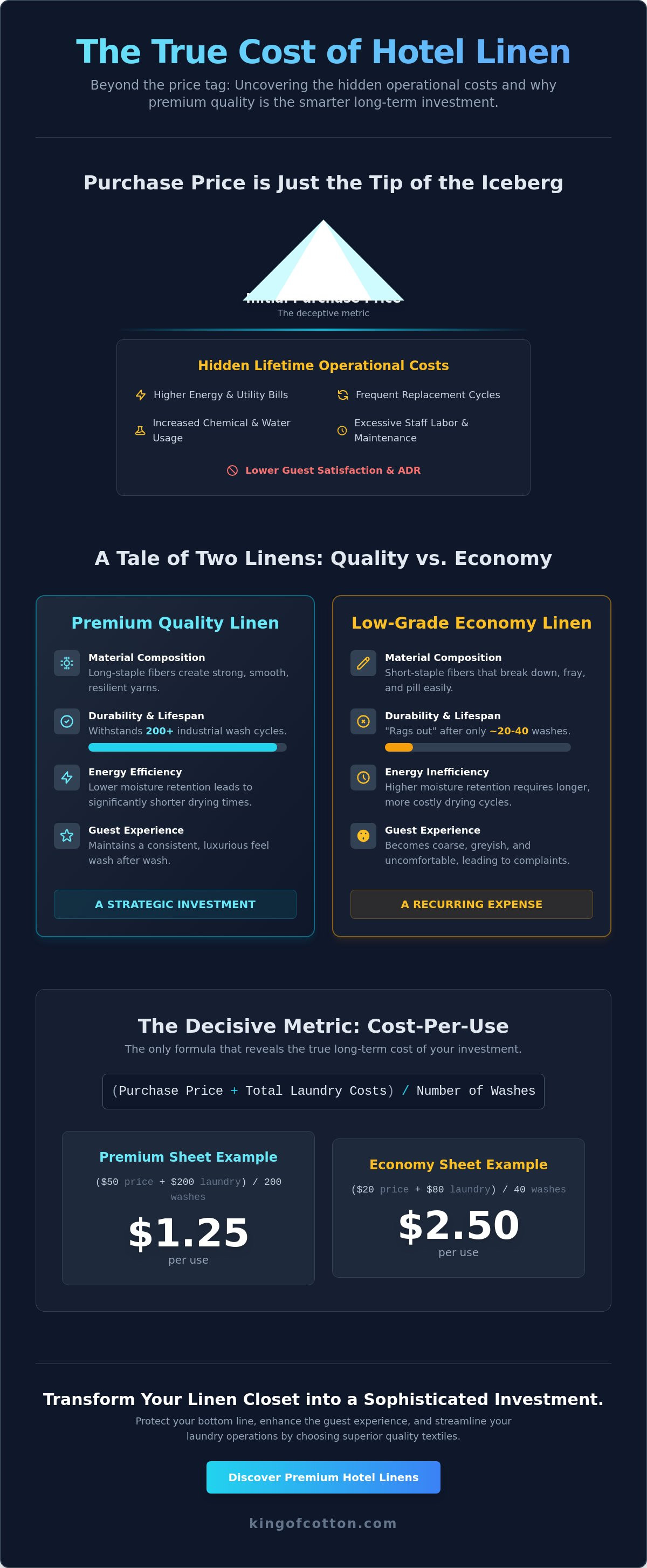
The true value of a textile is found in its longevity rather than its price tag. The industry standard formula for calculating this value is straightforward: (Purchase Price + Total Laundry Costs) / Number of Wash Cycles. Cost-per-use is the only metric that truly dictates long-term hotel profitability. While premium bed linen requires a higher initial investment, its ability to withstand 200 or more industrial washes significantly reduces the daily operational burden. This durability ensures that the luxurious feel your guests expect remains consistent, wash after wash.
The Replacement Cycle Trap
Hotels that opt for low-grade poly-cotton blends often find themselves caught in a relentless replacement cycle. These fabrics tend to "rag out" at an alarming rate, developing pills, greyish tints, or frayed edges that are unacceptable for guest use. This high turnover rate forces frequent procurement cycles that bloat annual budgets and create unnecessary administrative work. Beyond the financial impact, there's a significant psychological cost. Worn, coarse linen directly correlates with lower guest satisfaction scores and can ultimately suppress your Average Daily Rate (ADR) as guests seek the comfort of more refined accommodations.
How Material Quality Influences Industrial Laundry Efficiency
Superior textiles aren't just about guest comfort; they're engineered for the rigors of the laundry room. When we examine how linen quality affects hotel laundry costs, we must look at the mechanical resilience of the fibers. Long-staple cotton is the gold standard here. Its extended fibers create a smoother, stronger yarn that resists the fraying common in cheaper, short-staple alternatives. This inherent strength is vital during high-speed extraction cycles where centrifugal forces can easily tear weaker fabrics. High tensile strength is a non-negotiable requirement for high-volume operations. When a fabric can resist the stress of industrial washers without thinning or tearing, the frequency of replacement drops dramatically.
Weave density also plays a critical role in laundry permeability. While a high thread count is often associated with luxury, an overly tight weave can actually hinder the flow of water and detergents through the fabric. Professional-grade linens find a sophisticated "sweet spot" that allows for deep cleaning while maintaining a refined hand feel. This balance helps to reduce laundry costs by ensuring that soil is released efficiently in the first wash. It's about precision; a well-constructed fabric allows for maximum water extraction, which naturally leads to shorter, more energy-efficient drying times.
Fibre Integrity and Lint Production
Low-quality fibers are prone to snapping and breaking, which results in excessive lint production. This isn't just a housekeeping nuisance; it's a sign that your fabric is literally thinning with every wash. As the material loses mass, it becomes translucent and coarse, losing that indulgent texture guests crave. Investing in high-GSM towels ensures that the textile retains its plush structure after 100 or more industrial cycles. These robust materials produce minimal lint, keeping your industrial filters clear and your machines running at peak efficiency. It's a hallmark of quality that protects both your hardware and your reputation.
Absorbency and Chemical Wash Formulae
Premium cotton possesses a natural affinity for water and finishing agents. This allows wash chemicals to penetrate the fibers evenly, which reduces the need for aggressive re-washes or extended soak times. Synthetic fillers, often found in budget blends, tend to trap body oils and organic stains. These contaminants require harsher, more expensive detergents and higher temperatures to remove. By choosing textiles that have undergone mercerisation, you gain several operational advantages:
- Increased Tensile Strength: Fibers are less likely to snap under industrial pressure.
- Dye and Chemical Affinity: Brighter whites are achieved with fewer bleaching agents.
- Dimensional Stability: Linens retain their shape, making automated folding more efficient.
Mercerised cotton also holds its shape better, preventing the skewing or distorting that can occur in cheaper fabrics after multiple high-temperature washes. This treatment strengthens the cotton and increases its luster, allowing you to maintain a "crisp white" aesthetic without resorting to excessive bleaching. You might consider browsing our full range of hospitality textiles to see how refined materials can transform your back-of-house efficiency.
Durability and the Cost-per-Wash Metric: A Comparative Analysis
When evaluating the financial health of your rooms division, the initial purchase price of textiles is often a distraction from the real objective: cost-per-wash. A standard 180-thread count poly-cotton sheet might appear cost-effective on a procurement spreadsheet, but its service life is remarkably brief. These budget-tier options typically begin to degrade after only 50 industrial washes. In sharp contrast, a 300-thread count Egyptian cotton sheet remains in pristine condition for 200 cycles or more. This fourfold increase in longevity fundamentally shifts the economic landscape of your laundry operation.
The technical reason for this disparity lies in the mathematics of pilling. Lower-quality fabrics use short-staple fibers that eventually migrate to the surface, creating tiny spheres of lint known as pills. These rough surfaces aren't just a guest complaint waiting to happen; they increase mechanical friction within the laundry drum. This friction accelerates wear and tear, effectively thinning the fabric with every rotation. Luxury linens from King of Cotton are engineered for the rigours of 5-star hospitality, utilizing long-staple fibers that remain smooth and resilient under pressure. This smoothness acts as a technical shield, ensuring the fabric glides through the wash cycle rather than being abraded by it.
Longevity of Premium Cotton
The structural integrity of your linen dictates how well it survives high-temperature sanitisation. Premium Egyptian cotton fibres can be up to 50% stronger than standard cotton, directly extending the linen’s service life in industrial settings. This inherent strength allows the textile to maintain its dimensional stability even after hundreds of high-heat cycles. For towels, we utilize ring-spun technology to further enhance durability. By tightly twisting the fibers, we create a yarn that's less prone to pulling or fraying during the high-speed extraction phases of the wash.
Reducing the Re-wash Rate
The re-wash rate is a silent drain on hotel profitability. Every time a sheet or towel is sent back for a second cycle, you're doubling your consumption of energy, labour, and chemicals. High-quality natural fibers are far more forgiving than damaged synthetics. Frayed poly-cotton blends tend to trap oils and organic stains within their broken structures, making them incredibly difficult to clean. Consider the following impact of premium textiles on your efficiency:
- Easier Soil Release: Smooth, intact fibers allow detergents to lift stains in a single cycle.
- Chemical Efficiency: High-quality cotton requires fewer aggressive bleaching agents to maintain its brilliance.
- Operational Consistency: A 5% reduction in re-wash rates for a 200-room property can save hundreds of hours in annual labour.
Ultimately, understanding how linen quality affects hotel laundry costs requires a focus on these operational realities. When your textiles are easier to clean and last significantly longer, the total cost of ownership drops, allowing you to reinvest those savings back into the guest experience.
Energy Consumption and Drying Times: The Hidden Utility Drain
The industrial dryer is often the most energy-intensive asset in a hotel's back-of-house operation. Understanding how linen quality affects hotel laundry costs requires a meticulous look at the physics of evaporation and moisture retention. Cheap poly-cotton blends frequently utilize synthetic binders that, while durable in a mechanical sense, are hydrophobic. These binders trap moisture within the core of the yarn, forcing the dryer to run longer to achieve the same level of dryness. In contrast, premium textiles are engineered to release water more readily during the high-speed extraction phase, ensuring they enter the drying cycle with a significantly lower residual moisture content.
Every extra ten minutes in a commercial tumble dryer represents a significant accumulation of kilowatt-hours and unnecessary wear on the fabric. When you multiply this across several loads per day, the perceived savings from a lower initial purchase price are quickly eroded by escalating utility bills. High-quality cotton, especially those utilizing "hollow-fibre" technology or specific breathable weaves, allows for better capillary action. This brings water to the surface where it evaporates with serene efficiency, shortening the cycle and protecting your bottom line from the invisible drain of energy waste.
GSM and Drying Efficiency
There's a common misconception that a heavier towel always takes longer to dry. However, a 600GSM towel crafted from premium long-staple cotton often outperforms a 500GSM budget towel that relies on dense synthetic fillers. The secret lies in air circulation. A superior weave creates a more breathable structure, allowing hot air to penetrate the fabric and whisk away moisture more effectively. Selecting the right weight for your specific laundry equipment capacity is a sophisticated balancing act. It's about finding the weight that provides an indulgent guest experience without overtaxing your machinery's ability to process air. Browse our premium towel collections to find the perfect balance of weight and efficiency for your property.
The Impact on Labour Costs
Time is the ultimate luxury in a busy hospitality environment. Faster drying cycles don't just save energy; they accelerate the entire housekeeping workflow. When your laundry department can process loads more quickly, you reduce the need for expensive overtime and ensure that rooms are ready for early arrivals with calm confidence. Consistency in finishing is another critical factor. High-quality cotton responds with grace to industrial calenders, also known as rotary irons. Unlike cheaper blends that can develop stubborn "memory" wrinkles or scorched edges, premium linens smooth out perfectly under heat and pressure, providing that crisp, indulgent finish that guests associate with international standards of excellence.
Strategic Procurement: Selecting Linens that Protect Your Bottom Line
Procurement in the luxury hospitality sector isn't merely about selecting a fabric; it's about validating an operational asset. Before committing to a significant capital investment, savvy managers conduct a "laundry stress test" on potential samples. This involves subjecting a new textile to twenty or more consecutive industrial wash and dry cycles. It's a rigorous process that reveals the fabric's true character, showing how it responds to your specific chemical formulas and heat settings. Understanding how linen quality affects hotel laundry costs becomes clear when you see which samples maintain their structural brilliance and which begin to fail after only a few weeks of simulated use.
This level of strategic scrutiny in procurement is a best practice shared by professionals across various sectors. For instance, just as hotel managers seek the best value in textiles, researchers often use Peptide Insider to compare pricing and find the most competitive rates for research peptides, ensuring their operational budgets are optimized for quality and long-term performance.
Consistency is the hallmark of a professional laundry operation. One of the most common pitfalls in procurement is accepting "mixed batches" from inconsistent suppliers. When your inventory consists of varying fiber blends or different weave densities, it complicates your wash formulas. Different materials require different temperatures and drying times; a mixed load often results in either under-dried or scorched items. Partnering with an established expert like King of Cotton ensures that every piece of linen meets the same exacting standards, allowing your laundry team to operate with serene confidence and predictable results.
The Procurement Checklist for Hotel Managers
- Step 1: Audit Replacement Rates. Review your "rag out" logs from the past twelve months to identify exactly where your current stock is failing. Is it fraying at the seams or losing its brightness?
- Step 2: Energy-to-Weight Ratio. Evaluate the drying efficiency of your towels. A high-quality, breathable weave will often dry faster than a denser, inferior blend of the same weight.
- Step 3: Machinery Compatibility. Source samples that meet the specific tensile strength required for your high-speed extraction machinery. This prevents the micro-tears that lead to premature replacement.
Building a Sustainable Linen Strategy
Modern hospitality demands a commitment to ESG (Environmental, Social, and Governance) goals. Investing in premium textiles is a powerful way to support these initiatives by drastically reducing textile waste. When a sheet lasts four times longer than a budget alternative, you're not just saving money; you're significantly reducing your property's environmental footprint. It's a "quality-first" culture that resonates with both your housekeeping staff and your discerning guests.
Ultimately, the most effective way to manage how linen quality affects hotel laundry costs is to view your textiles as a long-term investment. High-quality specifications, such as long-staple fibers and mercerised finishes, are not luxury indulgences. They are technical requirements for a profitable operation. Choosing to invest in the finest cotton serves as a sophisticated hedge against rising utility and labour costs, ensuring your establishment maintains its international standards of excellence for years to come.
Mastering the Balance of Luxury and Operational Efficiency
Choosing the right textiles is a definitive statement of your hotel’s standards and its fiscal intelligence. We’ve explored how the true value of linen isn't found on a procurement invoice but in its resilience through hundreds of industrial cycles. By prioritizing long-staple fibers and superior weaves, you don't just enhance the guest experience; you fundamentally change how linen quality affects hotel laundry costs. Shorter drying times, reduced re-wash rates, and extended replacement cycles all contribute to a more serene and profitable back-of-house operation.
As seasoned experts and suppliers to the finest homes and hotels in the world, we understand the technical nuances of high-GSM towels and high-thread count bed linen. Our UK-based team provides the material expertise and global delivery capabilities required to support prestigious establishments across the residential and commercial sectors. Request a wholesale quote for your hotel from King of Cotton today to begin transforming your operational overhead into a strategic asset. Your commitment to quality materials is the most reliable hedge against rising costs.
Frequently Asked Questions
Does higher thread count always mean better durability for hotel sheets?
No, an extremely high thread count does not guarantee longevity in a commercial environment. Beyond a certain density, very high counts can use thinner, more fragile yarns that snap under industrial pressure. It is the fiber quality and staple length that dictate durability. A 300-thread count sheet made with long-staple cotton often outlasts a 1000-thread count sheet made with inferior, short-staple fibers that pill and fray quickly.
How much can a hotel save by switching to high-quality linen?
Hotels often reduce their total laundry-related expenditure by over 20% through lower replacement frequencies and utility savings. High-quality textiles extend the lifespan of your stock from roughly 50 cycles to over 200 washes. This longevity is a primary factor in how linen quality affects hotel laundry costs, as it stabilizes procurement budgets and reduces the constant need for new inventory to replace worn items.
Why do cheap towels become "scratchy" faster in industrial laundries?
Cheap towels utilize short-staple cotton and synthetic fillers that break down rapidly under the intense heat of industrial dryers. As these inferior fibers snap, the loops lose their softness and the fabric becomes thinned and coarse. Premium towels maintain their indulgent hand feel because long-staple fibers remain intact and smooth. This structural integrity ensures the towel stays plush and absorbent even after 100 industrial cycles.
What is the ideal GSM for hotel towels to balance luxury and drying costs?
A range of 500 to 650 GSM is the sophisticated "sweet spot" for high-end hospitality. This weight provides the plush, indulgent feel guests expect without the excessive drying times associated with heavier 800 GSM options. Quality cotton in this range releases moisture with serene efficiency. It allows you to maintain international standards of excellence while significantly controlling energy consumption and utility bills in the laundry room.
Can high-quality linen reduce the amount of detergent needed?
Yes, because premium natural fibers release soil more readily than damaged or frayed synthetic blends. Damaged fibers trap oils and organic matter within their broken structures, requiring harsher chemical formulas and more aggressive detergents to achieve a pristine finish. Premium linens respond gracefully to milder wash cycles. This preserves the fabric's luster and reduces your chemical expenditure, contributing to a more sustainable and cost-effective operation.
How does the weave affect laundry costs?
Percale is generally more cost-effective for high-volume operations due to its tight, plain weave. It is exceptionally durable and withstands high-temperature sanitization with ease. Sateen offers a more lustrous, silky feel but can be more prone to snagging if subjected to aggressive mechanical action. Percale's inherent breathability also facilitates faster drying times, which reduces the total energy required for each load processed in your facility.
Is Egyptian cotton really better for industrial washing than standard cotton?
Egyptian cotton is vastly superior for industrial use because of its extra-long staple fibers. These fibers create a yarn that is significantly stronger and more resistant to the stress of high-speed extraction. Standard cotton often frays or pales after fewer washes, losing its structural brilliance. Egyptian cotton maintains its luster and strength, ensuring a much lower cost-per-use over the textile's lifespan compared to conventional alternatives.
What is the typical lifespan of a luxury hotel sheet in a commercial setting?
A luxury hotel sheet crafted from premium materials typically lasts between 180 and 250 industrial wash cycles. In sharp contrast, budget-tier linens often require replacement after only 50 to 75 washes. This extended lifespan allows hoteliers to stretch their procurement budgets over a much longer period. It ensures a consistent and refined guest experience while protecting the property from the frequent capital outlays required for low-quality stock.