

First Home Bedding Checklist: What to Buy for Your New Home
A first home bedding checklist should start with what makes a bed comfortable, not what makes it look finished. Get the fit, duvet and pillows right first; decorative cushions and extra layers can wait. The right essentials will make your bedroom feel restful from the first night, without filling cupboards with things you don’t yet need.
It’s natural to wonder which pieces are essential and whether the linen you choose will fit. UK bed and duvet sizes don’t always match, and mattress depth matters when you’re choosing a fitted sheet. A little planning can spare you an ill-fitting sheet or a duvet that doesn’t sit as you’d like.
This practical checklist helps you prioritise the essential bed layers, choose suitable sizes and quantities, and compare cotton options such as percale and sateen. It also covers care considerations and simple finishing touches, so you can create a coordinated, comfortable bedroom that’s easy to look after.
Key Takeaways
- Build a comfortable bed in stages, beginning with the essential layers rather than decorative extras.
- Use the first home bedding checklist to organise your purchases, then compare each item’s stated dimensions with your bed and duvet.
- Explore percale, sateen and Egyptian cotton by feel and care needs to find linen that suits your preferences.
- Decide whether a spare set would make changing and caring for your bedding more convenient.
- Finish with considered touches once your core bedding is in place for a bedroom that feels coordinated and restful.
First home bedding checklist: what do you need for the bed?
A comfortable bed doesn’t have to come together all at once. Start with the layers you need for sleeping, then add practical or decorative extras once you’ve settled into your new home. This essentials-first approach helps you make a considered choice without buying a full collection before you know how you’ll use the room.
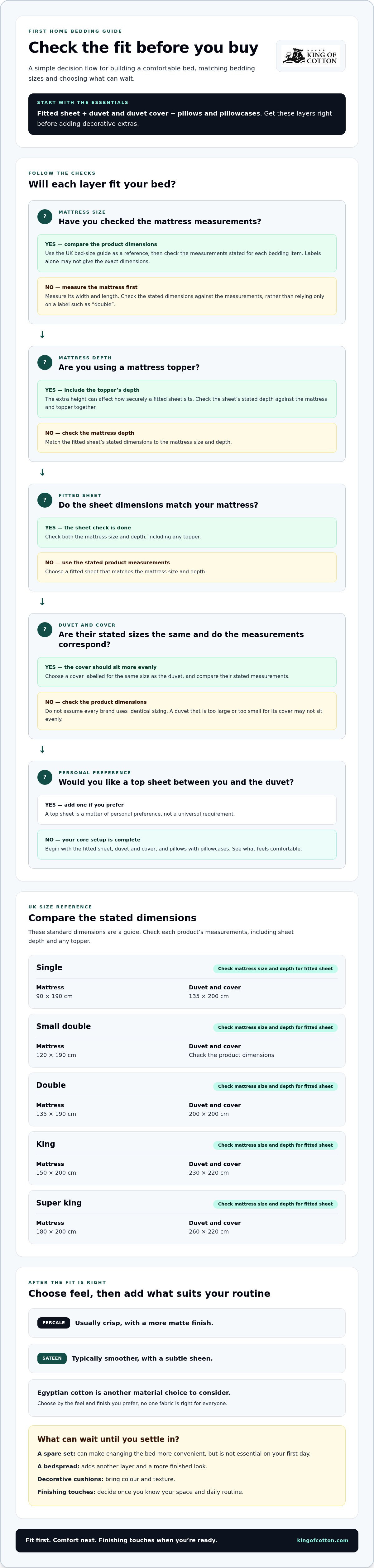
The minimum complete bedding setup is a fitted sheet, a duvet with a duvet cover, and pillows with pillowcases. Choose sizes that suit your mattress, duvet and pillows. Check the product dimensions rather than relying on labels alone.
Which bedding items are essential from day one?
Each core layer has a simple role. A fitted sheet covers the mattress, while a duvet provides warmth inside its removable cover. Pillows support your head as you rest, and pillowcases cover them and can be removed for laundering. Together, these pieces create a usable sleep setup without requiring decorative extras.
- Fitted sheet: the layer that sits over your mattress. Check the sheet’s dimensions and depth against your mattress.
- Duvet and duvet cover: the insulating layer and its removable outer covering. Match the cover to the duvet dimensions.
- Pillows and pillowcases: choose enough pillows for your sleep needs, then make sure each case fits its pillow.
A top sheet, placed between you and the duvet, is a matter of personal preference rather than a universal requirement. If you’re unsure whether you’ll use one, begin with the core layers and see what feels comfortable. For a reference when identifying your bed size, consult UK Bed Sizes; compare the measurements with the bedding product details before buying.
What can wait until after you move in?
A spare set can make changing the bed more convenient, but it isn’t essential on your first day. A bedspread adds another layer and a more finished look, whilst decorative cushions bring colour and texture. These touches are easiest to choose once you know how much space you have and what your daily routine allows.
Prioritise a comfortable, easy-to-manage bed before styling it. After a few nights, you’ll have a better sense of whether you want an extra layer, a spare set ready to use or a simpler arrangement. Browse the bedroom collection for bedding and finishing options, and build a coordinated look at your own pace.
Match your first home bedding checklist to UK bed and duvet sizes
Before ordering, identify your mattress size and depth. A label such as “double” is a useful starting point, but it isn’t a substitute for checking measurements. UK and European sizing conventions differ, and product dimensions can vary. Use the UK bed-size guide as a reference, then compare its measurements with the details given for each item.
How do you choose a fitted sheet that fits?
Measure the mattress across its width and length, then check its depth against the fitted sheet’s stated dimensions. If you use a mattress topper, include its depth too, as it adds height and can affect how securely the sheet fits. Measure the mattress, including any topper, before ordering.
The table shows standard UK mattress and duvet dimensions for comparison. Treat them as a guide, not a substitute for the product measurements. For more on bedding terminology and dimensions, see the Sleep Products Association’s Bedding Dimensional Guidelines.
| Bed size | Mattress dimensions | Duvet and duvet cover dimensions | Fitted sheet check |
|---|---|---|---|
| Single | 90 × 190 cm | 135 × 200 cm | Match the mattress size and depth |
| Small double | 120 × 190 cm | Check the product dimensions | Match the mattress size and depth |
| Double | 135 × 190 cm | 200 × 200 cm | Match the mattress size and depth |
| King | 150 × 200 cm | 230 × 220 cm | Match the mattress size and depth |
| Super king | 180 × 200 cm | 260 × 220 cm | Match the mattress size and depth |
Small-double duvet dimensions aren’t included here, so use the stated measurements for the duvet and cover you’re considering. The same principle applies across sizes: don’t assume a label alone tells you the exact dimensions.
Should the duvet and duvet cover be the same size?
Choose a cover labelled for the same size as the duvet, then compare their measurements to make sure they correspond. A duvet that’s too large or too small for its cover may not sit evenly inside it. The amount of drape you prefer and whether you share the bed can also shape your choice, but rely on stated dimensions rather than assuming every brand uses identical sizing.
Once you’ve confirmed the fit, explore bed linen options to bring your sheet and duvet cover together in a considered finish.
Compare cotton bedding materials for comfort, feel, and care
Once you’ve settled the sizes, think about how you want your sheets to feel and how much care fits your routine. Percale and sateen are cotton fabric options with distinct finishes, whilst Egyptian cotton is another material choice to consider. The right fit depends on your preference, not on one fabric being right for everyone.
Percale or sateen: which feel might suit you?
Percale usually feels crisp and has a more matte finish; sateen typically feels smoother, with a subtle sheen. These differences come from how the fabric is woven, so consider the finish you enjoy against your skin and the look you prefer on the bed. If you like a fresh, crisp feel, percale may appeal; if you favour a smoother hand and gentle lustre, explore sateen.
Egyptian cotton is a fibre option, while percale and sateen describe fabric weaves. The terms answer different questions, so check how a product is described rather than treating them as alternatives in the same category. For broader context on how material, weave and other factors relate, read this overview of bed linen materials and quality.
Use the fabric description to guide your comparison, but avoid choosing by thread count alone or expecting a particular weave to guarantee better sleep. Touch and finish are personal: what feels crisp and inviting to one person may not suit another. Compare the product details and base your choice on the qualities that matter to you.
How should first-time buyers think about cotton care?
Care is part of the decision, especially if you want bedding that fits smoothly into your household routine. Washing and drying guidance can vary with the fabric and the product’s construction, so read the care label for each item rather than assuming all cotton bed linen should be treated identically. Consider whether the instructions suit the way you normally wash and dry your bedding.
For your first home bedding checklist, compare feel, finish and care guidance together. A fabric you enjoy using and can care for comfortably is a more considered choice than one selected on a single specification. Explore the bed linen collection to compare cotton options and find a finish that suits your bedroom and routine.
Plan bedding quantities and bedroom essentials for your first home
There’s no single bedding quantity that suits every household. Your laundry routine, available storage and priorities for settling in all play a part. Keep the first home bedding checklist simple: prepare one complete set for a comfortable night’s sleep, then decide whether a spare set would make changing the bed easier.
How many sets of bedding should a first home have?
A spare set can give you more flexibility between washes, but it also needs somewhere to live and may not be an immediate priority. If storage is limited or you’d rather focus on the essentials first, begin with the set you need now. Once you understand how often you wash and change your bedding, you can judge whether another set would be useful.
Use this sequence as a shopping note you can save and revisit:
- Confirm the bed: identify the mattress size and depth before choosing linen.
- Choose core linen: select the fitted sheet, duvet cover and pillowcases you’ll use from day one.
- Select duvet and pillows: consider your comfort preferences and the complete sleep setup.
- Decide on a spare set: weigh laundry flexibility against storage and other moving-in priorities.
- Add extras later: choose finishing touches once you know how the bedroom works for you.
Think about your routine. If washing and drying bedding takes time in your home, a spare set may be convenient. If you have limited cupboard space, keeping the initial selection streamlined may suit you better. Neither approach is a rule; choose quantities that feel manageable in your home.
Which bedroom extras are worth considering later?
A bedspread can add a decorative layer and bring a more finished feel to the room, but it isn’t essential for a comfortable bed. Other styling touches can wait until you’ve settled in and seen how much space you have. Duvets and pillows, by contrast, are part of the sleep setup, so consider them alongside the linen rather than treating them as decoration.
Complete your first home bedding checklist with considered choices
A well-planned bed comes together in a clear order: measure first, choose the core layers, compare materials, read care instructions, then decide whether you want finishing touches. You don’t need to buy every extra straight away. A considered setup that fits your bed and suits your routine is a better foundation than a room full of bedding you may not use.
A final checklist before you buy
Use this short list to review your choices before ordering:
- Measure: confirm the mattress width, length and depth, including any topper, before selecting a fitted sheet.
- Match: compare the duvet and cover size labels and stated dimensions.
- Choose: select your preferred material and finish, such as percale or sateen, based on the feel you enjoy.
- Check care: read the instructions for each item and consider whether they suit your household routine.
- Plan quantities: decide whether a spare set works for your laundry habits and available storage.
- Style later: add a bedspread or other decorative touches once you’ve settled into the room.
This final review brings the first home bedding checklist together without making the process feel complicated. Prioritise the pieces you’ll use every night, then build on them as you discover what makes your bedroom feel comfortable and complete.
Where can you find bedding for a first home?
King of Cotton supplies bedroom linen to individual homes as well as hospitality businesses. Choose from bed linen, duvets and pillows to bring the practical layers of your setup together, then consider towels, bathrobes or other bedroom finishing touches as your needs take shape.
Explore the bed linen collection for options for your new home. If you’re planning an order, you can also review the delivery information as part of your preparations. Start with what fits and feels right; the finishing touches can follow in their own time.
Make your first bedroom feel like home
A thoughtful first home bedding checklist keeps the essentials in focus: check the fit, choose the layers you’ll use every day, compare fabric feel and care, then add finishing touches when you’re ready. Getting the mattress, sheets, duvet and pillows right gives you a comfortable foundation without needing to buy everything at once.
King of Cotton supplies bedding for individual homes and hospitality businesses. Explore bed linen in Egyptian cotton, percale and sateen, alongside duvets and pillows, to bring comfort and a considered finish to your new bedroom.
Explore the bed linen collection and choose the pieces that suit your bed, preferences and routine. Take it one considered choice at a time, and soon your new bedroom will feel distinctly yours.
Frequently Asked Questions
What bedding do you need for your first home?
For your first home, start with a fitted sheet, a duvet and matching duvet cover, plus pillows and pillowcases. These essentials create a complete sleep setup; a top sheet, spare set, bedspread and decorative cushions can be added later if they suit your preferences and routine. Check mattress, duvet and pillow dimensions before buying so each layer fits. This simple first home bedding checklist gives you a practical starting point.
How many sets of bedding should you buy for a new home?
Choose the number of bedding sets that suits your laundry routine, storage space and priorities when moving in. One complete set provides the essentials; a spare can make changing the bed more convenient whilst the other set is being washed or dried. There’s no universal quantity to buy. If cupboard space is limited, begin with what you need and decide whether a spare would be useful once you’ve settled in.
How do I know what size bedding to buy in the UK?
Check your mattress width, length and depth, then compare them with the fitted sheet’s stated measurements. Standard UK mattress sizes include single at 90 × 190 cm, double at 135 × 190 cm, king at 150 × 200 cm and super king at 180 × 200 cm. UK duvet sizes differ from mattress sizes, so check each product’s dimensions rather than relying on the label alone. Include a mattress topper when checking sheet depth.
Should your duvet cover be the same size as your duvet?
Choose a duvet cover intended for the same size duvet, and compare the stated dimensions of both items before buying. Size labels are a useful guide, but they don’t guarantee that every brand uses identical measurements. A well-matched cover helps the duvet sit properly inside it. Your preferred amount of drape and whether you share the bed may influence the duvet size you choose, so weigh these preferences alongside the measurements.
Is percale or sateen better for first-time bedding?
Neither is universally better; the right choice depends on the feel and finish you prefer. Percale is commonly described as crisp with a matte appearance, whilst sateen is often smoother to the touch with a subtle sheen. These terms describe different weaves, not a guaranteed level of comfort or sleep quality. Consider product descriptions and care instructions as well as appearance, then choose the finish that feels right for your bedroom.
What is the difference between Egyptian cotton and regular cotton bedding?
Egyptian cotton is a specific cotton option, whilst “regular cotton” is a broad description that doesn’t identify a particular weave or finish. Check the product details to understand the material and construction rather than assuming that one label tells you everything about how bedding will feel or perform. Percale and sateen, for example, describe weaves, so they’re different considerations from the cotton type. Your preferred feel, finish and care needs can guide your choice.
Do you need a top sheet in your first home?
No, a top sheet isn’t essential for a complete bedding setup. It sits between you and the duvet, but whether to use one comes down to personal preference and your usual sleep routine. You can begin with a fitted sheet, duvet and cover, then decide after moving in whether an additional layer would be comfortable or convenient. Focus first on bedding that fits your bed and feels right for you.