

Which pillow sizes suit your bed width?
The right pillow arrangement starts with bed width, not just pillow size. A standard UK pillow is typically 50 x 75 cm, although some retailers list standard pillows at 50 x 70 cm. For a practical guide to pillow sizes in the UK, match the pillow dimensions to the bed and the pillowcase, then consider how much coverage you want.
Choosing pillows can seem simple until a pillowcase feels too loose or the bed looks underfilled. This guide to pillow sizes in the UK explains standard dimensions, how different arrangements work across bed widths, and what to check when matching pillowcases to rectangular, square or longer pillows.
Key Takeaways
- Match the number and arrangement of pillows to your bed width for a balanced look, from a single bed to a super king.
- Longer king and super king pillows can provide fuller coverage on wider beds, while standard pillows may leave visible gaps.
- Continental square pillows need a different case shape from rectangular UK pillows, so compare the dimensions before choosing.
- An Oxford edge is decorative and doesn’t mean the pillow itself needs a different size.
- Fabric and washing temperature can affect how a pillowcase fits over time, so factor care into your choice.
What Is the Standard Pillow Size?
A standard UK pillow is commonly 50 x 75 cm, although 50 x 70 cm is also widely used. King and super king pillows typically measure 50 x 90 cm. This guide to pillow sizes in the UK explains the common variations and how to match a pillow with its case.
Retailers may also list standard pillows measuring 48 x 74 cm or 46 x 71 cm. The term “standard” therefore covers several dimensions, rather than one identical size. A guide to pillow sizes in the UK is most useful when it compares measurements directly, not just the labels printed on packaging.
Standard UK pillow measurements
A standard UK pillow is a rectangular pillow commonly listed at 50 x 75 cm. That measurement matters when replacing either a pillow or its case, as even a small length difference can change how neatly the case fits.
Other listed standard dimensions include 50 x 70 cm, 48 x 74 cm and 46 x 71 cm. A standard UK pillow is also described as 20 x 30 inches. For example, a 50 x 70 cm pillow is 5 cm shorter than a 50 x 75 cm option, despite having the same width.
Children’s and cot-bed pillows are listed at 40 x 60 cm. This smaller size is distinct from adult standard pillows, so matching the case to the child’s pillow dimensions helps avoid excess fabric.
Pillowcase dimensions and fit
A standard UK pillowcase typically holds a 50 x 75 cm pillow. Both Oxford and housewife pillowcases usually fit this pillow size, so the style doesn’t require a different-sized pillow.
An Oxford case has a 5 cm decorative edge around the pillow compartment. The border frames the pillow; it doesn’t mean the pillow itself needs extra width or length. Choose according to the pillow dimensions, rather than measuring the outer edge of the Oxford style.
A 50 x 70 cm pillow may sit differently inside a case made for a 50 x 75 cm pillow. The same principle applies to pillows measuring 48 x 74 cm or 46 x 71 cm. Comparing the stated width and length is more reliable than relying on “standard” alone.
Specialist UK pillow dimensions
UK king and super king pillows typically measure 50 x 90 cm, providing more length than standard pillows. Australian measurements differ: a standard Australian bed pillow is 48 x 73 cm, a king pillow is 51 x 91 cm, and a European pillow measures 65 x 65 cm.
These regional differences matter when pairing imported pillows with UK cases. For instance, the Australian 48 x 73 cm standard pillow is not the same size as a UK 50 x 75 cm pillow. Compare the measurements on both items before choosing a case, especially if the labels use different country-specific terms.
Choosing pillow sizes for different bed widths
UK pillow sizes are separate from mattress and bed sizes. Bed width describes the sleeping surface; pillow dimensions describe each pillow. Choose an arrangement that suits the available width and the coverage you prefer.
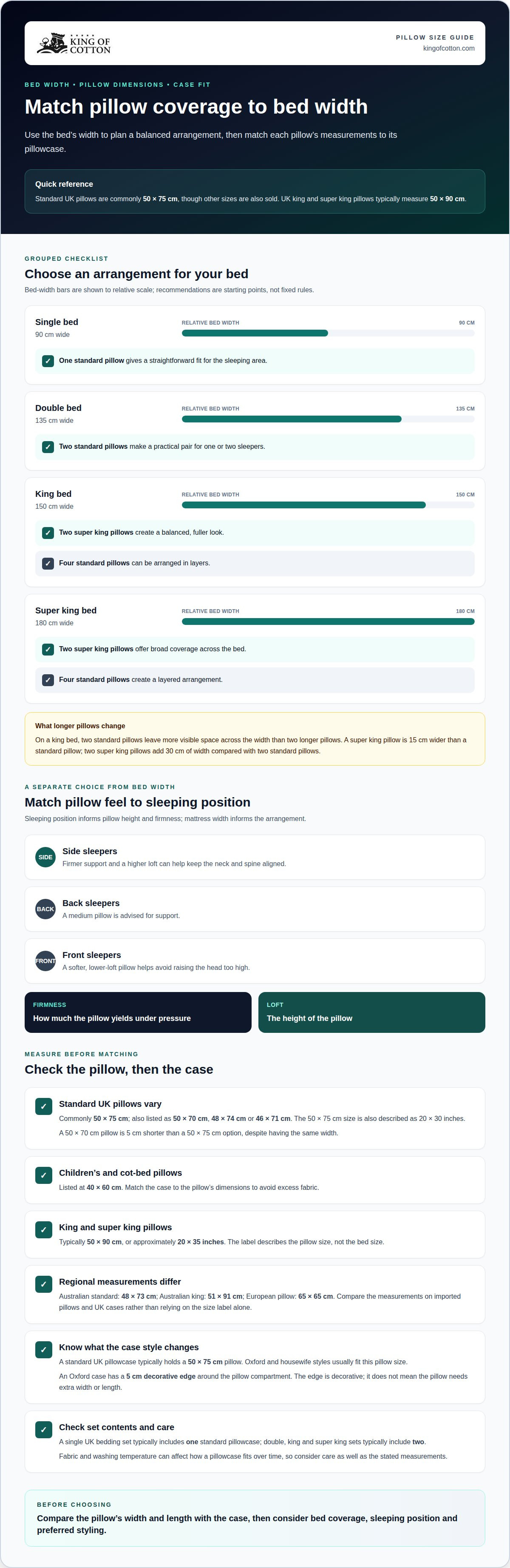
A single bed is 90 cm wide, a double is 135 cm, a king is 150 cm, and a super king bed is 180 cm. These widths help you judge how much of the mattress your pillows will cover. Your choice can also depend on whether you prefer a simple sleeping arrangement or a fuller, layered appearance.
- Single bed, 90 cm: one standard pillow gives a straightforward fit for the sleeping area.
- Double bed, 135 cm: two standard pillows provide a practical pair for one or two sleepers.
- King bed, 150 cm: two super king pillows create a balanced, full look, or four standard pillows can be layered.
- Super king bed, 180 cm: two super king pillows offer broad coverage; four standard pillows create a layered arrangement.
These arrangements are starting points, not fixed rules. On a king size mattress, two standard pillows leave more visible space across the width than two longer pillows. Four standard pillows can fill that space when layered in pairs. On a super king bed, two longer pillows create a continuous line across the head of the bed, while standard pillows may look less substantial on their own.
Sleeping position helps determine pillow height and firmness, rather than mattress width. Side sleepers generally benefit from firmer, higher-loft pillows to help keep the neck and spine aligned. Back sleepers are advised to choose a medium pillow for support. People who mainly sleep on their front are advised to choose a soft, lower-loft pillow so their head isn’t raised too high.
Firmness and loft describe different aspects of a pillow. Firmness refers to how much the pillow yields under pressure; loft describes its height. For example, a side sleeper may prefer firm support and greater loft, while a front sleeper may find a softer, lower profile more comfortable. A back sleeper’s medium option sits between those preferences.
Before buying, consider who shares the bed, how the pillows will be arranged, and whether they’re for sleeping or display. A double bed shared by two sleepers may suit a pair, while a single sleeper may choose extra pillows for a layered look. For coordinated bedroom styling, explore bedroom bedding alongside your chosen pillow arrangement.
A king bed is described as 150 cm wide. Pillowcase quantities can also help when choosing a set: a double, king or super king UK bedding set typically includes two standard pillowcases, while a single set includes one.
For a queen-sized bed, the guide recommends two or four standard pillows. For a super single bed, it recommends one standard pillow. Use these recommendations to compare arrangements with the bed category and the contents of a bedding set, then choose the coverage and styling you prefer.
King and super king pillow sizes
UK king and super king pillows typically measure 50 x 90 cm, or approximately 20 x 35 inches. Their extra length gives broader coverage across a king bed or super king bed than standard pillows. The label describes the pillow size, not the bed, so compare the stated dimensions before buying a replacement or matching pillowcase.
A super king pillow is 15 cm wider than a standard pillow. Placing two super king pillows side by side adds 30 cm of width compared with two standard pillows. That difference can create a fuller line across a wide mattress, whilst two standard pillows may leave more visible space at the sides.
For a king bed, two longer pillows can give the head of the bed a balanced appearance. On a super king bed, the same pair creates a broad, continuous row. Four standard pillows are another option for either bed size, arranged in pairs to add layers without using longer pillows.
Long pillows suit larger beds where proportion and coverage matter. The UK extra-long size measures 105 x 50 cm and is described as suitable for Caesar and Wyoming king-size beds. These beds need a longer shape than a typical UK king pillow, so an extra-long pillow can provide coverage across more of the mattress.
Emperor sizes offer another extended option. An emperor pillow measures 50 x 100 cm, while a large emperor pillow measures 51 x 107 cm. Those dimensions are longer than the 50 x 90 cm king and super king size. Check the exact pillow size before choosing an emperor case, because the longer measurements are not interchangeable.
Superking and large pillowcases should match the pillow’s dimensions. A standard pillowcase may not accommodate a 50 x 90 cm pillow, and a king-size case may not suit a 51 x 107 cm large emperor pillow. Match both measurements, width and length, rather than relying on broad labels such as “large” or “king”.
For side sleepers, pillow dimensions determine the available surface, while firmness and loft affect its feel and height. Keep these considerations separate when replacing a pillow: choose the length and width to suit the bed and case, then select firmness and loft according to personal preference.
A simple comparison helps prevent a mismatch: measure the current pillow, note its width and length, then compare those figures with the new pillowcase. For example, a 105 x 50 cm extra-long pillow needs a case intended for that longer shape, not one chosen only because it says “super king”. That check keeps the pillow neatly covered and proportionate on a larger bed.
Do continental square pillows fit UK pillowcases?
UK square pillows measure 65 x 65 cm, so they need square cases, not standard rectangular ones. UK, European and US size labels aren’t automatically equivalent; compare the dimensions in centimetres to find a suitable case.
European and continental pillow dimensions
European and continental pillow sizes vary by shape and market, which matters when matching imported pillows with UK bedding. A European pillow measuring 50 x 70 cm may sit slightly loose inside a UK pillowcase measuring 50 x 75 cm.
Labels alone can mislead: “European” may refer to a rectangular pillow, while “continental” often means a square one. US labels also aren’t direct equivalents of UK names. Compare the pillow’s and pillowcase’s stated width and length before buying.
UK square pillow dimensions
A UK square, or continental, pillow measures 65 x 65 cm. Its equal sides distinguish it from rectangular standard pillows, so a standard rectangular case won’t provide the intended fit.
Choose a square pillowcase with dimensions made for a 65 x 65 cm pillow. The correct shape keeps the case sitting evenly around the pillow, rather than leaving excess fabric at one end or pulling tightly across the corners.
A German square pillow measures 80 x 80 cm, which is larger than the UK 65 x 65 cm size. The difference matters if you’re bringing bedding from Germany: a UK square case will be too small for an 80 x 80 cm pillow. Match the case to the pillow’s actual measurements.
Square pillows can also change the look of a bed. For example, a 65 x 65 cm continental pillow placed behind rectangular pillows creates a taller, layered arrangement. Its broad face adds a distinct shape, while king pillows and standard pillows have a longer, narrower profile.
Fabric doesn’t make different dimensions interchangeable. A cotton case labelled for a 65 x 65 cm pillow is intended for that square size, not a 50 x 70 cm European pillow. Check both measurements before choosing, particularly if the pillow and case use different regional sizing labels.
For a simple comparison, write down the pillow’s width and length, then compare those figures with the case. A 50 x 70 cm European pillow and a 65 x 65 cm UK continental pillow are different shapes, even though both may be described as European-style bedding. That distinction can transform how neatly the finished bed looks.
Pillow and pillowcase size mismatches
A pillowcase may feel loose, tight or uneven if its shape or dimensions differ from the pillow. Compare the measurements, fabric and construction to identify the cause. A well-fitting case also helps bedding look composed in the bedroom.
Start by comparing the pillow’s width and length with the case label. A case that’s too large can leave excess fabric at the open end; one that’s too small may pull across the corners or fail to enclose the pillow comfortably. Square and rectangular pillows need different case shapes, even when labels use familiar regional terms.
Oxford styling doesn’t require a larger pillow. Its 5 cm border runs around the edge, so the pillow inside can remain the same size as one used with a housewife case. Judge the fit by the pillow compartment, not the decorative border.
- Loose fit: compare the case length and width with the pillow, then look for excess fabric at the opening or corners.
- Tight fit: check whether the pillow exceeds either case measurement or whether the fabric has shrunk.
- Shape mismatch: match a square pillow with a square case, rather than forcing it into a rectangular one.
Fabric can alter the fit after washing. Pillowcases made from pure 100% linen can shrink, while cotton pillowcases can shrink a few per cent during their first washes, especially at higher temperatures. Washing pillowcases at 40 degrees is recommended to keep shrinkage minimal. A breathable fabric still needs enough room to cover the pillow without strain.
Regional sizing adds another source of confusion. For example, an 80 x 80 cm German square pillow won’t fit a UK 65 x 65 cm square case. A European rectangular pillow measuring 50 x 70 cm may also sit slightly loose in a 50 x 75 cm UK case. Compare the actual dimensions, not just words such as “European”, “continental” or “standard”.
Fit also affects the bedroom’s appearance. A pillow that’s too small for its case can look lost in loose fabric; an overfilled case may appear strained. Consistent case sizing creates a smoother line on a made bed, while mixing square and rectangular shapes can add deliberate contrast.
For a simple check, lay the empty case flat and compare its stated dimensions with the pillow before dressing the bed. If you’re replacing pillows as well as cases, keep the measurements together so each new pair matches. Explore pillow options to find a size that suits your bedding arrangement.
When choosing a cushion insert, the guide recommends one that’s the same size as its cover. Matching the dimensions gives you a clear starting point rather than relying on appearance alone. Check the insert and cover together before arranging them, and keep the sizing consistent when replacing either piece. This helps avoid a mismatch and find an insert that fits its cover.
King of Cotton: Duvets & Pillows
King of Cotton offers Duvets & Pillows for readers choosing bedding to suit a particular bed and sleeping arrangement. Use the dimensions covered in this guide to compare a pillow with its case, then consider how its shape and size will sit on your bed. Coordinating it with bed linen can help create a considered finish, from the pillow arrangement to the wider bedroom.
If you’re choosing a new pillow or refreshing your bedding, contact King of Cotton to discuss your requirements.
Make your bedroom feel considered
Let your final choice reflect how you want your bedroom to feel, from a calm, uncluttered arrangement to a more layered finish. Use this guide to pillow sizes in the UK as a starting point, then bring together pieces that suit your room and daily routine.
King of Cotton also offers Bed Linen, Towels, and Bathrobes & Gowns, helping you create a considered feel across bedroom and bathroom textiles. If you’d like help with your next choice, contact King of Cotton. A thoughtful selection can make everyday moments feel more restful and refined.
Frequently Asked Questions
Why Doesn't My Pillow Fit Its Case?
A pillow may not fit because its case is designed for different dimensions or a different shape. For example, a square pillow won’t sit correctly in a rectangular case, while a 50 x 70 cm pillow may feel loose in a longer case. Fabric can also shrink during washing, particularly pure linen or cotton washed at higher temperatures. Check whether the mismatch comes from the pillow’s measurements, its shape or changes to the fabric.
What are the standard UK pillow sizes in cm?
Common UK standard pillow dimensions include 50 x 75 cm and 50 x 70 cm. Some retailers also list standard pillows at 48 x 74 cm or 46 x 71 cm, so the term “standard” doesn’t guarantee identical measurements. UK king and super king pillows typically measure 50 x 90 cm, while square continental pillows measure 65 x 65 cm. Use the pillow’s stated dimensions when matching it to a case.
How do I measure a pillow and choose the right pillowcase size?
Lay the pillow flat and measure its width from side to side, then its length from end to end. Compare both measurements with the pillowcase’s stated size, making sure the shapes match: a square pillow needs a square case. For instance, a 65 x 65 cm pillow needs a case intended for that size, not a rectangular standard case. If replacing only the case, use the pillow’s measurements rather than its label alone.